Science1 publisher3 min readPublished
Chalmers researchers put grass protein forward as the market Swedish leys are missing
Two Chalmers professors say cereal farmers already know that grass and clover improve their soil and stop at the question of who buys the cut. Their answer, in GCB Bioenergy, is a refinery that presses out protein feed.
The Scientist · Science desk
What happened
- Grass and clover leys are long established in Swedish farming but uncommon in the cereal-dominated arable districts, and one reason is that there has to be a market for what gets harvested.
- Chalmers researchers examined green biorefineries that process grass and clover into several products at once, and published the work in the journal GCB Bioenergy.
- Pressing leaves large fibre-rich residual streams, and so far those byproducts have mainly been sent to biogas production.
Compiled by The ScientistSomething wrong?How this is made
Why it matters
- constraint Because the process starts with freshly cut biomass, the plant has to exist before the rotation changes, and no single farm can commission one.
- decision A feed compounder choosing between grass protein and soy is choosing on price and consistency. The benefits Cederberg lists accrue to the landscape.
- capability If the fibre residue finds outlets beyond biogas, one cut of a ley sells into two revenue streams instead of one. The second stream changes what a plant can pay the farm for the grass.
- precedent Denmark's pilot plants are the template the Swedish argument leans on, so Nordic uptake will track whether those pilots scale.
The two halves of this case rest on evidence of very different vintages. On the soil side there are decades of it: long-term field experiments run at the same site for several decades show that more diverse crop rotations, and leys in particular, raise the carbon content of the soil [16]. On the market side the reference case is newer and smaller, a set of Danish pilot plants that extract protein from fresh grass and make a feed capable of replacing imported feed [6].
Goran Berndes, professor of biomass and land use at Chalmers [5], said the Danish result was what made the idea attractive. As he put it: "by biorefining the protein from leys, we could reduce dependence on soy protein, which is associated with a number of environmental problems" [7].
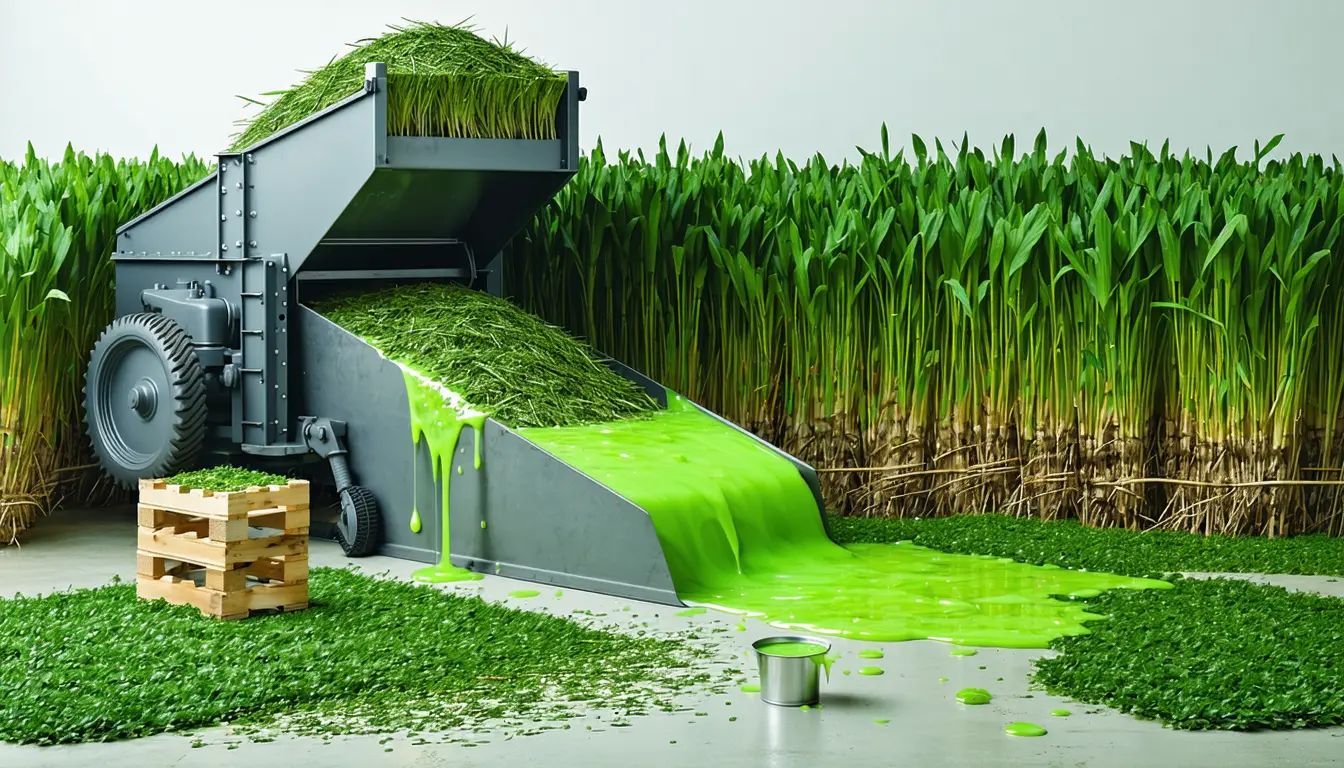
The process itself is mechanical. Freshly harvested grass and clover are pressed, the protein is separated, and that protein can go to animal feed in place of some of the soy Europe imports [8]. The phys.org account of the work does not report an extraction yield, a plant capacity or a price per tonne of fresh biomass [21]. Christel Cederberg, professor of sustainable agricultural systems at Chalmers [4], put the constraint on the demand side. "Farmers are well aware that growing grass and clover improves soil quality, but the challenge is finding a market for this biomass resource" [3].
Pressing also leaves large quantities of fibre-rich residue [10], and until now that stream has mostly gone to biogas [11]. Berndes said the group sees "many additional possibilities, including biochar, textiles and even carbon capture" [12], with captured carbon dioxide either stored underground or used as an industrial feedstock in place of fossil carbon dioxide [12]. Work on the fibre as a raw material for bio-based materials is still under way [20]. Cederberg was blunt about how far along it is: "It is too early to say which applications are the most promising today. More development work is needed" [13].
Asked whether more land under grass and clover would make farming more resilient, Cederberg said: "Yes, but this is a long-term strategy" [17]. What those decades-long trials measure is soil carbon, and, through organic matter, the soil's water-holding capacity [16][18], not yield figures from a dry year. And the dry year is recent. Repeated heat waves and a prolonged lack of rainfall depleted soil moisture in parts of Europe over the summer of 2026 [14]. In August the European Commission's Joint Research Centre reported worsening prospects for several summer crops and severe losses in the areas most affected [15].
Cederberg is specific about where the gains would land. Swapping soy for grass protein, she says, would mean "substantially reduced negative impacts from pesticides, more circular nutrient systems, maintained soil fertility and better conditions for biodiversity in agricultural landscapes" [9].
What to watch
- Whether the Danish pilot plants publish extraction yields and a delivered price per tonne of fresh biomass that a Swedish cereal farm could plan around.
- Which residue product lands a buyer first, since a textile or biochar contract changes a plant's economics more than another biogas offtake.
- Whether the long-running Swedish rotation trials report soil carbon and water-holding results from the 2026 drought year.