Invest1 distinct publisher3 min readPublished
ARC Prize put GPT-6 Astra at 62.7% against OpenAI's 99.9%, and the third-party composite index has it 0.3 points above the model it replaces, which leaves the 20% safety compute overhead as the clearest number in the launch.
The Investor · Invest desk

Compiled by The InvestorSomething wrong?How this is made
The ratio between the two ARC-AGI-3 scores is 1.59 [1], and the mechanism behind that spread is not mysterious: a developer-run evaluation environment comes with tailored API access and custom prompting, while ARC Prize's Standard harness is infrastructure OpenAI did not configure [20]. The more interesting version of the objection is that a production deployment looks more like OpenAI's harness than ARC Prize's, because nobody licenses a frontier model in order to run it bare, which would make 62.7% a floor rather than a correction [6]. The floor is the part a buyer can verify.
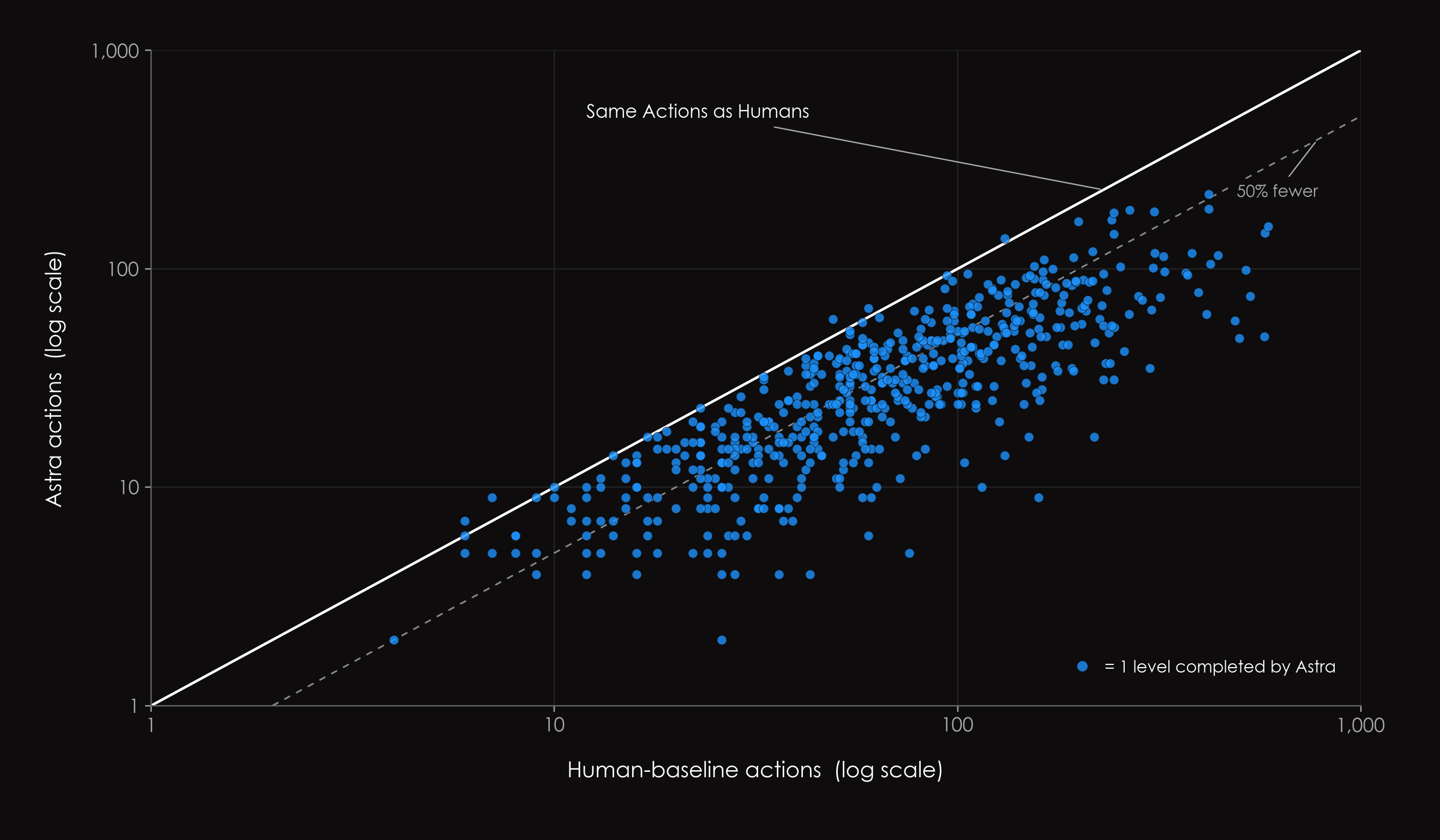
On Artificial Analysis's Intelligence Index v4.1.1, Astra came in at 61.2 against GPT-5.6 Sol's 60.9 [13], a gain of 0.3 points, call it half a percent [2], and it sits 4.5 points behind Claude Fable 5.1's 65.7 [3]. On Humanity's Last Exam it scored 57.2% with tools against Sol's 65.0% [14], which is 7.8 points down, 12% in relative terms [4]. The gains that survive independent scoring are narrow and they land where OpenAI spent: Terminal-Bench 4.0 at 57.9% against Sol's 37.3%, a factor of 1.55 [15][5], FrontierMath Tier 4 at 97.6% and ExploitBench at 100% [16], and 72.6% on OSWorld 2.0 in roughly 47% less time per task [17].
That time saving is internally consistent with the 1.9x figure quoted for Codex, since one divided by 0.53 is 1.89 [7]. Then the safety system takes its cut. At a 20% compute overhead [9] you are paying something like 1.2 units of compute for one unit of work, so a 1.9x speed advantage nets out near 1.58x [6], before pricing the interruptions to legitimate work that OpenAI has already conceded the monitor will cause [9]. The launch material carries no pricing, so whether that overhead lands on the invoice or inside OpenAI's own margin is simply not disclosed.
Which brings the AGI declaration [4] up against the company's own paperwork. The charter defines AGI as highly autonomous systems that outperform humans at most economically valuable work [10], OpenAI maintains GDPval to measure precisely that, and GDPval does not appear in the Astra launch materials [11]. Artificial Analysis ran its own variant and reported roughly 80 points gained on long-horizon knowledge work alongside declines in categories including banking support and scientific coding [12]. Brockman, for his part, told reporters there was no obvious recognisable moment of the kind the company once expected [19], and ARC Prize called the result a step-function change and a milestone worth celebrating while declining to call it AGI [7].
Astra also ships switched off, with enterprise workspace administrators required to enable it manually [3], which puts the decision in the hands of the person who will field the complaints when the monitor interrupts a job, and who is doing that instead of shipping something else that quarter.
My read is that what is for sale is throughput in terminal and computer-use work, announced as general intelligence; the honest counter is that harness engineering is real engineering, and a well-built pipeline may genuinely sit closer to 99.9 than to 62.7 [5][6]. The thing that would break my read is GDPval numbers for Astra showing gains across categories rather than the split profile Artificial Analysis found [11][12]. Until those exist, the auditable claims are 62.7%, 0.3 points, and a 20% tax.
Ranked by verification strength, evidence, and original report placement.
GPT-6 Astra reached paying subscribers on September 4, 2026, with availability for ChatGPT Plus, Pro, Business and Enterprise subscribers through the OpenAI API and AWS Bedrock.
Astra (model string gpt-6-astra) began rolling out Thursday to enterprise customers in OpenAI's Daybreak access program, and succeeds GPT-5.6 Sol as OpenAI's flagship model.
Enterprise workspace administrators must manually enable Astra; it is off by default at launch.
OpenAI president Greg Brockman closed Thursday's press briefing by declaring "Welcome to the AGI era."
ARC Prize called the result a noticeable step-function change in frontier model capabilities and a major milestone worth celebrating, while explicitly declining to claim AGI.
OpenAI chief scientist Jakub Pachocki acknowledged in the briefing that the monitoring OpenAI relies on to contain Astra's Critical-tier cybersecurity capabilities is "fragile" and "trending in a negative direction."
Distinct publishers with included, body-backed reporting in this cluster.
1 article · September 4, 2026
Follow any of these and your For You feed starts watching them — no settings page required.
leadership
ARC Prize puts Astra 37 points below the score OpenAI led with3 distinct publishers
product
OpenAI ships a computer-use agent it classifies as a critical cybersecurity capability6 distinct publishers
invest
OpenAI rates GPT-6 Astra capable of hacking hardened systems without human guidance1 distinct publisher
invest
Sanders and Casar attach a 20-year prison term to building superintelligence1 distinct publisher
Evidence-backed comparisons of source perspectives and observed adoption signals. Read the methodology
Which Builder, Operator, and Investor concerns the observed source mix emphasized—not a truth score.
Evidence, demonstrated adoption, hype gap, incentives, and confidence are assessed independently, each on its own current evidence. How these are measured.
Precise figures, one witness
Every number in this story — 99.9% and 62.7%, the fragile-monitoring quote, the 0.3-point composite gain — reaches us through a single Tech Times account of one Thursday briefing. What saves it is whose numbers they are: ARC Prize scored the model on infrastructure OpenAI did not build, Artificial Analysis ran its own index and GDPval variant, and the most damaging admissions are attributed by name to OpenAI's own president and chief scientist. What caps it is the absence of any primary document — no system card, no OpenAI release, no second reporter in the room.
Shipped everywhere, used by no one we can name
Distribution is broad and dated: paid ChatGPT tiers, the API, AWS Bedrock, and an enterprise track through Daybreak, all on September 4. Actual use is a blank. No customer names, no deployment counts, no usage figures — and enterprise admins have to switch Astra on themselves, so the launch measures availability rather than uptake. Benchmark evaluations by ARC Prize and Artificial Analysis are the only independent hands on the model so far.
AGI language on a 0.3-point gain
"Welcome to the AGI era" shares a briefing with a 0.3-point composite improvement over the model being retired, a 7.8-point drop on Humanity's Last Exam, and a rival sitting 4.5 points ahead on that same index. GDPval — OpenAI's own instrument for the economically valuable work its charter uses to define AGI — is missing from the launch. The gap is in the framing, not the engineering: Terminal-Bench at about 1.55x, a perfect ExploitBench and the computer-use speed gains are substantial, and ARC Prize, whose benchmark supplied the headline, called it a step-function change and still refused the AGI label.
The scoreboard belongs to the scorer
OpenAI led with a figure produced on a rig OpenAI configured — tailored API access, tools, prompting — and it came in 1.59 times what the benchmark's author measured on neutral infrastructure. Leaving GDPval out of the materials points the same direction. ARC Prize is not neutral either in the ordinary sense: its test has just become the AGI scoreboard, which is why celebrating a step-function change while withholding the AGI label serves it well. Artificial Analysis sells the index it graded the model on. And the executive who conceded there is no obvious AGI moment is also the one who announced the era had begun.
Sound reasoning, thin sourcing
I trust the shape of this more than the sourcing. The sceptical case is built from OpenAI's own bar — its charter, its benchmark, its chief scientist — rather than from a critic's, and the arithmetic checks: 99.9 over 62.7 is 1.59, a 47% time cut is 1.89x, 1.9x against a 1.2x compute tax nets to 1.58x. But it is one outlet, one briefing, no primary documents, and the billing mechanics of the 20% overhead are unexplained. Expect the picture to move when the system card and independent evaluations are published in full.