Product1 publisher2 min readPublished
Alphabet's Intrinsic gives away the robot control layer integrators keep rewriting
The Google-owned robotics unit put its real-time control, motion planning and pose estimation code under Apache 2.0 at ROSCon, along with a CNC machine tending reference design for Universal Robots and FANUC hardware.
The Product Desk · Product desk
What happened
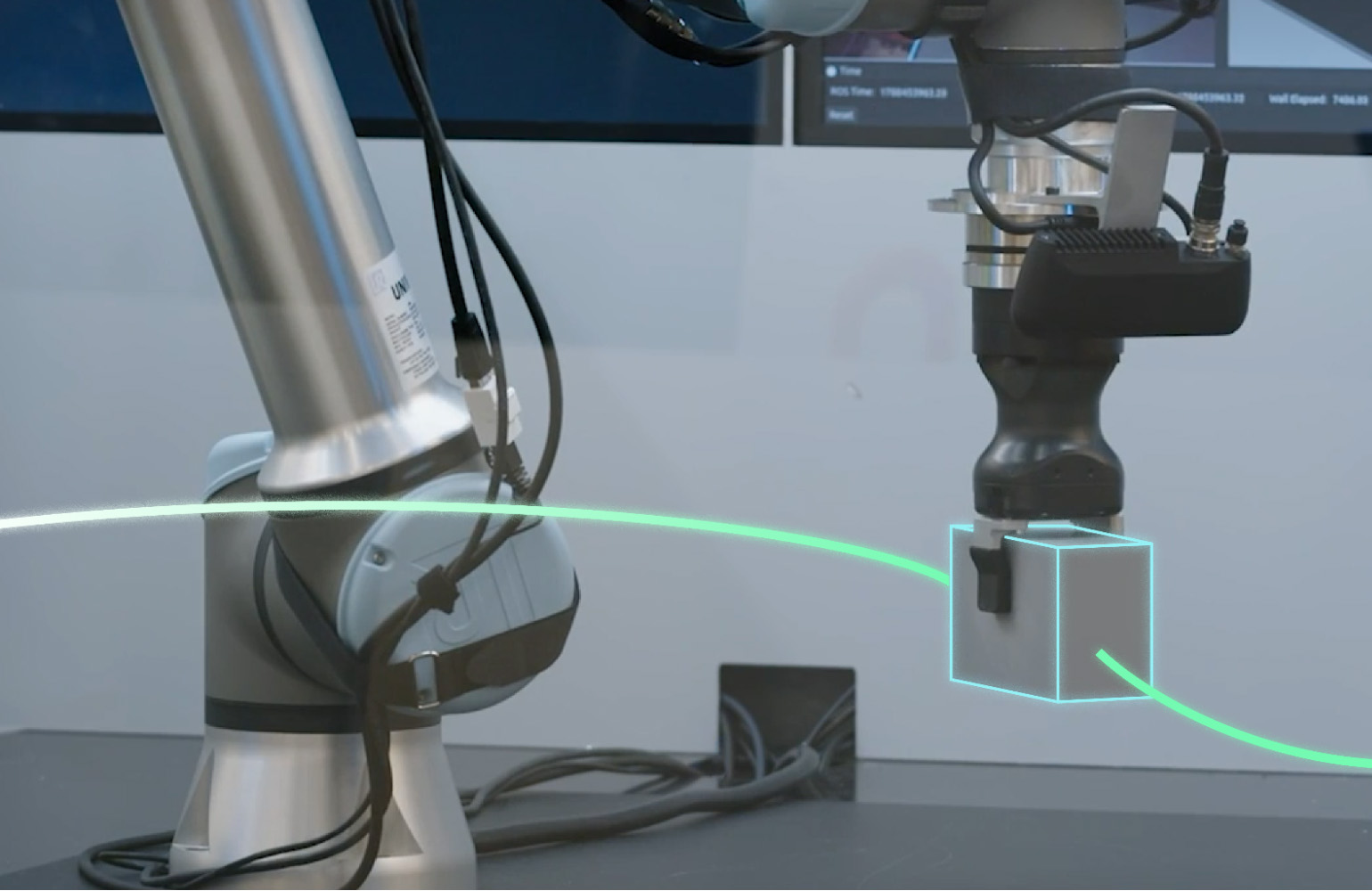
- Intrinsic, the robotics software unit Alphabet owns, released the core of its industrial robotics platform as Intrinsic Core under a permissive Apache 2.0 license at ROSCon 2026 in Toronto.
- Its control framework is hardware-agnostic and adapts a robot's trajectory mid-movement from sensor feedback, which Intrinsic said removes the need to rewrite software and drivers for each new arm or gripper.
- The pose estimation block is built on Nvidia's FoundationPose and lets robots detect and handle parts without rigid, expensive physical fixtures.
- Intrinsic also published the Open Machine Tending Solution, a reference design for AI-powered CNC machine tending that supports modular customization for Universal Robots and FANUC hardware.
Compiled by The Product DeskSomething wrong?How this is made
Why it matters
- decision Any team carrying 'write our own control and orchestration layer' in next year's plan now has to defend that line against Apache-licensed code that already adapts trajectories and generates collision-free paths.
- cost The license fee drops to zero and the integration bill does not move: the same engineer who was going to write drivers instead owns a calibration and control stack written elsewhere.
- constraint Adopting the free perception block puts Nvidia's FoundationPose in the path of every part-detection job, so changing that later means rewriting the layer you took on to avoid rewrites.
- precedent With real-time control, motion planning and calibration available under a permissive license, robotics software vendors charging for that middle layer have to price against free.
The integrator who spent last month writing a driver so one brand of gripper would behave on one brand of arm is the audience here. Intrinsic's description of Intrinsic Control names that job directly: a hardware-agnostic real-time control framework so arms and grippers can be changed without rewriting the underlying software and drivers each time [5].
Teams treat that work as a one-time build: a quarter of scope, two engineers. In practice they rewrite it per hardware pairing and per site. The blocks Intrinsic put under Apache 2.0 cover the parts that get rewritten most, including collision-avoidance path generation that replaces manual joint-by-joint programming [7] and grasp planning that adapts a gripper to where the object actually sits [8].
Intrinsic said the release is about democratizing access to intelligent robotics [12] and that it hopes to foster a broader robotics developer ecosystem on shared open-source tools [13]. What arrives on a shop floor is narrower than that. It is a preconfigured ROS-compatible environment that runs on local hardware [4], with Nvidia's FoundationPose sitting inside the pose estimation block [6], plus simulation, calibration and Intrinsic-ROS drivers behind one interface [9]. Intrinsic was founded in 2021 and folded into Google's operations in February [3].
The market number is Intrinsic's own. The company said tens of thousands of shops in the US and Europe fabricate intricate parts and that only 8% of them use any form of automation, citing high costs and technical barriers [11]. By that count 92% buy none [14]. What free control software changes is how much code that integrator writes before quoting the job. The price of an arm, and of an integrator's time, is the same either way.
A sort that works on any robotics roadmap: list every piece of software the robot needs, then cross out anything a competitor's engineers would write the same way. Control loops, motion planning, calibration and vision drivers belong on the crossed-out list [9]. What survives is the cell layout and the cycle time.
The cost sits on the other side of that trade. When a trajectory adapts mid-move into something it should not, the code path belongs to someone else, and the shop still calls you. The report does not describe support terms and does not name a shop running Intrinsic Core.
What to watch
- Whether Intrinsic publishes support or maintenance terms, or a paid tier sitting alongside the Apache 2.0 code.
- Whether any named shop or integrator runs production machine tending on the Open Machine Tending Solution with Universal Robots or FANUC hardware.
- Whether the pose estimation block stays tied to Nvidia's FoundationPose as other perception models become available.