Invest1 publisher2 min readPublished
Stripe puts a human approval step between agents and Link's 200 million consumers
Link's new wallet for agents hands a bot a one-time-use card or a Shared Payment Token backed by credentials it never sees, and Stripe says every spend request still needs the account holder's review first.
The Investor · Invest desk
What happened
- Stripe has launched Link's wallet for agents, built on a new Issuing for agents product that opens the full set of Issuing APIs to developers who want to run their own agent spending.
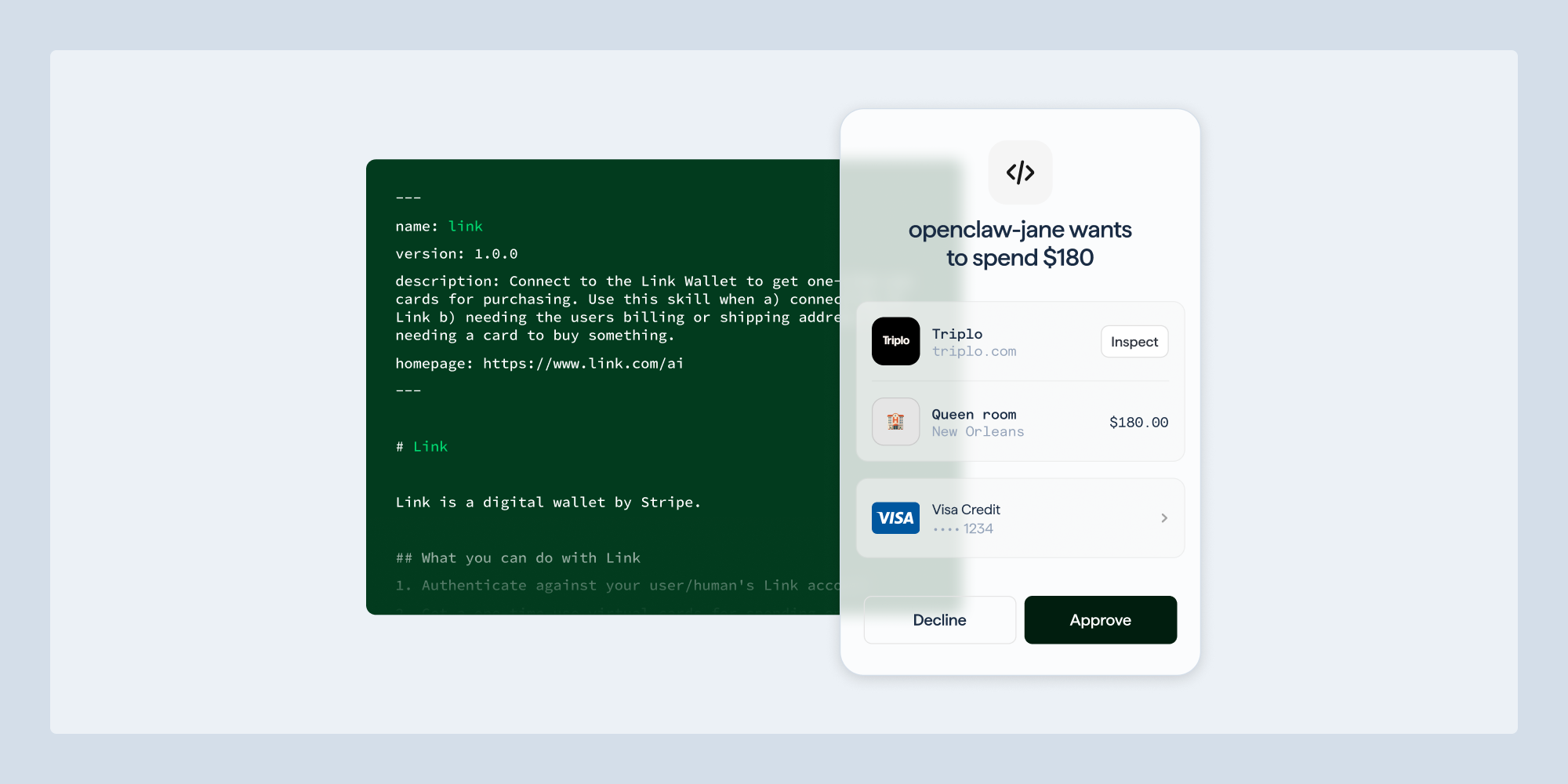
- An authorized agent receives either a one-time-use card or a Shared Payment Token backed by the cards and bank accounts already in the consumer's Link wallet, and never sees the raw credentials.
- Each spend request currently needs the account holder's review, delivered as a notification and approved on the web or in Link's new iOS and Android apps, before any credential is released.
- The credential can be scoped by amount, currency and merchant, and the consumer can track agent spending and manage connected agents from inside Link.
- Stripe names OpenClaw as an example of a personal AI agent a consumer could enable to make an authorized purchase on their behalf.
Compiled by The InvestorSomething wrong?How this is made
Why it matters
- capability A team shipping a consumer agent inherits wallet infrastructure, the abstraction across payment types and the fund flows, instead of building and securing them itself.
- constraint At one review per purchase, a weekly shopping agent asks its owner 52 times a year, so agent purchase frequency is bounded by how often a person opens an app and taps approve.
- decision A business that wants its own branded agent wallet now chooses between Link's version and building on the Issuing APIs, where it owns onboarding, card-level permissions and authorization-time fraud rules.
- precedent Stablecoins and agentic tokens are listed as coming soon; until they arrive, the single-use card is what agents actually transact with.
A merchant has to do nothing for this to work. After the consumer approves, Link returns the credential to the agent and the agent completes the purchase [18]. Stripe's stated reason for building it this way is that machine payments protocols are still gaining adoption, so agents need to work with the payment options sellers and consumers use today [12]. Nothing about the seller's checkout changes, because what arrives is a card payment on rails the seller already accepts [1].
More than 200 million consumers use Link [10]. But 200 million Link users are not 200 million agent grants. Each consumer has to complete an OAuth grant for each agent [4], and then clear each spend request one at a time [6]. A shopping agent that buys once a week for one person generates 52 approvals a year [19].
Stripe announced both products in its Sessions keynote [17], and wrote of the approval gate: "We're planning on expanding these controls to let people set spending limits, and choose when agents can act without additional approval" [9]. The plumbing for that already exists in the issuing layer, where permissions sit at the card level and fraud controls can be introduced at transaction authorization [15]. Once a person sets a cap and walks away, the live question is who picked the cap and who absorbs a purchase the person did not want. Stripe did not disclose pricing, nor any count of connected agents or transactions.
If the machine-native protocols win real merchant support, the single-use card is a bridge and the Shared Payment Token is Stripe's position on the far side of it [12]. If unattended limits ship and consumers set them loosely, the binding problem becomes disputes and liability. I lean to the second, and monthly approval-to-purchase data from Stripe would settle it faster than any argument about protocols.
The business-facing half is pitched at developers automating their own spend, fintechs embedding agent-issued cards for expense management, vertical SaaS platforms issuing agent cards to SMB customers, and marketplaces issuing cards to sellers so their agents can automate supplier payments, logistics and fulfilment purchases [16].
What to watch
- Whether the promised spending limits and unattended-approval settings ship, and what default caps Stripe allows.
- Whether stablecoin and agentic-token support arrives in Link's wallet for agents, since the post lists them as coming soon.
- Any disclosure of pricing, or of how many Link consumers have connected an agent and approved a spend.