Science1 distinct publisher3 min readPublished
Two years of transactions from Melbourne, Sydney and Adelaide show spending down 7% above 35C, and air-conditioned department stores taking 35% less between 3 and 6pm.
The Scientist · Science desk

Compiled by The ScientistSomething wrong?How this is made
The cleanest test in this dataset is the department store, because it removes the obvious explanation. Those buildings are cooled and mostly enclosed, and they still took 35% less between 3 and 6pm on days above 35C [4]. What heat suppresses is not time spent indoors but the trip to get there: the car park and the walk from the stop, and the decision made at half past two that it can wait. Convenience stores, reachable in a few minutes from home, held their trade [5]. Cooling the shop floor does not address that, and cooling the shop floor is the part of the adaptation budget most retailers have already spent.
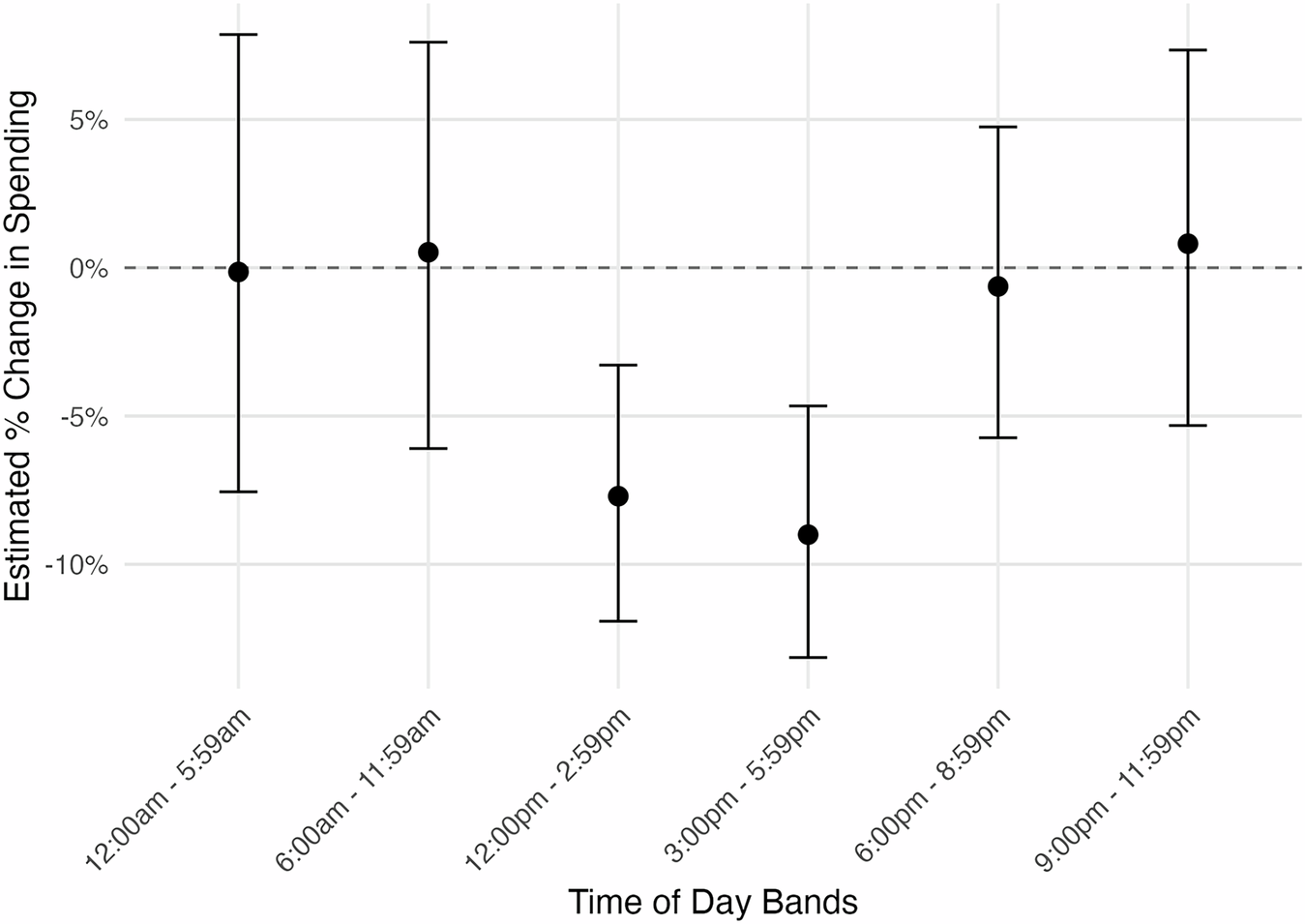
The 7% headline is doing a lot of averaging [3]. One category in one three-hour window lost five times that [16], because the aggregate is spread across hours where the effect is small or absent. A manager rostering against the headline figure is rostering against the wrong figure.
Frequency matters as much as depth. Across the two years, 35C or above was reached on 62 days out of roughly 2,193 city-days, about 2.8% [2][14]. Per city per year that is around 13 or 14 days in Adelaide, ten in Melbourne, seven or eight in Sydney [15]. That is often enough to show up several times a summer and rare enough that nobody builds a permanent roster around it, which is why the response tends to be nothing.
Demand moves into the evening, and the evening is the part of the urban day that has been deliberately thinned out. Public transport frequency falls after the commuter rush, community centres, child care and public buildings tend to close early, and parks often lack the lighting or safety measures to be used after dark [7]. Libraries serve as heat refuges but shut before the temperature drops [13]. Seoul now keeps more than 120 public libraries open until 10pm as climate shelters [9], Paris and Toulouse are holding parks and swimming areas open into the night [10], and Dubai, where summer temperatures can pass 50C, has opened floodlit beaches overnight [11]. The researchers, writing at phys.org, say there is little evidence of a wider shift and that authorities in many cities are not yet planning for afternoons that are unpleasant or dangerous [8].
The unresolved number is the split between deferred and forgone. The authors state that some purchases were postponed and others lost altogether [6], without publishing the proportion [17]. That ratio decides the whole response. If most of the 7% is deferral, later hours recover the revenue and the only cost is scheduling labour into a different block. If a large share is lost outright, extending hours mainly redistributes trade toward whoever stays open, and the operators who move first carry staffed evening hours against sales that never existed.
Streets, building cooling and tree planting remain necessary, and the authors say so [12]. They are also capital projects with delivery timelines. Opening and closing times are the lever available before the next hot afternoon.
Ranked by verification strength, evidence, and original report placement.
Researchers analysed anonymised large-scale bank card transaction data and daily temperature records from Melbourne, Sydney and Adelaide between January 2023 and December 2024; the dataset captures virtually all point-of-sale spending in three-hour intervals.
Temperatures reached 35C (95F) or higher on 62 days over the study period: 27 in Adelaide, 20 in Melbourne and 15 in Sydney.
When temperatures rose above 35C, overall spending fell 7% during heat waves; consumers spent less between midday and early evening before spending stabilised after sunset, with the sharpest daytime falls from noon to 6pm.
Department and variety stores were among the hardest hit: despite being air-conditioned, spending was 35% lower between 3 and 6pm on extremely hot days.
Spending on eating out, entertainment and shopping dropped during the afternoon before recovering in the evening, while spending at convenience stores proved more resilient.
Some purchases were postponed to cooler periods, such as evenings or the days before or after extreme heat, but others were lost altogether.
Follow any of these and your For You feed starts watching them — no settings page required.
Evidence-backed comparisons of source perspectives and observed adoption signals. Read the methodology
Which Builder, Operator, and Investor concerns the observed source mix emphasized—not a truth score.
Evidence, demonstrated adoption, hype gap, incentives, and confidence are assessed independently, each on its own current evidence. How these are measured.
One peer-reviewed study, told through a single outlet
The quantitative core is specific and traceable: near-census point-of-sale card data plus daily temperatures for three cities over 24 months, with a named journal and DOI, and concrete effect sizes (7% overall, 35% at department and variety stores from 3-6pm). What holds the score down is that the cluster contains exactly one article, written by the researchers themselves, with no confidence intervals, no control specification, no decomposition of deferred versus lost spending, and only 62 qualifying hot days concentrated in three Australian cities.
Scattered city pilots, no systemic rescheduling
There are three concrete, named deployments of time-shifted public infrastructure (Seoul libraries to 10pm, night-opening parks and pools in Paris and Toulouse, floodlit overnight beaches in Dubai), which is more than anecdote. But the authors themselves state there is little evidence of a wider shift, and that most cities still run a daytime model with thinning evening transport and early-closing public facilities. No usage figures, budgets or outcome data accompany any of the examples.
Prescription runs ahead of the measurement
The measured facts are modest and well-bounded, but the framing - cities 'must' stay open later, nightlife becoming 'normal life lived at night' - generalises from 62 hot days in three Australian cities to European and global urban policy. The overstatement is one of scope and imperative rather than of numbers: the effect sizes themselves are stated plainly, and the authors are candid that adoption is thin and more research is needed, which keeps the gap moderate rather than large.
Authors publicising their own paper and its policy ask
The piece is written by the researchers behind the cited npj Urban Sustainability paper and republished from The Conversation, so its purpose includes amplifying that study and arguing for a specific agenda - extended library and facility hours, more evening transport, lighting investment and worker protections. That is a legitimate and disclosed position, not a concealed one, but it means the framing selects supportive precedents (Seoul, Paris, Toulouse, Dubai) and omits cost, staffing and effectiveness counter-evidence. The aggregating publisher adds no independent scrutiny.
Traceable numbers, single unchallenged voice
Confidence is mid-range: the effect sizes are specific and anchored to a peer-reviewed, DOI-identified paper using near-census transaction data, which is stronger than survey or anecdote. But the cluster has one publisher, one authorial voice, no independent replication or dissent, no uncertainty statistics, and the policy conclusions extend well past the three cities actually measured.
science
A handful of Texan pumas saved the Florida panther. Genetics is still off the plan.1 distinct publisher
science
Most kingfish carrying the mushy-flesh parasite cook up firm, so the cook test misses them1 distinct publisher
science
H5N1 is in Australian resident birds, and overseas the first wave does most of the killing1 distinct publisher
science
A PNAS study says X's feed learns from your arguments, not your likes2 distinct publishers
Distinct publishers with included, body-backed reporting in this cluster.
phys.org
1 article · August 25, 2026