Science2 distinct publishers2 min readPublished
By the time a plume reaches a distant city, sunlight has stripped its color and campfire odor and turned part of it into ozone, so the senses that flag smoke nearby stop working at range.
The Scientist · Science desk

Compiled by The ScientistSomething wrong?How this is made
The reason a nose is a poor instrument here is chemical, not perceptual. Sunlight is the engine: solar ultraviolet photons break bonds in the smoke's molecules and create radicals that oxidize its volatile organic compounds, with nitrogen oxides steering the reactions [10]. The color and odor people rely on are among the first things that chemistry consumes, even as its products accumulate.
What accumulates is smog. Within hours of leaving the flames, the emitted mixture reacts to form ground-level ozone, a lung irritant and the defining ingredient of urban smog [9]. A plume that began as a wood-smoke problem can arrive downwind as something closer to what a city's own traffic makes on a hot afternoon.
The starting chemistry is set at the flame. Hot, intense fire fronts throw off nitrogen oxides and reactive carbon compounds such as aromatic hydrocarbons, which raise cancer risk over long exposure, plus smaller amounts of nitrous acid, hydrogen cyanide and isocyanic acid [5]. Cooler, smoldering combustion emits a different but not safer blend, heavy on toxic aromatic oxygenates and ammonia [6]. Burning conditions fix both the makeup of the smoke and how it will age [7].
Distance and altitude decide how much aging happens. Big fires loft their plumes out of the planetary boundary layer into the free troposphere, about 2 kilometers up, where high-altitude winds carry them thousands of miles [8]. In that cold air the photochemistry can stall, and it restarts when the parcel sinks back below roughly the same 2 kilometer level into warmer air [12]. That altitude behaves as a switch [1]: the boundary that isolates smoke from reactive conditions is the one that reintroduces it, often as the plume settles over populated ground. Add dilution as clean air mixes in [11], and the plume that reaches a distant city looks fainter without being safe.
Fresh smoke already carries fine particulate matter, nitrogen oxides and VOCs, some of them known carcinogens [3]. The NOAA Chemical Sciences Laboratory has been characterizing how that inventory shifts, burning fuels under controlled conditions and flying aircraft through real plumes [4]. For anyone managing exposure hundreds of miles from a fire, clear-ish skies and no campfire smell are not an all-clear.
Ranked by verification strength, evidence, and original report placement.
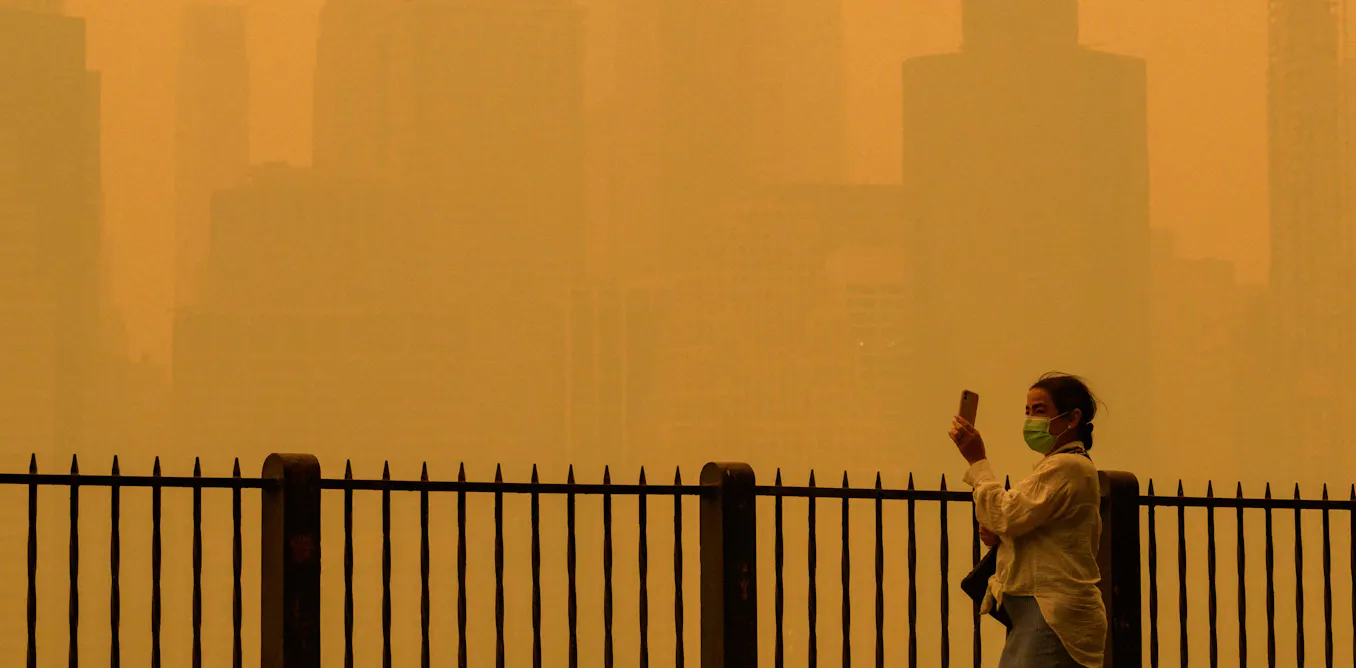
As wildfire smoke plumes travel thousands of miles, sunlight and atmospheric chemistry bleach their color, strip away their campfire aroma and add them to the mix of urban smog.
Smoky skies plagued the East Coast and Midwest again in summer 2026, as wildfires hundreds of miles away forced people to cancel sports practices and run air conditioners around the clock.
When a forest burns, the wildfire emits large amounts of fine particulate matter (PM2.5), nitrogen oxides and volatile organic compounds (VOCs); these compounds and particles can harm the lungs, heart and organs and include known carcinogens.
A team at the NOAA Chemical Sciences Laboratory tracks how the pollutant mix transforms, from studying controlled fuel burns in the lab to flying research aircraft through wildfire smoke plumes.
Hot, intense flames produce nitrogen oxides and reactive carbon compounds such as aromatic hydrocarbons that can increase the risk of certain cancers with long-term exposure, plus smaller amounts of nitrous acid, hydrogen cyanide and isocyanic acid, all of which can be toxic to humans.
Lower-temperature smoldering wildfires release a different mix that is not safer, enriched with toxic aromatic oxygenates and ammonia, which can irritate the respiratory system.
Follow any of these and your For You feed starts watching them — no settings page required.
Evidence-backed comparisons of source perspectives and observed adoption signals. Read the methodology
Which Builder, Operator, and Investor concerns the observed source mix emphasized—not a truth score.
Evidence, demonstrated adoption, hype gap, incentives, and confidence are assessed independently, each on its own current evidence. How these are measured.
Coherent expert mechanism, single-origin and uncited
The mechanistic account is internally consistent and comes from a named atmospheric chemist describing NOAA Chemical Sciences Laboratory lab-burn and aircraft work, which is credible provenance. But the cluster contains one article and its verbatim syndication, with no citations, no measurements, no datasets and no independent expert corroboration, and one internal wrinkle: the same ~2 km altitude is given both as the injection height and as the aging-restart height without reconciliation. Evidence is therefore adequate for direction and mechanism, weak for magnitude.
No adoption events in scope
This is a scientific explainer about atmospheric chemistry. The supplied sources describe no release, deployment, benchmark, pricing, licensing or usage disclosure, and the only real-world uptake signal is an unquantified mention of cancelled sports practices and heavy air-conditioner use during summer 2026. That is not sufficient to score adoption, and no adoption observations were recorded.
Slightly overstated certainty, restrained framing
Framing is measured rather than promotional: the author explicitly refuses the claim that smoldering emissions are safer and closes by calling downwind smoke an area of active research. The mild positive gap comes from mechanisms and thresholds stated as settled fact without citations, error bars or measured concentrations, and from an unreconciled altitude figure, so certainty of expression runs slightly ahead of the evidence supplied.
Researcher explaining own field, no commercial stake
The visible incentive is a working NOAA laboratory scientist raising the public salience of their own research area, published through an academic-author explainer platform and amplified by an aggregator that benefits from syndicated science content. No product, vendor, funding round or commercial interest appears anywhere in the sources, so incentive pressure is real but modest and disclosed on the face of the article.
Moderate: expert single-origin explainer
Confidence is limited by structure rather than content. The mechanisms described are mainstream atmospheric chemistry from a credentialed practitioner and no source contradicts them, which supports moderate confidence; but the cluster has one origin, two identical texts, zero quantitative support and no adoption dimension to triangulate against, so the assessment cannot be graded higher.
science
A handful of Texan pumas saved the Florida panther. Genetics is still off the plan.1 distinct publisher
science
Most kingfish carrying the mushy-flesh parasite cook up firm, so the cook test misses them1 distinct publisher
science
H5N1 is in Australian resident birds, and overseas the first wave does most of the killing1 distinct publisher
science
A PNAS study says X's feed learns from your arguments, not your likes2 distinct publishers
Distinct publishers with included, body-backed reporting in this cluster.
phys.org
1 article · August 25, 2026
theconversation.com
1 article · August 25, 2026