Science1 publisher2 min readPublished
Microgravity readings suggest low-density, chamber-like structures behind Tutankhamun's north wall
Egypt's Supreme Council of Antiquities is weighing a proposal to drill and send camera-carrying miniature tractors through, on the strength of 1,200 gravity readings and a rereading of surveys that earlier teams called empty.
The Scientist · Science desk
What happened
- Mamdouh Eldamaty and colleagues at Egypt's National Research Institute of Astronomy and Geophysics ran ground-penetrating radar inside KV62 and report a network of corridors and rooms cut before Tutankhamun was buried.
- George Ballard, who analysed the results, is confident they show a 2-metre-wide corridor densely packed with rubble leading away from the burial chamber.
- The gravity work took more than 1,200 readings across a 35-square-metre area, the first use of gravitational techniques to probe the density of ground around the site.
- The conclusions are published online in the Occasional Papers of the Amarna Royal Tombs Project, the project whose founder first proposed the hidden-chamber reading.
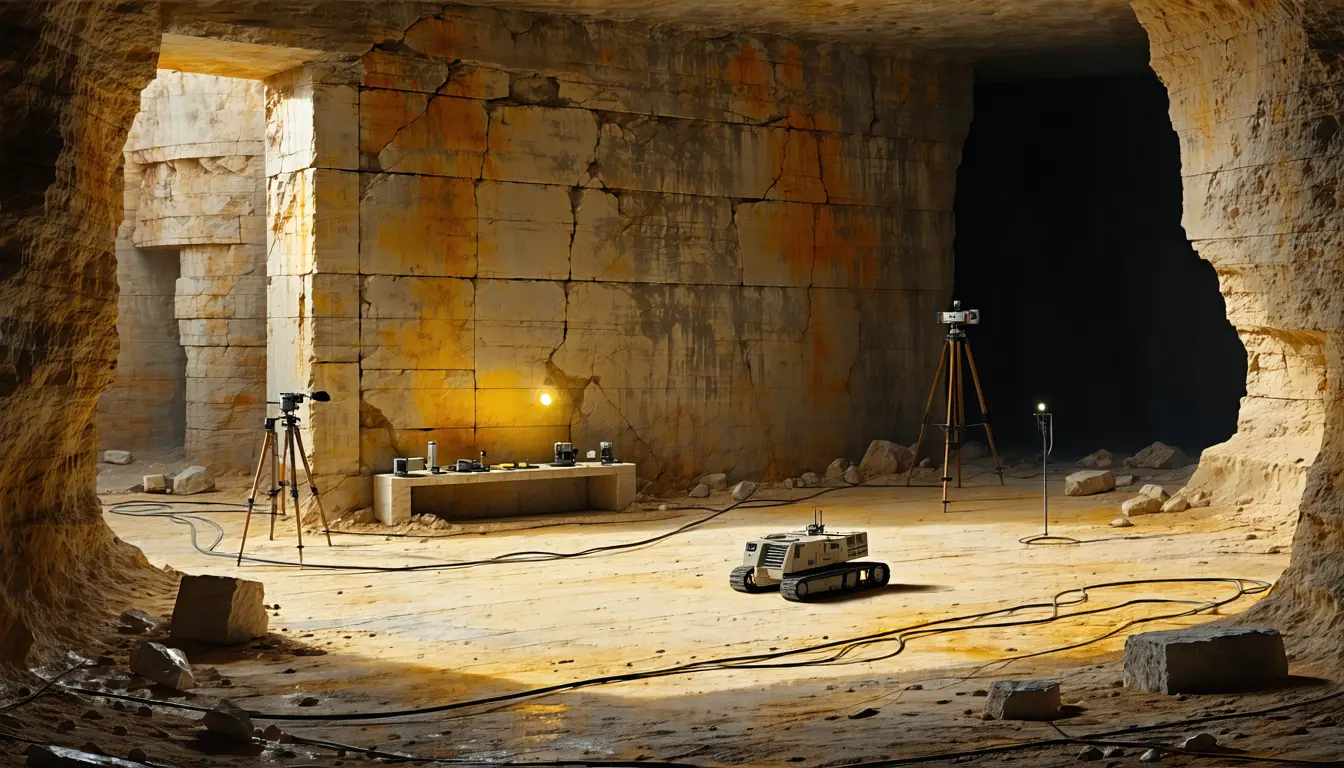
- Egypt's Supreme Council of Antiquities holds the decision on whether to look; if it approves, careful drilling to deploy camera-equipped miniature tractors could start in November, Ballard told Nature.
Compiled by The ScientistSomething wrong?How this is made
Why it matters
- decision Approving the drill converts a decade of contested remote surveys into one physical test that cannot be undone; declining leaves the question exactly where the geophysics has left it.
- constraint Because one analyst reread the older datasets alongside the new ones, the apparent convergence of radar, gravity and resistivity is not independent replication of the corridor.
- capability Defining the target as packed rubble instead of air gives any future survey a different density signature to test for, so the earlier null results no longer settle the matter.
More than 1,200 readings over 35 square metres works out to about 34 stations per square metre. If the grid was regular, that is an average spacing near 17 centimetres, over a patch roughly six metres on a side [1][3][2]. Microgravity registers density through tiny variations in Earth's gravitational field, and the team turned to it because radar shot through the walls from inside the tomb has limited range [13]. What the map showed, according to George Ballard, is "structures with right angles, of low density - and those structures are interestingly parallel on their axes to the north wall" [15].
Geophysical tests of the hidden-chamber idea have gone both ways, with some teams concluding chambers were present and others finding that the data revealed nothing [4]. Ballard's explanation is that the earlier work hunted the wrong thing: a large void immediately behind the wall, when the feature he reports is a corridor densely packed with rubble [12][11]. He is a structural engineer and president of the geophysics consultancy GBG Group, and he analysed the new radar results along with all available data from the previous surveys [10].
So the agreement now claimed across radar, gravity and older electrical work is, in part, one analyst rereading existing datasets with a different target in mind. A 2017 electrical-resistivity survey found anomalies in similar locations, and those were dismissed at the time as unrelated to KV62 [16]. Nicholas Reeves is a co-author of the new paper. The independent British Egyptologist proposed in 2015 that the north wall was a false wall, on the basis of lines and cracks in it and ancient alterations to its paintings [2][20].
Density is what these instruments measure. Whether anything was interred in a low-density rectangle, and who, is a separate question. The Nefertiti attribution rests on Reeves's reading of the tomb, which is unexpectedly small for a royal burial. He argues it was originally much larger, before Tutankhamun's unexpected death [19][1][3].
Mamdouh Eldamaty, an archaeologist at Ain Shams University in Cairo and a former Egyptian antiquities minister, said a confirmed find could "rank among the most transformative archaeological discoveries of the modern era" [8][5]. The team highlights one feature, "anomaly 7", a mostly low-density zone hosting a roughly square, high-density area within it [17].
What to watch
- Whether the Supreme Council of Antiquities attaches conditions, such as fixed drill locations or a further non-invasive survey before any hole is made.
- Whether a team with no role in this analysis re-runs radar or gravity at KV62 using a rubble-filled corridor as the target signature.
- What the cameras return if the miniature tractors go in: packed rubble, a natural fissure, or undisturbed bedrock.