Product1 publisher3 min readPublished
Two thirds of Angle Health's $600m round buys out early holders at $2.5bn
The $2.7bn headline price attaches to the $200m Series C. The Wall Street Journal reports the $400m tender offer priced at $2.5bn, and weighting the two puts the whole round nearer $2.57bn. None of the company's growth figures is audited.
The Product Desk · Product desk
What happened
- Angle Health announced a $600m raise at a $2.7bn valuation, led by Vitruvian Partners, a growth investor headquartered in London.
- The company's own announcement splits that into a $200m Series C and a larger $400m tender offer, which buys shares from existing holders and is not new money for the business.
- The Wall Street Journal, which reported the deal an hour before the release went out, says the $400m secondary priced at $2.5bn.
- Angle Health says it sells cover to more than 5,000 US employers across 47 states, some of them with as few as two staff.
- It says median renewal increases for its customers run 5% to 7%, against an 18% median for small and midsize businesses in a June 2026 study by JPMorganChase unit Morgan Health.
Compiled by The Product DeskSomething wrong?How this is made
Why it matters
- cost Liquidity cost the sellers 7.4%: they cleared at $2.5bn while the new money set the $2.7bn number that every league table and comparison will quote.
- decision An employer signing this plan is choosing where staff get infusions and imaging, because part of the saving depends on members using at-home and free-standing settings.
- exposure The smallest employers are picking an insurance carrier on growth and profitability numbers that no outside auditor has tested, and they carry the claims risk if the book turns.
- constraint Platforms that run only the administrative layer cannot put a renewal number on the table at all, so a broker weighing them against Angle Health is not comparing the same product.
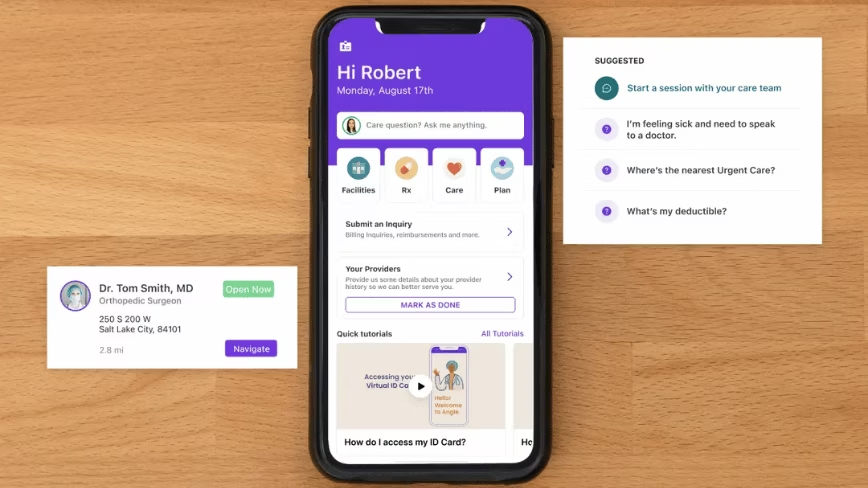
A broker feeds a staff census into a tool called Benefit Builder and gets firm quotes back in minutes, then adjusts the plan designs in real time [16]. For the two-person shop at the far end of that quote, the year that counts is the second one, when the renewal price arrives. Angle Health's claimed median renewal sits 11 to 13 percentage points below the small-business median it cites [27].
The $2.7bn valuation attaches to the fresh capital, not to the two thirds of the round that changed hands between investors [6]. Weight the two prices by the money behind each and the full $600m clears near $2.57bn: (200 x 2.7 + 400 x 2.5) / 600 [7]. The spread between the two prices is $200m, or 7.4% of the headline [8].
Ty Wang, the co-founder and chief executive, says the company was not looking to raise, had little debt and was already growing, and that the round arrived less than ten months after its Series B [9]. "We did not set out to build another health insurance company," he told the Wall Street Journal [19]. He and chief technology officer Anirban Gangopadhyay founded the company in 2019, started trading in 2021, and had worked together at Palantir [23].
The pressure the round is priced against comes from outside the company. WTW projects an 11.1% rise in US employer healthcare costs in 2027, the steepest in more than two decades [14]. American employers are absorbing the largest jump in health insurance costs in twenty years, and small firms carry the worst of it [15]. Small businesses employ close to half the US workforce [26].
The company's own figures are the ones nobody has checked. Angle Health reports 120% year-on-year growth, four consecutive quarters of profitability on both an EBITDA and a net income basis, and close to $1bn in annualised premium equivalents, none of it independently audited [11][12]. The Journal reports that customer count and revenue both more than doubled in the most recent year [28]. Close to $1bn spread over more than 5,000 employers averages under $200,000 of premium per employer [24], and the headline valuation is about 2.7 times premium equivalents [25].
Vitruvian's partner on the deal put the advantage in plan variety. "Because of AI, they're able to manage thousands of different designs," said Jeremy Gelber [18]. What a covered employee meets is more specific. The system steers members towards cheaper settings for the same treatment, and the examples the company gives are at-home infusions, free-standing imaging centres instead of hospital departments, and prescriptions sourced internationally [17].
A benefits buyer can sort the claimed savings into two columns: the ones the employer captures by signing, and the ones that need a member to do something different. Underwriting and negotiated pricing sit in the first. At-home infusion and an overseas pharmacy sit in the second, and the HR generalist who rolled the plan out fields those calls. Angle Health says it has signed care delivery partnerships covering high-cost medications, infusions, outpatient surgery and radiology, and that the arrangements cut cost without cutting quality [22].
What to watch
- The renewal distribution behind the 5% to 7% median, and how second- and third-year customers price.
- Whether the next primary round prices above $2.7bn, after this secondary cleared at $2.5bn.
- Any filing that puts Angle Health's premium volume on the record independent of the company.