Product1 distinct publisher3 min readPublished
A reported August phone call from Mark Zuckerberg is the latest time a binding AI review has come back voluntary. For teams planning compliance, the live choice is an industry-funded reviewer or a film-style ratings scheme, and both let the model ship.
The Product Desk · Product desk

Compiled by The Product DeskSomething wrong?How this is made
For anyone writing next year's model-release checklist, the question that matters is whether a government office will need to clear a launch before it happens. None of the surviving proposals creates one. The two paths still on the table are a body funded by the firms it would review and a voluntary ratings scheme, and their backers are arguing over how much self-regulation should apply, with self-regulation itself no longer in question [2].
The heavier of the two is sold as pre-deployment review. Google DeepMind's Demis Hassabis popularised it in a July essay and briefed White House officials over the summer, proposing a standards body modelled on FINRA that would test advanced models for risk before wide release [6]. Look at the model being copied: FINRA is industry-led, funded by the more than 3,000 firms it oversees, seats member-firm representatives on its board, and reports to the SEC [7]. And as Politico notes, FINRA has little involvement in signing off new investment products, which is the exact pre-deployment function the AI body would exist to perform [8]. FINRA, in other words, is being borrowed for a job it doesn't do.
The lighter path drops the pretence. David Sacks, Trump's former AI and crypto czar, has proposed a body modelled on the Motion Picture Association's voluntary film ratings; he called the regulator idea a "DMV for AI" where models queue for a test, argued on his August podcast that the MPA's standards forestalled more intrusive government action, and said Elon Musk backs the approach [9][10].
For planning purposes, the direction of travel matters more than the current draft. A 90-day mandatory review has already become a 30-day voluntary window, with formal government evaluation authority swapped for a collaborative framework, after industry pushed back on competitiveness grounds [11]. That is a two-thirds cut to the review window [15], and it moved in one direction.
The mechanism doing the moving is a phone call. A senior White House official, granted anonymity, said Zuckerberg opposed the proposal [3], though another person familiar said he did not ask Trump to reverse himself, only that appointees reflect the president's light-touch approach, and that Trump called him first [4]. Meta declined to comment, and TNW, which relayed Politico's report, has not independently verified the call [5]. Sacks delayed Trump's first AI executive order in May with a single call on the morning of the signing [12]. Politico reports these one-on-one conversations have become an informal part of policymaking, able to slow or redirect proposals after officials have developed them [13]. Zuckerberg's public reasoning is on record: he wrote in August that a policy delaying a release even by a month would "add significant risk to American leadership" over China [14].
So the forcing question for a compliance plan is what the body can actually stop a team from shipping, whatever it's called. Sort the options that way: a reviewer with authority to withhold a launch sits in one box, a ratings sticker you can print and ship past sits in another. Every proposal that has survived contact with industry sits in the second. The workable plan is self-certification against a ratings queue you can clear on your own timeline, with the review file kept ready in case a body with teeth arrives later. And "we passed review" is worth reading closely, because on the FINRA precedent it need not mean a launch was ever cleared [8].
Ranked by verification strength, evidence, and original report placement.
In an August essay Zuckerberg wrote that any policy delaying a model's release, even by a month, would 'add significant risk to American leadership' over China.
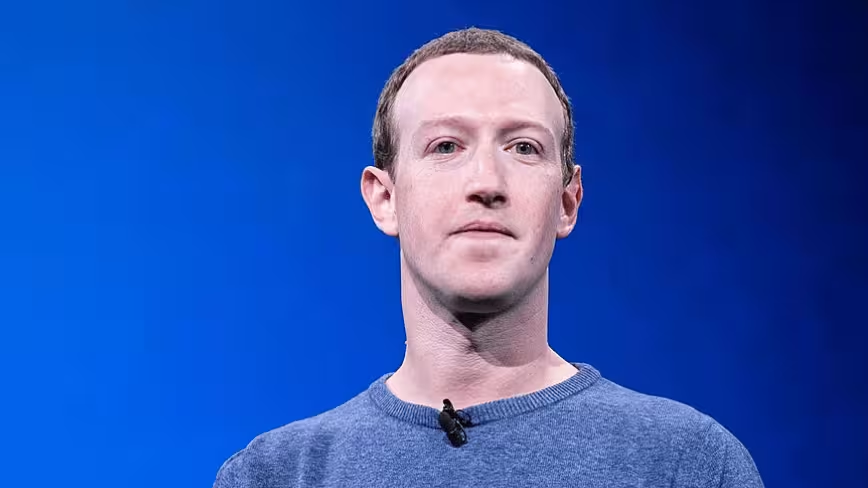
Politico reporters Sophia Cai and Charles Rollet reported that Mark Zuckerberg raised concerns about a proposed national AI regulator in a previously unreported call with Donald Trump during the week of 17 August.
The two options still on the table are a FINRA-style body funded by the firms it would oversee and an MPA-style voluntary ratings scheme, so the debate is over how much self-regulation rather than whether. Neither is a government regulator.
Meta declined to comment, and TNW has not independently verified the call.
The heavier plan is an independent body modelled on FINRA that would review advanced models and test them for risks before wide deployment. It was popularised by Google DeepMind's Demis Hassabis, who proposed a FINRA-style standards body in a July essay and briefed White House officials over the summer.
FINRA is an industry-led body funded by the more than 3,000 firms it oversees, with member-firm representatives on its board, reporting to the Securities and Exchange Commission.
Distinct publishers with included, body-backed reporting in this cluster.
Follow any of these and your For You feed starts watching them — no settings page required.
leadership
Zuckerberg argued against a FINRA-style AI reviewer in a direct call with Trump1 distinct publisher
invest
Washington pitches Carolina Principles to G20, urging no new AI rules or bodies1 distinct publisher
leadership
Data center opposition is now a siting cost, and the industry is pricing it as a PR line1 distinct publisher
product
Washington's secret AI test is coming for open weights, and release dates go with it2 distinct publishers
Evidence-backed comparisons of source perspectives and observed adoption signals. Read the methodology
Which Builder, Operator, and Investor concerns the observed source mix emphasized—not a truth score.
Evidence, demonstrated adoption, hype gap, incentives, and confidence are assessed independently, each on its own current evidence. How these are measured.
Contested core, checkable frame
The call rests on two anonymous accounts inside a single Politico story, relayed by The Next Web with an explicit note that it has not verified them, against a flat no-comment from Meta. Everything around that core is documentary and durable: FINRA's funding base and board composition, Hassabis's July essay and summer briefings, Sacks's recorded podcast remarks, the May executive order delay. The weakest link is the event in the headline, and the two sources describing it disagree about what Zuckerberg actually asked for.
Nothing standing to measure
No body exists, nothing binds anyone, and both plans are described as still under consideration. The one concrete change on the record, a mandatory 90-day review becoming a voluntary 30-day window, is a change to draft text rather than a mechanism anyone is using. There is no uptake here to score, and we will not manufacture one from a proposal.
Headline generalises from two instances
The claim that every binding AI review Washington has proposed came back voluntary is carried by one softening and one delayed executive order. Two data points can make a pattern, but the body of this reporting is more careful than its headline: the FINRA-style plan survives, and nothing shows the August call changed it. The dek, which tells compliance teams the live choice is an industry-funded reviewer or a ratings scheme and that both let the model ship, is the part the evidence supports without stretching.
Each proposer would benefit from its own template
The heavier plan comes from a frontier lab's chief executive; the lighter one from the president's former AI czar, who also reports Musk's backing. The FINRA template would be paid for by the firms under review, with their representatives on the board. The objection to review speed comes from a company whose own release cadence it would govern. Pulling the other way, the White House account of the call is anonymous, and Anthropic, OpenAI and Google would not state a position at all, which the piece reads as informative from an industry that usually comments freely.
Firm on the choice, thin on the call
We can lean on the shape of the decision: two named templates, named authors, a documented earlier retreat from mandatory review. The specific event in the headline is one newsroom's anonymous sourcing, unverified by the outlet that relayed it, with its own two sources describing different asks. That supports planning against a voluntary regime; it does not support saying a phone call moved the policy.