Science1 publisher3 min readPublished
Switzerland's glaciers ran out of winter snow on June 29, the second-earliest date on record
Glacier Loss Day fell on June 29 in Switzerland, three days later than the 2022 record, after one of the five thinnest central-Alpine snowpacks in three decades. The date fixes timing; the season's total ice loss is a separate measurement.
The Scientist · Science desk
What happened
- By June 29, 2026, Switzerland's glaciers had melted through all of the previous winter's snow, the point after which further melting comes out of the ice itself.
- That was the second-earliest such date on record, three days later than the melt-out in 2022.
- phys.org attributes the speed largely to two consecutive European heat waves in June and July that pushed temperatures above 40 degrees Celsius in parts of central Europe.
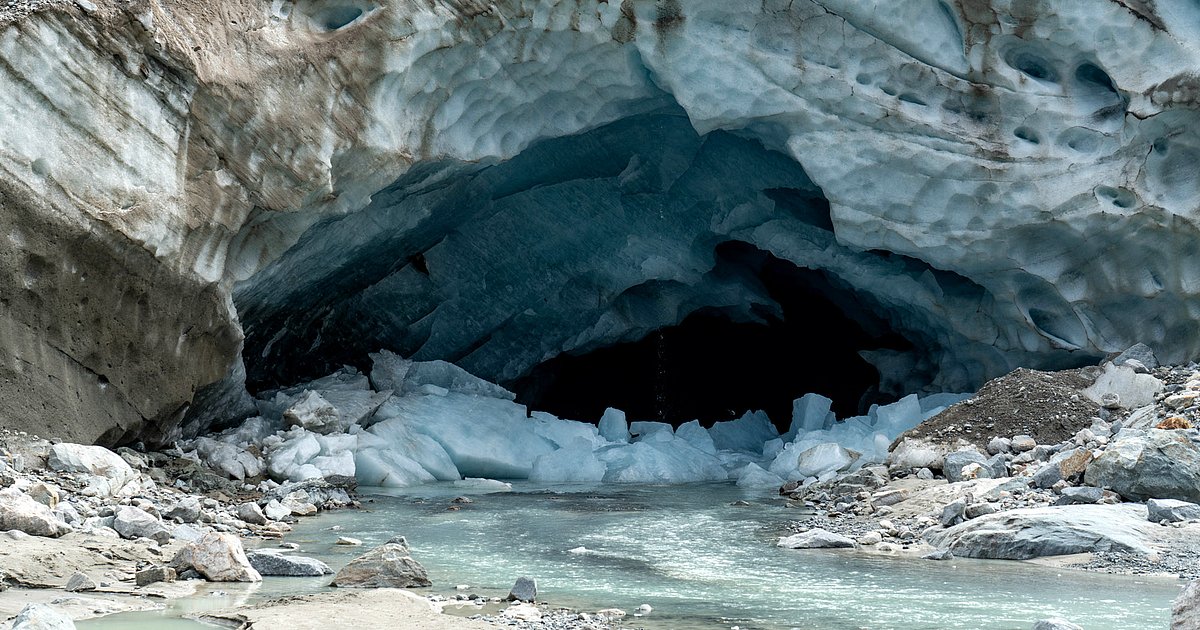
- The Rhone Glacier in the southern Swiss Alps lost more than 4 meters of ice thickness across June and July.
- Tignes said its usual six-week summer ski season on the Grande Motte Glacier ended early this year because a lack of snow made the slopes unsafe.
Compiled by The ScientistSomething wrong?How this is made
Why it matters
- exposure About 2.5 million people take drinking water from the Rhone, and millions more depend on the agriculture it supports. Their supply now turns on how a thinning glacier releases water through the year.
- constraint The extra runoff arriving now is easing central Europe's drought, but it is water spent months before the season when the catchment has least of it.
- decision Grande Motte is a quarter of Tignes' terrain, and Altta's chief executive puts the disappearance of summer skiing 10 to 15 years out. That is the horizon the resort has to plan lifts and snowmaking against.
- exposure The daytime freezing level reached 4,500 meters in June with little overnight refreezing even high up. That raises avalanche and slope instability risk for anyone working or climbing on those faces.
Glacier Loss Day is a calendar date, and only that. GLAMOS defines it as the point where the previous winter's snow is gone and further melting starts eating into the glacier's own mass, until autumn snowfall begins rebuilding the pack [2]. Matthias Huss, who heads the network, told Agence France-Presse that this year's date came "three months too early, compared to a healthy state" [3]. Counted forward from June 29, that puts a healthy melt-out near the end of September [1].
phys.org does not report a 2026 figure for how much ice the summer then removed. For 2022, whose melt-out fell on June 26 [2], it puts the loss at about 6% of total glacier mass [5]. That is two dates, three days apart in four years, and too few to read a distribution from. The stronger reason to plan for 2022-class years is physical: snow depths in the central European alpine region last winter were among the five lowest in three decades [9], and thin snow exposes older, darker ice that absorbs more sunlight than snow and melts faster [10].
For a rate, the Rhone Glacier is the closest the record comes. Spread across the 61 days of June and July, its loss of more than 4 meters of thickness works out to at least 6.6 centimeters a day [3]. GLAMOS put the July figure at 10 centimeters a day [12], roughly half again that two-month average [4].
In the Mont Blanc massif, aerial imagery shows meltwater streams running down bare rock alongside the Bossons Glacier, in places where its ice reached the valley floor in the 1980s [23]. A hole first spotted in the glacier's lower tongue in 2025 is still visible more than a year later [24].
At Tignes, summer skiing on the Grande Motte Glacier normally runs about six weeks in June and July across 19 kilometers of trails [17]. Clement Colin, chief executive of Altta, the company that manages the resort's lifts, told France 3 that people "would not be skiing on the glacier for much longer" [19]. The resort has put artificial snow machines at the lower perimeters [20], and still plans to open for the winter season at the end of November [21].
Downstream, the timing counts for more than the total. The melt raises early-season runoff, which is useful during central Europe's current drought [15]. phys.org reports that the Rhone can no longer sustain the flow volumes communities farther downstream have long depended on in mid- and late summer [22], and that the catchment is likely to face severe water security problems in the late-summer months, once glacial ice no longer contributes much to streamflow [16]. That projection is conditional on the glacier continuing to melt as forecast [16].
What to watch
- GLAMOS's end-of-season mass balance for 2026. It would show whether a near-record date came with a 2022-scale loss of about 6% of glacier mass.
- Measured Rhone flows in August and September, the months phys.org expects to run short once ice stops contributing.
- Whether Tignes attempts a summer ski season on Grande Motte in 2027 or extends artificial snow further up the glacier.