Product1 publisher3 min readPublished
Energy Department grants $1.9 billion to squeeze 23 gigawatts from the existing grid
Energy Department grants of $1.9 billion will fund 31 projects in 26 states promising more than 23 gigawatts from existing power lines. The gains come from weather sensors and rerouting, so they help data center plans most where a congested line is the bottleneck.
The Product Desk · Product desk
What happened
- The Energy Department will put nearly $2 billion into 31 projects in 26 states that it expects to add more than 23 gigawatts of capacity, enough to power 16 million homes.
- The funded work uses sensors that read real-time weather to keep transmission safe, along with tools that direct power away from congested paths.
- Officials said projects were ranked by how quickly they could be put into operation, with money from the bipartisan infrastructure law passed under Joe Biden.
- Recipients will match the $1.9 billion in federal funding with $3.35 billion of their own.
- State agencies in Colorado, Indiana, Ohio and Oklahoma were the largest recipients, drawing $810 million between them.
Compiled by The Product DeskSomething wrong?How this is made
Why it matters
- constraint Capacity set by live weather readings holds only in the right conditions, so a data center that needs firm supply at a winter peak cannot count the headline gigawatts as firm.
- cost With the federal share near 36 percent, projects that Wright says recipients had held off on now go ahead mostly on the recipients' own money.
- contradiction The utility trade group describes steady yearly investment, but Wright and the grid-tech trade group describe utilities that waited, and a developer's timeline depends on which account holds.
PPL's territory in eastern Pennsylvania had two data centers come online this year, and six more are under construction [6]. With others in advanced planning, the utility says its peak demand could quintuple by 2032 [6]. PPL's piece of the federal money is $71.5 million to modernize an existing high-voltage line across roughly 30 miles of northern Pennsylvania [7]. It works out to about $2.4 million a mile [1].
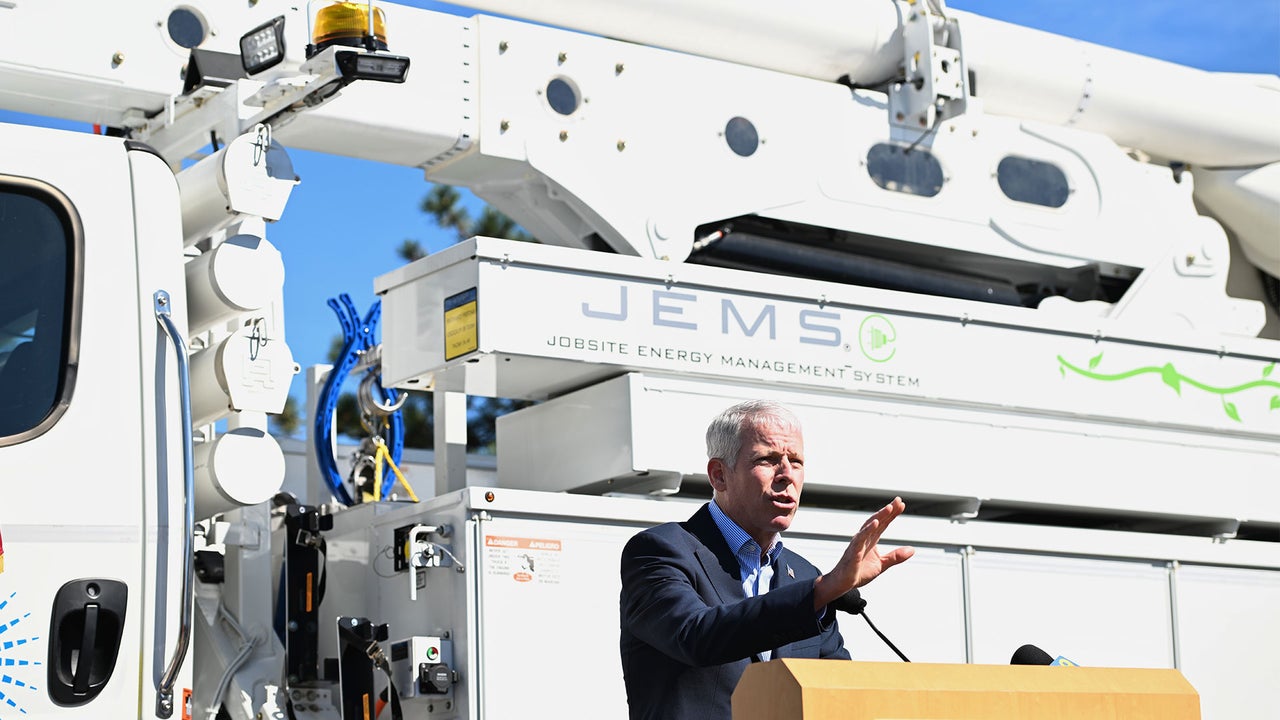
Energy Secretary Chris Wright promoted the grants at a PPL facility in Allentown. "This is a quick way to lower electricity prices and increase reliability: using fibers that are already in the transmission lines to analyze what's the temperature out, what's the wind out, how can we use this transmission line to distribute more power, but safely and only in the right conditions," he said [5]. The final clause matters most to anyone buying power. A line rated on live weather readings carries more when conditions allow and less when they do not [3][5]. The department did not say how much of the 23 gigawatts is available in the wrong conditions.
The work behind the headline figure is technology upgrades across nearly 21,000 miles of line and component work on more than 1,500 miles [12]. With the recipients' match, the projects cost about $5.25 billion, and Washington pays about 36 percent [2][3]. Federal money comes to less than $83 million per promised gigawatt, and total spending to less than $228 million [4][5]. The four state agencies took about 43 percent of the federal money [6].
Here's what the utility industry says its members do. Drew Maloney, CEO of the Edison Electric Institute, said utilities make a "significant investment" every year in new technologies to strengthen the grid [9]. Here's what Wright says grant recipients actually did: many projects had been under consideration, but recipients hadn't "quite pulled the trigger" [11]. He said he didn't know whether the projects would have been done without federal funding [11]. Julia Selker, executive director of the WATT Coalition, a trade group for grid-enhancing technologies, said U.S. utilities lag Europe in adopting them despite past federal money to develop and test them [8].
Speed is the department's case. Wright said work should begin right away, and he hoped some efficiencies would be in place before this winter, when extreme weather drives demand up [10]. The substitution the record describes is for power plants: Congress and some states want utilities using these tools to lessen the need to build new ones [16].
For a planner, the decision sorts on two axes. One is whether the constraint is a congested line or a shortage of power to put on it. The other is whether the load can ride through capacity that drops when conditions turn, or needs firm supply at the winter peak. Sensors and rerouting fit the first square best: a congested line serving a load that can flex [3]. With a firm load on the same congested line, the help extends only up to the rating the utility will commit to in bad weather, and that worst-case rating is the figure to get in writing. Where generation is short, the funded tools help indirectly at most, because they move power and do not make it [3]. The department's own claim carries a hedge of its own: officials said the upgrades could improve reliability and lower costs for about 100 million Americans [4].
What to watch
- Whether the department or recipients publish the rating each upgraded line can carry in worst-case weather, separate from the 23-gigawatt total.
- Whether any funded efficiencies are running before this winter's demand peaks, the timeline Wright said he hoped for.
- Whether utilities outside the program buy the same sensors without grant money, a direct test of Selker's claim that U.S. utilities lag Europe.