Build1 distinct publisher3 min readPublished
The paper reports up to 30% factuality gains over prior baselines with no fine-tuning, though its own introduction concedes that RAG with Google search had already cleared those baselines by more than ten points.
The Engineer · Build desk

Compiled by The EngineerSomething wrong?How this is made
Atomic-fact decomposition is the part that has to hold. RAC takes a finished answer, splits it into atomic facts, verifies each one against retrieved content, and revises the answer from the verdicts [2]. Retrieval is either a search engine such as Google or a corpus such as Wikipedia [8]. On the request path that is generation, then decomposition, then one retrieval, then one verify-and-correct pass, all in sequence [13]. The efficiency claim rests on retrieving once and correcting once, which the authors say cuts latency sharply against similar prior methods [5]. Read the comparison class carefully: it is other correction pipelines, not the pipeline you are running now with no correction stage in it.
The 30% is a ceiling [3]. Two datasets, each evaluated with and without RAG, is four measurement conditions per model before you count models [12]. The reported figure is the best cell in that grid. For it to transfer to your service, three things have to be true at once: your quality metric has to be the factuality metric those datasets score, your outputs have to decompose into propositions that are independently checkable, and your retrieval has to be as strong on your questions as web search was on theirs.
That last condition is where the paper is most useful, and it is buried in the introduction rather than the abstract. The authors report that RAG with Google search alone lands more than ten points above previous baselines, which is why they skipped the two obvious research moves of improving retrieval quality and correcting retrieved content [6]. Treat that as an ordering for your own work. Retrieval reach is the large term. Post-hoc correction is the smaller term stacked on top of it, and if you are grounding on a private corpus you are not starting from the base they measured.
The adoption cost is genuinely low, and that is the craft worth praising here. No additional fine-tuning, any instruction-tuned model, positioned as a post-processing component of RAG [4]. That means you can put it behind a flag, measure it, and delete it, and nothing has to be retrained when the base model changes underneath you. The code is published [9], so the margins in the paper's Table 2 are checkable by someone outside the group, which is more than the excerpt I have supports on its own: it ends mid-sentence and carries no tables and no dataset names [11].
Where it breaks is the independence assumption. A biography splits cleanly into facts that a retriever can adjudicate one at a time. A summary's faithfulness to its source document does not decompose that way, and neither does a chain of arithmetic where fact four is only wrong because fact two was. The paper also gives the honest reason the stage exists at all: correct retrieved content in the context does not guarantee correct output [7]. The same is true one layer up, since the component doing the correcting is the same class of model that produced the error, and nothing in the described loop verifies the corrector.
So the pitch that survives contact with the mechanism is narrower than 30% off a fine-tune. It is a deletable stage, priced in one extra model pass and one retrieval per answer, on outputs that are lists of separable claims.
Ranked by verification strength, evidence, and original report placement.
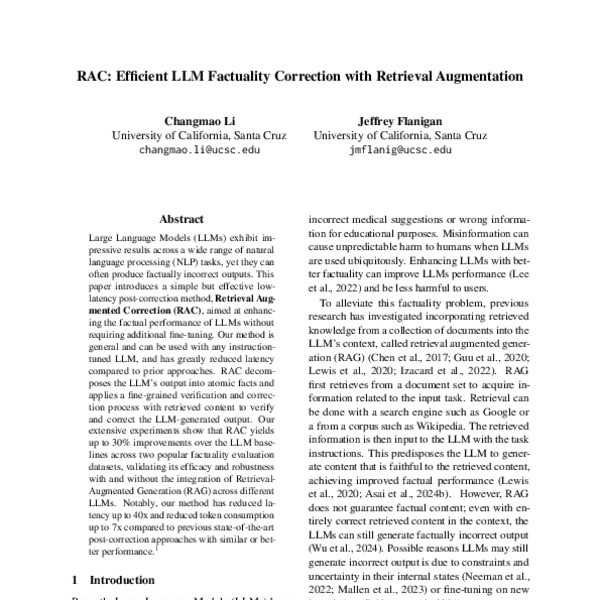
A paper titled "RAC: Efficient LLM Factuality Correction with Retrieval Augmentation", published on arxiv.org, introduces Retrieval Augmented Correction (RAC), described as a simple, low-latency post-correction method for improving the factual performance of LLMs without requiring additional fine-tuning.
The method is described as general, usable with any instruction-tuned LLM, requiring no additional fine-tuning, and can be viewed as a post-processing component of RAG.
The paper states that its code is available at github.com/jlab-nlp/Retrieval-Augmented-Correction, and points to a Table 2 for its improvement over prior retrieval-based correction work.
RAC decomposes the LLM's output into atomic facts and applies a fine-grained verification and correction process with retrieved content to verify or correct those atomic facts, then revises the LLM output accordingly.
The paper states that RAG by itself does not guarantee factual content, and that even with entirely correct retrieved content in the context, LLMs can still generate factually incorrect output.
The paper notes that retrieval can be done with a search engine such as Google or from a corpus such as Wikipedia.
Distinct publishers with included, body-backed reporting in this cluster.
1 article · September 3, 2026
Follow any of these and your For You feed starts watching them — no settings page required.
build
A docs bot that refuses to answer is working: the case for an evidence gate over a bigger window1 distinct publisher
build
The cheapest retrieval win this week sat at ingest, not in the agent loop1 distinct publisher
build
Retrieval Is Not A Cheap Agent, And An Agent Is Not A Smart Retriever1 distinct publisher
build
RAG prototypes work because a human picked the files. The drive does not come pre-curated1 distinct publisher
Evidence-backed comparisons of source perspectives and observed adoption signals. Read the methodology
Which Builder, Operator, and Investor concerns the observed source mix emphasized—not a truth score.
Evidence, demonstrated adoption, hype gap, incentives, and confidence are assessed independently, each on its own current evidence. How these are measured.
Mechanism spelled out, results withheld
The two numbers doing all the persuading — 30% over baselines, ten-plus points from Google-search retrieval — live in tables that are not in the text we have, and the rendered contributions bullet even loses its figure mid-sentence: "improve factualty by up to , depending on the application". Against that, the method itself is described precisely enough to reimplement. Design: credible. Performance: take it on trust.
A repository link and nothing else
The only distribution fact anywhere in this reporting is a GitHub URL in a footnote, and a URL is not usage: no stars, forks, dependent projects, third-party reimplementation, or anyone outside the authors' group saying they ran it. We will not score adoption off a hyperlink.
The headline number shares its credit
Two things pull the same way. "Up to 30%" is the best cell in a grid of at least four conditions per model, presented as though it characterised the method. And the paper's own introduction concedes that RAG with ordinary Google search already beat previous baselines by more than ten points — so a large share of the distance from "previous baselines" was travelled before the correction step ran. "Greatly reduced latency" is likewise measured against rival correction pipelines, not against simply answering the question, which RAC unavoidably makes slower.
Authors marking their own homework
The single account of RAC is written by the people who built RAC, and every adjective earns them something: simple, general, plug-and-play, greatly reduced latency. The revealing line is "Surprisingly, we find that these steps are not necessary" — two competing research directions set aside on the strength of a result the reader cannot see. That is ordinary preprint behaviour rather than misconduct, but nothing in this reporting has passed an adversarial reader.
Sure what it does, unsure how well
We can describe RAC's behaviour and its per-answer cost with reasonable assurance, because the pipeline is laid out plainly and the arithmetic of adding a pass is not in dispute. Everything about efficacy rests on a truncated document with no tables and unnamed benchmarks, and no second publisher has touched the story, so there is no outside reading to test ours against.