Science1 publisher2 min readPublished
Detection dogs pushed a Georgia weasel camera survey's hit rate from 1.5% to 81%
Detection dogs found weasels on ground where hundreds of randomly placed cameras had recorded almost nothing. The habitat rules that came out of that then put cameras in the right places elsewhere in Georgia.
The Scientist · Science desk
What happened
- University of Georgia researchers spent a year testing two ways of finding long-tailed weasels across about 30,000 acres of North Georgia wilderness, and published the comparison in Wildlife Letters.
- Nine of 599 randomly placed cameras, checked every two weeks over roughly 300 nights, recorded a weasel, a hit rate of 1.5%.
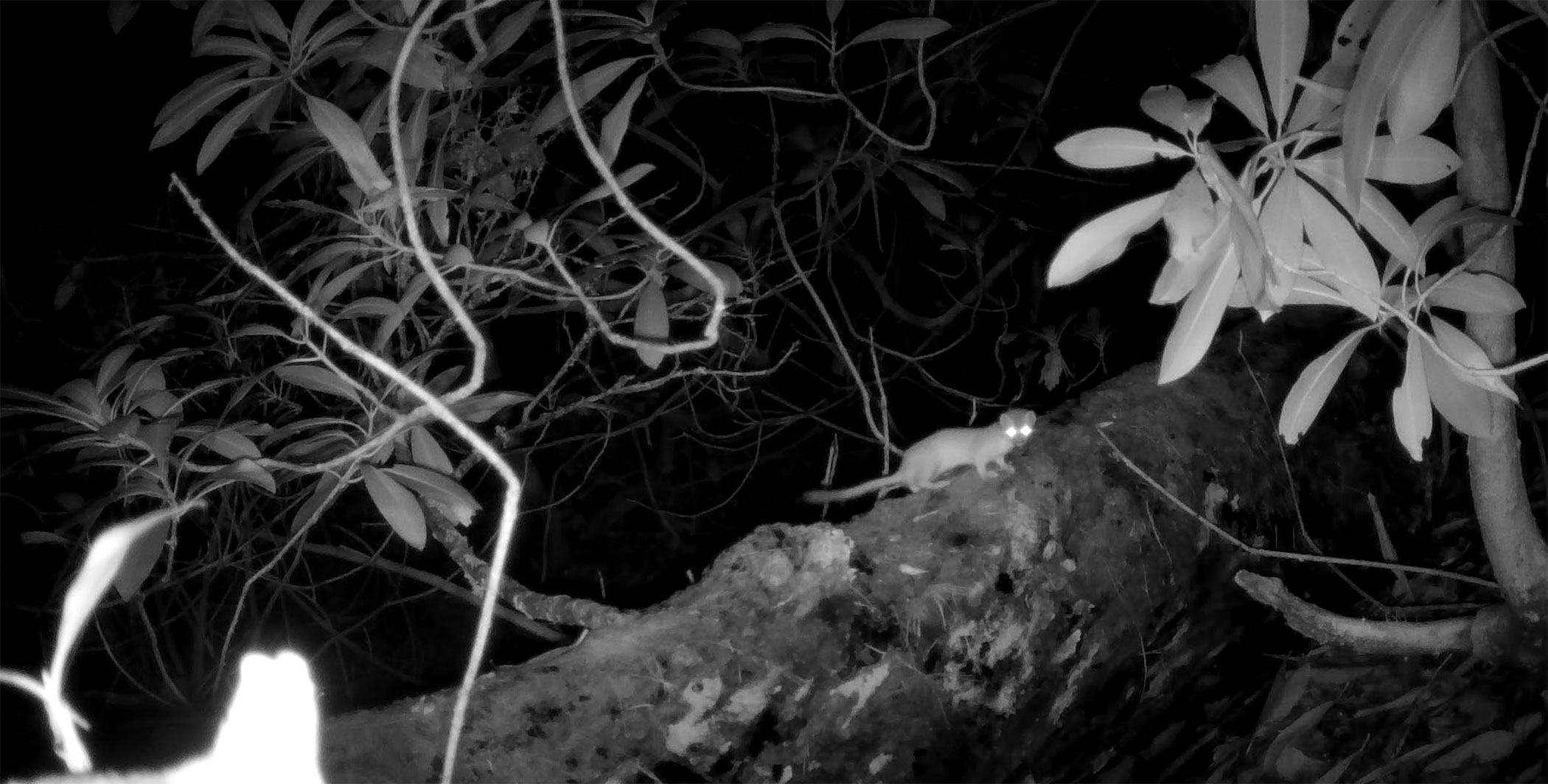
- Cameras moved to the 16 spots where detection dogs alerted logged 77 weasels in just over 200 nights, which the team puts at an 81% camera success rate.
- The placement lessons from the dogs were then applied at 20 Georgia wildlife management areas with 756 cameras over two periods of about 120 nights.
- In the Southeastern Plains, a camera at Flat Tub Wildlife Management Area near Denton recorded the first weasel seen in that region in more than 30 years.
Compiled by The ScientistSomething wrong?How this is made
Why it matters
- capability The dogs' contribution comes down to a habitat description that cameras can be aimed at, so an agency can survey a species it previously could not detect without keeping a dog team on every site.
- constraint Because the productive sites were picked for the likelihood of a weasel being there, the resulting detection counts cannot be read as abundance or compared between areas as a population index.
- decision Myers ties monitoring directly to land protection and trapping rules. Georgia now has to decide what presence in four of five regions should change in a state that had almost no weasel data.
- contradiction A reader quoting the effectiveness gain has to choose between the 30-fold figure in the write-up's subheading and the 54-fold ratio of the two rates it reports.
The dogs did more than sniff out animals; they gave the survey an independent check on presence, which a camera grid cannot give itself. "They told us there were weasels present on the site and that we should be seeing them on our randomly placed cameras," said Jenna Myers, the study's corresponding author and a doctoral candidate in UGA's Warnell School of Forestry and Natural Resources [11][19].
Effort differed sharply between the two phases. Random placement ran 599 cameras for roughly 300 nights, about 180,000 camera-nights, and nine of those cameras recorded a weasel [4][5][23]. Dog-chosen sites ran 16 cameras for a little over 200 nights, about 3,200 camera-nights, and yielded 77 weasel detections [6][7][24]. That is roughly 56 times the camera-nights for the nine positives [25].
The 81% success rate is 13 cameras out of 16 [26]. Small denominator, and the two phases differ in two ways at once: who picked the sites, and where the sites were. What the comparison measures is the whole workflow of dog search followed by camera deployment. The researchers describe the study as among the first to validate the method, and report that the dog-guided placement cost about 10 times less than traditional methods [9][8].
The phys.org subheading on the study credits the technique with being 30 times more effective than stand-alone camera monitoring [21]. The two rates printed in the same article, 1.5% and 81%, differ by a factor of 54 [22]. The article does not reconcile them.
The part another state can copy is the habitat description. Weasels turned up near water sources with dense forest cover or downed logs [12]. Detection rates peaked in April and May, which the researchers attribute to females hunting, storing food, mating and raising young, with a smaller peak in fall when weasels may forage to build stores before winter [13].
Those rules produced a weasel in the Southern Coastal Plain, at Dixon Memorial Wildlife Management Area near the Okefenokee Swamp, where none had ever been detected [15]. "When I first realized that we detected a weasel in the Southern Coastal Plain, I immediately called Jenna and started crying. I couldn't believe we had found swamp weasels!" said Lexie Dingerson, a coauthor and master's student at Warnell [17][20].
One of the five sampled regions produced nothing [30]. The dogs can answer whether that blank is real absence or another run of false negatives. The cameras cannot. Dingerson said: "We have to better understand populations, which is why this new monitoring strategy is important. Our research offers a starting point." [18]
What to watch
- A replication outside Georgia, with different dogs and handlers, would show whether the 81% belongs to the protocol or to this team.
- A dog-led survey in the one sampled region that came up empty would test whether that blank is real absence.
- Published dollar figures for both methods, including handler and dog training time, would put weight behind the tenfold cost claim.