Product1 distinct publisher3 min readPublished
The service has been on devices since March, but the app entry that made it visible is only days old, and it cleared 10 million downloads before anyone in support had a sentence to hand out.
The Product Desk · Product desk

Compiled by The Product DeskSomething wrong?How this is made
The first thing anyone does with an app they do not remember installing is try to open it, and Pulse does not open. There is no app drawer entry. On a Pixel it sits at Settings > Google services > All services > Privacy & security > System services, several taps away from where a worried person starts looking [6]. The arrival mechanism is unglamorous: Google says system services update on their own schedule, separately from the OS, which is how a package turns up on a phone nobody touched [7].
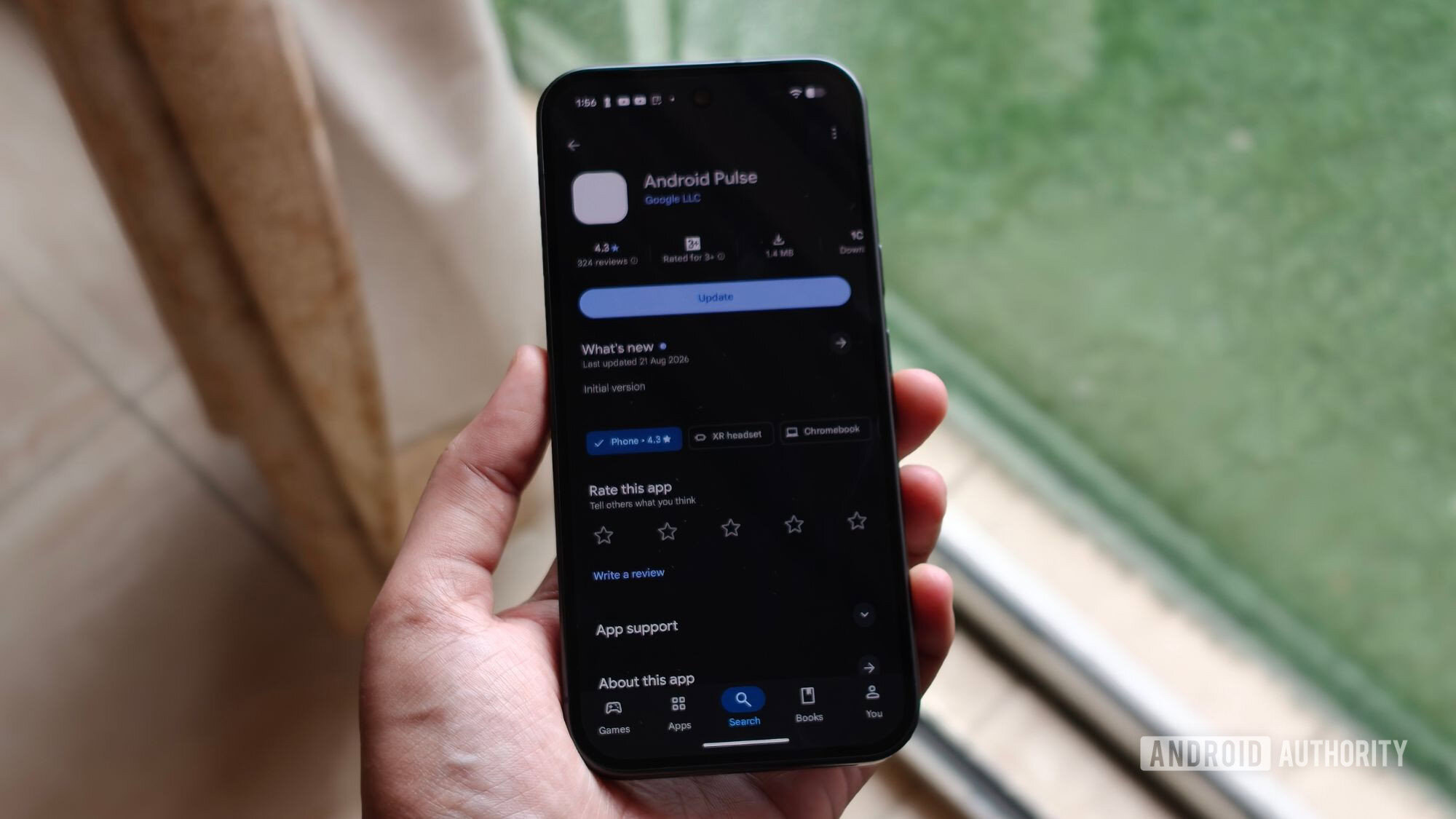
Users type the name into a search box, land on a forum thread or a news post, and then either uninstall something unrelated or decide the phone is compromised. Support teams tell themselves users do something else: open the Play Store listing and read the data-safety section, which says Pulse may collect app information and performance data and does not share it with third parties [5]. That is a real answer to a question almost nobody knows to ask, and the same listing never says what the thing is for [9].
The 10 million figure will get more respect than it deserves. A listing a few days old passing 10 million downloads [2] reads like uptake, but Google's own account is that the service had been present since March and the update only made it visible in settings [3][4]. What the counter measures is Google's distribution, not a decision any user made [11]. An install base assembled that way records Google's shipping decision, not any user's demand.
What Pulse does is still secondhand. BGR reports the service is understood to help maintain Android and keep devices secure, and infers it likely watches battery drain, memory usage and CPU activity [12], which would sit alongside the crash, app-not-responding, wake-lock and memory tracking Android already performs [13]. For app teams the adjacency worth noting is the enforcement end: Google already shows which apps drain the battery and has said it will add labels and warnings for apps that consume excessive resources [14]. That telemetry, invisible to users now, is exactly what developers will have to answer for once those labels and warnings ship.
The Safety Core comparison holds for sequence, not substance. That one scanned for unwanted content, per BGR's account [10]; Pulse, on the reporting available, reads resource telemetry [12]. What the two share is the order of operations, and the order is what costs a support team its afternoon.
The next one of these comes down to four questions, and the answers decide how much of that afternoon you lose. Can a user locate the thing on their own device? For Pulse, yes, if they know the path [6]. Does the listing say what it does? No [9]. Does it declare what it collects? Yes [5]. Is there a clean way out? No, since Google warns that disabling system services can break features or cause other issues [8]. Pulse answers two of four [16].
Given that score, the sensible move is to leave it installed and put the effort into the written answer rather than the removal, and the tradeoff is plain: you are accepting a service whose purpose you know only through a statement to a reporter [3] in exchange for not breaking device features on a hunch [8]. If someone genuinely fears malware, BGR's steer is the right one, which is Play Protect, with Advanced Protection for people who want the tighter setting [15]. That two-of-four score is the baseline against which to judge the next silent push.
Ranked by verification strength, evidence, and original report placement.
Google started adding an app called Android Pulse to Android devices this month, and users noticed it appearing on their phones without having installed it.
According to the Play Store listing, Pulse's listing was only a few days old and had already reached more than 10 million downloads.
The data-safety section of the Play Store listing says Pulse may collect app information and performance data, and that it does not share data with third parties.
Pulse cannot be opened from the app drawer like a normal app; on Pixel phones it appears under Settings > Google services > All services > Privacy & security > System services.
Google says system services can update separately, which is part of why Pulse could suddenly appear even though the user did not install anything.
Google warns that disabling system services can break certain features or cause other issues.
Distinct publishers with included, body-backed reporting in this cluster.
1 article · August 28, 2026
Follow any of these and your For You feed starts watching them — no settings page required.
build
Sideloading becomes a registered activity: budgeting for Android's September 2026 deadline1 distinct publisher
product
Android theft protection is now a Play Services baseline, not an OEM feature1 distinct publisher
security
Android's "unverified developer" flow ships, and the burden shifts to whoever builds the APK1 distinct publisher
build
Geofencing beats GPS polling on power, then loses to the OEM battery optimiser1 distinct publisher
Evidence-backed comparisons of source perspectives and observed adoption signals. Read the methodology
Which Builder, Operator, and Investor concerns the observed source mix emphasized—not a truth score.
Evidence, demonstrated adoption, hype gap, incentives, and confidence are assessed independently, each on its own current evidence. How these are measured.
Verifiable surfaces, second-hand substance
Split the story in two and the sourcing quality splits with it. The checkable half — a days-old listing, a ten-million counter, a five-level Pixel settings path, a data-safety box naming app and performance data — anyone can open a phone and confirm. The half that would settle the matter is thin: Google's only explanation reached us through a statement it gave Android Authority, relayed by BGR, and the origin date carries BGR's own hedge, 'appears to have existed since March'. What Pulse does is reasoning, flagged as such.
Ten million devices, zero decisions
The distribution is real and fast: past ten million in days, per the listing. But BGR's own account dismantles any reading of that as uptake — the service predates the entry, the app cannot be opened, and nobody installed it. So the number scores as reach, not as choice, and the ceiling comes from the fact that the only party demonstrating commitment here is Google.
Headline promises what the sourcing withholds
The overstatement is structural rather than shrill. A headline offering 'Here's What It Does' precedes a paragraph admitting Google doesn't say what it does, and the emotional heavy lifting is done by last year's Safety Core episode rather than by anything established about Pulse. To BGR's credit the conclusion is mild — leave it alone, worry about Play Protect instead — which keeps the gap modest. Meanwhile the genuinely notable fact goes underplayed: a resource-monitoring service sat on phones for five months before anyone was told, and the telling happened in a press statement.
Search-intent explainer, press-first disclosure
Two motives are visible in the text itself, neither hidden. Google surfaced a five-month-old service with a blank purpose field and then produced a sentence for Android Authority when asked — the explanation went to press before it went to the listing users can actually read. BGR, for its part, is servicing a search query about an unfamiliar icon, and closes by steering readers into its own hidden-features roundup. That combination reliably produces a piece that reassures and moves on rather than one that presses for the missing disclosure.
Sure about the artifact, unsure about the function
We would bet on the listing, the settings path, the data-safety wording and the counter. We would not bet on the March start date, which BGR itself hedges; on the resource-monitoring purpose, which is inference; or on the promised developer labels, asserted with no date or scope. Every point the story rests on comes from one outlet and nobody has re-checked any of it, so mid-range is the honest ceiling.