Invest1 distinct publisher3 min readPublished
Americans rate their bank's virtual assistant almost identically across five very different tasks, which suggests they are grading the bank rather than the technology.
The Investor · Invest desk

Compiled by The InvestorSomething wrong?How this is made
Dan Latimore, who runs North America research at RFI Global and banks with Bank of America, asked Erica whether he should buy a CD. Erica sent him to the CD page of the mobile app [15]. He put the same situation to Anthropic's Claude, framed as $15,000 sitting in checking, and got back federal deposit insurance, indicative rates, the possibility of Fed cuts and the liquidity trade-off [16]. The institution holding the transaction history produced a link. The system holding one sentence of context produced the reasoning. That is a deposit-pricing conversation, and it happened somewhere the bank cannot see.
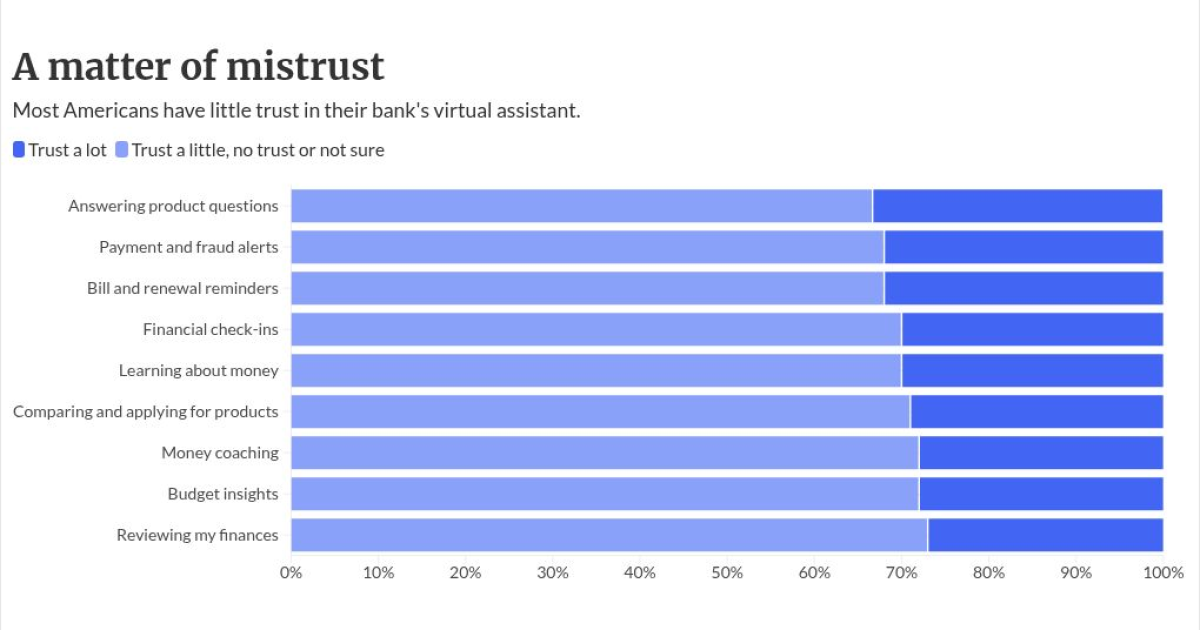
The survey numbers around that anecdote are more interesting than the headline. High trust runs 33% for product questions, 32% for fraud alerts, 30% for learning about money, 28% for budget insights and 27% for reviewing finances [2][3][4][5][6]. Five tasks of wildly different difficulty, six points of spread, a 30% average [20][21]. Answering a product FAQ and reviewing someone's finances are not the same engineering problem, but respondents grade them as though they were. They are not scoring capability. They are scoring the counterparty, which is roughly what Latimore says when he calls it tough to disentangle trusting the bank's AI from trusting the bank [12].
His prescription follows from that: stronger fraud mitigation and useful round-the-clock support, then climb the trust ladder [11]. The awkward part is that neither of those improves an answer, and the answer is where Claude won. Most bank assistants still serve pre-written libraries, some with natural language understanding mapping the question to a canned reply [13]. Latimore's own verdict is that they beat scrolling through menus and not much else [14]. A scripted assistant is cheap to keep running and quietly gets worse every time the free comparison improves.
Rebuilding is not a front-end project. Wenni Wu, chief growth officer at the seven-year-old Piermont Bank, says the hard part is holding data security and risk management steady while the technology goes in [17], and that AI is only as good as the data it can reach, with bank data spread across various systems that first have to be cleaned up [18]. On the customer side she expects small-business owners, who lack the device and access discipline of large firms and run their finances across a pile of separate software, to force the fragmentation question faster than banks would choose [19].
Then there is the arithmetic on the remedy. 78% say they hold banks to a higher AI standard than tech firms [8]; 63% say they would trust their bank's AI more if a human were clearly responsible for the outcome [9]. Different questions, so treat the 15-point gap as an outer bound rather than a measured deficit [23]. Even read generously, a named human owner is endorsed by fewer people than impose the stricter bar, so accountability language does not by itself buy parity. And on the easiest task in the battery, product questions, at least 67% still withheld high trust [22]. RFI frames the stakes as competitive, with consumers already taking financial questions to Claude and ChatGPT [24]. The competitor in that framing has no deposits to defend and no compliance review on its answers.
Ranked by verification strength, evidence, and original report placement.
Latimore, a Bank of America customer, asked the bank's Erica assistant whether he should buy a CD, and Erica sent him to the CD page of the mobile app despite the bank holding his transaction history.
Latimore asked Anthropic's Claude whether he should open a CD with $15,000 sitting in checking, and where and at what indicative rates; Claude's long answer covered federal deposit insurance, rates, potential Fed rate cuts and the liquidity trade-off.
American Banker frames the stakes as competitive: with more people using frontier models like Claude and ChatGPT for financial help, banks need to step up to compete.
RFI Global's U.S. Innovation Monitor survey asked 4,000 U.S. consumers, among other things, how much they trust their bank's chatbot.
About 33% of respondents said they trust their bank's virtual assistant 'a lot' to answer product questions.
About 32% said they trust their bank's virtual assistant 'a lot' for fraud alerts.
Follow any of these and your For You feed starts watching them — no settings page required.
Evidence-backed comparisons of source perspectives and observed adoption signals. Read the methodology
Which Builder, Operator, and Investor concerns the observed source mix emphasized—not a truth score.
Evidence, demonstrated adoption, hype gap, incentives, and confidence are assessed independently, each on its own current evidence. How these are measured.
One vendor survey, sizeable n, no published methodology
The core numbers come from a single 4,000-respondent survey reported by a single outlet, with no field dates, sampling frame, weighting, question wording or margin of error disclosed, and no independent replication. The internal arithmetic is checkable and consistent, and the flat spread across five tasks is a genuine pattern in the reported figures, but the qualitative layer rests on two named interviewees and one unrebutted anecdote.
Assistants widely fielded but scripted; genAI still pre-deployment
The source establishes that bank virtual assistants are commonplace yet mostly limited to pre-written answer retrieval, and that generative assistants are at the sandbox-experimentation stage for banks with larger budgets. No usage, containment, deflection or deployment counts are given, so adoption is scored on qualitative deployment state alone.
Mildly overstated headline over a defensible pattern
The 'Americans don't trust their banks' virtual assistants' framing is derived from a 'trust a lot' figure of roughly 30%, collapsing 'a little' with 'not at all' and leaving the middle of the distribution invisible; the competitive threat from frontier models is asserted without any usage data and leans on a single anecdote. Offsetting this, the underlying data point that trust barely moves across five dissimilar tasks is stated conservatively and is checkable, so the overstatement is modest rather than promotional.
Vendor-published survey plus practitioner positioning
The data originates with RFI Global, a research firm that sells exactly this kind of consumer insight, and its own head of research supplies both the diagnosis and the prescription, including the anecdote favoring an LLM over a named bank's assistant. The second interviewee is a growth executive at a digital bank positioning itself as combining regulated-bank trust with a tech-enabled approach. None of these interests are disclosed in the article, and the named bank did not comment.
Directionally credible, single-sourced, methodology-blind
Confidence is moderate: the sample is large and the arithmetic pattern is verifiable, so the qualitative conclusion that consumers grade the institution more than the task is reasonably safe. Precision on the levels is not, given one publisher, one vendor survey, no disclosed methodology, an internal inconsistency on the human-accountability question, and prescriptive material sourced from interested parties.
invest
Agents that move money turn deposit stickiness into an assumption, not a fact1 distinct publisher
science
Text watermarks land on 2 December. The detection they imply does not.1 distinct publisher
science
Claude's watermark is a compliance artefact, not a cheating detector1 distinct publisher
security
The nationalization argument is really a vendor-continuity memo1 distinct publisher
Distinct publishers with included, body-backed reporting in this cluster.
1 article · August 26, 2026