Product1 distinct publisher3 min readPublished
Chinese banks and telcos are packaging inference the way airlines package miles, though the analyst closest to the trend calls the consumer bundles a supply-led experiment whose users never see a balance.
The Product Desk · Product desk

Compiled by The Product DeskSomething wrong?How this is made
The card on the table at Jingu Yuan, a dumpling restaurant in Beijing, tells diners they are full after the dumplings and should collect tokens at the cashier so their agent can be fed some computing power too [12]. The voucher is worth 10 yuan of credit, and the two stores hand out more than 100 a day [11]. That is upwards of 1,000 yuan of inference given away daily with the vinegar, or about 30,000 yuan over a 30-day month [4].
Set it against what the carriers charge. China Telecom's entry plan is 9.9 yuan a month for 10 million tokens [6], which is 0.99 yuan per million [1]. China Mobile's Shanghai promotion, 400,000 tokens for 1 yuan on the phone bill [8], works out to 2.5 yuan per million [2]. China Unicom's business tiers are 15 yuan for 6 million and 45 yuan for 18 million [9], and both land on exactly 2.5 yuan per million, so the bigger bundle buys no volume discount [3]. These are prices set to round retail numbers rather than derived from marginal cost. On face value, one plate of dumplings hands over slightly more computing than China Telecom's cheapest month [5].
The bank cards run the same arithmetic at three orders of magnitude. Shanghai Pudong Development Bank's developer card tops out at subsidies worth 3 billion Qwen tokens [5], which is about 2,970 yuan of value at China Telecom's rate and 7,500 yuan at Unicom's [6]. China Merchants Bank got there in June with up to 1.8 billion MiniMax tokens for new holders [4], and Moonshot's Kimi card, issued with the Agricultural Bank of China and American Express, pays tokens and agent and coding quotas on spend [3].
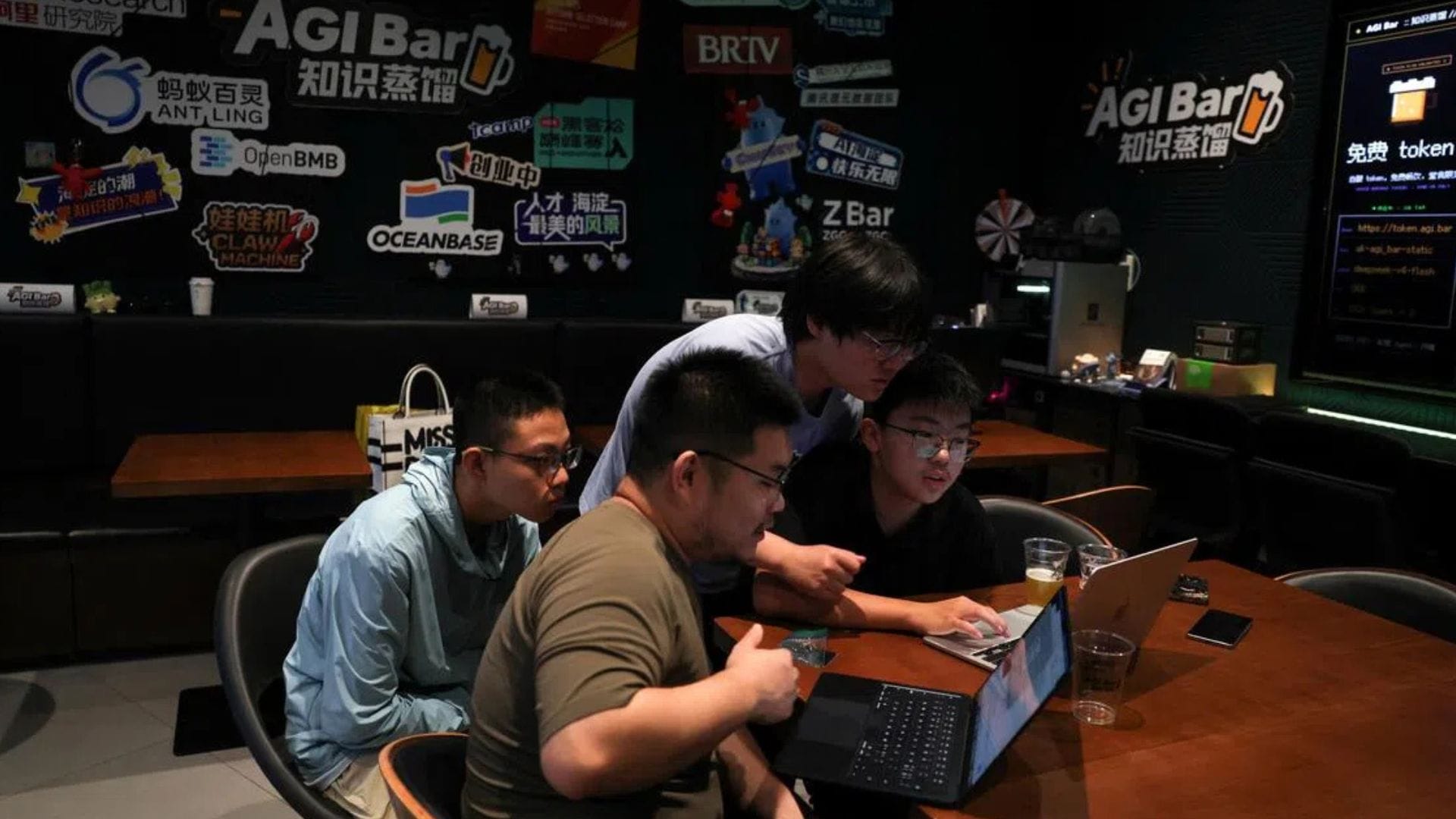
What teams tell themselves consumers do with a token balance is watch it, spend it down, and come back to top it up. What this reporting actually shows is vouchers leaving the till, and nothing about redemption or repeat use. Poe Zhao, who writes the Hello China Tech newsletter, told Rest of World that some of these consumer packages are a supply-led experiment, and that most ordinary users still meet AI inside an app or a feature without ever seeing a token balance [13][14]. The audiences named in the reporting support him: both bank cards are aimed at AI developers [4][5], and the AGI Bar, which gives drink-buyers unlimited DeepSeek V4 Flash off a local Nvidia DGX Spark, targets programmers and startup founders [10]. The people being handed a meter are largely people who already read one.
The supply side is real enough. Chinese open-source and open-weight models can cost 60% to 90% less than comparable OpenAI and Anthropic models [2], and token prices have become a competitive front in their own right [16]. National consumption went from 100 billion tokens a day in early 2024 to 500 trillion in mid-2026 [1], roughly 5,000 times [7]. Nothing in the reporting breaks out how much of that came from consumer bundles, so the giveaways cannot be credited with the growth on this evidence.
For anyone deciding whether to expose tokens as a unit in their own product, two axes settle it. Can the user see the unit, and does seeing it change what they do? Visible and behaviour-changing is a genuine price signal, which is what a mobile data plan is. Invisible and behaviour-changing is a rate limit, which users experience as breakage and blame you for. Visible but inert is dashboard decoration. Invisible and inert means the meter belongs in your cost accounting and nowhere near your interface. Developers sit in the first box, which is why metering them in tokens works; the tradeoff is that you have taught your best customers to shop on price per million, and that is the one number a rival running cheaper weights can undercut.
Ranked by verification strength, evidence, and original report placement.
In July, Moonshot AI launched a credit card named after its Kimi model in partnership with the Agricultural Bank of China and American Express; users earn Kimi AI tokens as well as agent and coding quotas on their spending.
The trend began in June when China Merchants Bank launched a credit card targeting AI developers, offering new cardholders up to 1.8 billion tokens for use on MiniMax's models.
Shanghai Pudong Development Bank launched a credit card for AI developers offering subsidies worth up to 3 billion tokens for Alibaba's Qwen models.
China Telecom offers consumer plans starting at 9.9 yuan a month for 10 million tokens, with larger allowances available for heavier users and businesses.
China Telecom runs a TokenHub platform offering subscriptions on 142 large models, as the state-owned carrier tries to evolve from selling telecom connectivity to selling AI computing and services.
China Mobile offered 400,000 tokens for 1 yuan in Shanghai, payable through users' phone bills.
Distinct publishers with included, body-backed reporting in this cluster.
1 article · September 4, 2026
Follow any of these and your For You feed starts watching them — no settings page required.
product
Baidu's AI line grew 25 percent and still lost the arithmetic1 distinct publisher
product
Swapping a frontier API for a self-hosted open-weight model relocates the audit question1 distinct publisher
invest
Google Ships Flash Instead of Pro While OpenAI Loses Its Two Best Operators1 distinct publisher
invest
Anthropic calls Chinese AI distillation 'theft,' citing national security risks1 distinct publisher
Evidence-backed comparisons of source perspectives and observed adoption signals. Read the methodology
Which Builder, Operator, and Investor concerns the observed source mix emphasized—not a truth score.
Evidence, demonstrated adoption, hype gap, incentives, and confidence are assessed independently, each on its own current evidence. How these are measured.
One reporter's legwork, no second pair of eyes
The granular material is strong and clearly first-hand: table-card copy in a dumpling shop, a bar's workstation, carrier price sheets, three named bank cards with their model partners. The weakness is structural. Every one of those facts rests on Rest of World alone, and the three numbers doing the most rhetorical work — 500 trillion tokens a day, the 5,000-fold climb since early 2024, the 60–90% price gap against OpenAI and Anthropic — appear with no origin named at all. One analyst is the only outside voice in the whole account.
Supply side committed, demand side unread
Count the channels and adoption looks broad: three banks issuing token-reward cards, all three state carriers metering inference, a bar serving a locally hosted model, a restaurant chain of two with a voucher run-rate, resale listings on Xianyu, and Guangzhou banks underwriting startups against token throughput. Count the users and there is almost nothing — one figure, the 100-plus vouchers a day, and no redemption rate behind it. Suppliers have shipped; whether anyone spent the tokens is not in this reporting.
Abundance read as appetite
The gap is modest, and mostly a matter of framing: five channels of giveaway are presented as tokens "entering everyday life" when what is documented is vendors, banks and carriers pushing capacity outward. Rest of World deserves credit for printing its own antidote — the supply-led-experiment quote sits high in the piece rather than buried. Where the story overreaches is the global framing: token prices are called a two-sided front in the AI race and not one American price cut is shown.
Every price here is a promotion
Nearly all the numbers originate in marketing. Moonshot, MiniMax and Alibaba want throughput and developer lock-in; the banks want relationships with startups they cannot underwrite on physical assets; China Telecom is openly trying to become something other than a pipe, and TokenHub is that pitch; a dumpling shop giving away 1,000 yuan a day of credit gets foot traffic and, evidently, press. Quotas advertised as maximums — 1.8 billion, 3 billion tokens — are the classic shape of an offer designed to be quoted rather than exhausted.
Trust the scene, not the totals
We would bet on the texture — the cards, the plans, the bar, the vouchers all read as observed rather than assembled from press releases. We would not bet on the precision of the macro figures, and the arithmetic we ran on top of the carrier prices is only as good as advertised bundles that may not be comparable in model tier or throughput. One outlet, one analyst, no redemption data: enough to establish that this is happening, not enough to size it.