Build1 publisher3 min readPublished
An essay from a one-person AI-native shop argues the catalog governs inventory and the gateway governs single tool calls, so nothing records which projects a pending change touches or who accepted it.
The Engineer · Build desk

Compiled by The EngineerSomething wrong?How this is made
The missing piece is a join key. A blast radius computed over a catalog graph is a claim about a snapshot: these edges, at this moment, therefore these projects. Write the result back as a catalog property and the inputs stop existing, because the catalog is assembled by integrations that sync from source repositories, CI systems and cloud providers, and is re-derived continuously [3]. What remains is an approval whose inputs have been replaced, in a field the next sync or the next writer can silently overwrite, with part of the judgment coming from an LLM-scored risk value [5]. Store the approval in a mutable field and it holds the evidentiary weight of a comment, however well formatted.
The runtime side has the opposite resolution problem. A gateway can allow or deny a tool call, require a human to approve a sensitive action, and log every request an agent makes, all at the granularity of one action by one agent [7]. The log records that an agent wrote to a file, without a field for which portfolio-level change that write belonged to, what the change was expected to affect, or who accepted responsibility for the whole of it [8]. Two records, no shared change identity. Neither layer is bad at its own job, which is why buying both does not close the gap [1][2].
What would have to be true for this to transfer. The author writes from a single-person AI-native delivery practice where agents produce most of the code, and argues change volume then grows past what anyone can reconstruct from commit history [12][10]. The essay concedes the older arrangement worked: when humans wrote most of the code, the git log was reviewable at human speed and a tech lead could hold the week's changes in their head [9]. So the requirement tracks the agent-authored share of diffs and the number of dependency edges that cross into projects owned by someone else. Inside a single repository, the essay says intent-level governance is a code review discipline; the machinery is for the portfolio case [14].
The evidentiary form is specified as three properties: an impact claim computed deterministically, an immutable and identified snapshot to compute it from, and an approval bound to that exact computation in an append-only record neither the platform nor the requester can rewrite [6]. That sketches a shape; the schema still has to be written. The supplied text promises a minimal implementation and breaks off mid-sentence while introducing what an auditor and an incident responder need from it [15], so there is nothing yet on what identifies the snapshot, where the append-only record lives, or what it costs to keep.
The mechanism holds regardless. A prediction stored where the next sync can replace it stops being evidence of anything the moment the sync runs [5], and the fix needs an identifier that both the catalog and the tool-call log agree on [8]. The price of maintaining that identifier is the part still to be shown.
Ranked by verification strength, evidence, and original report placement.
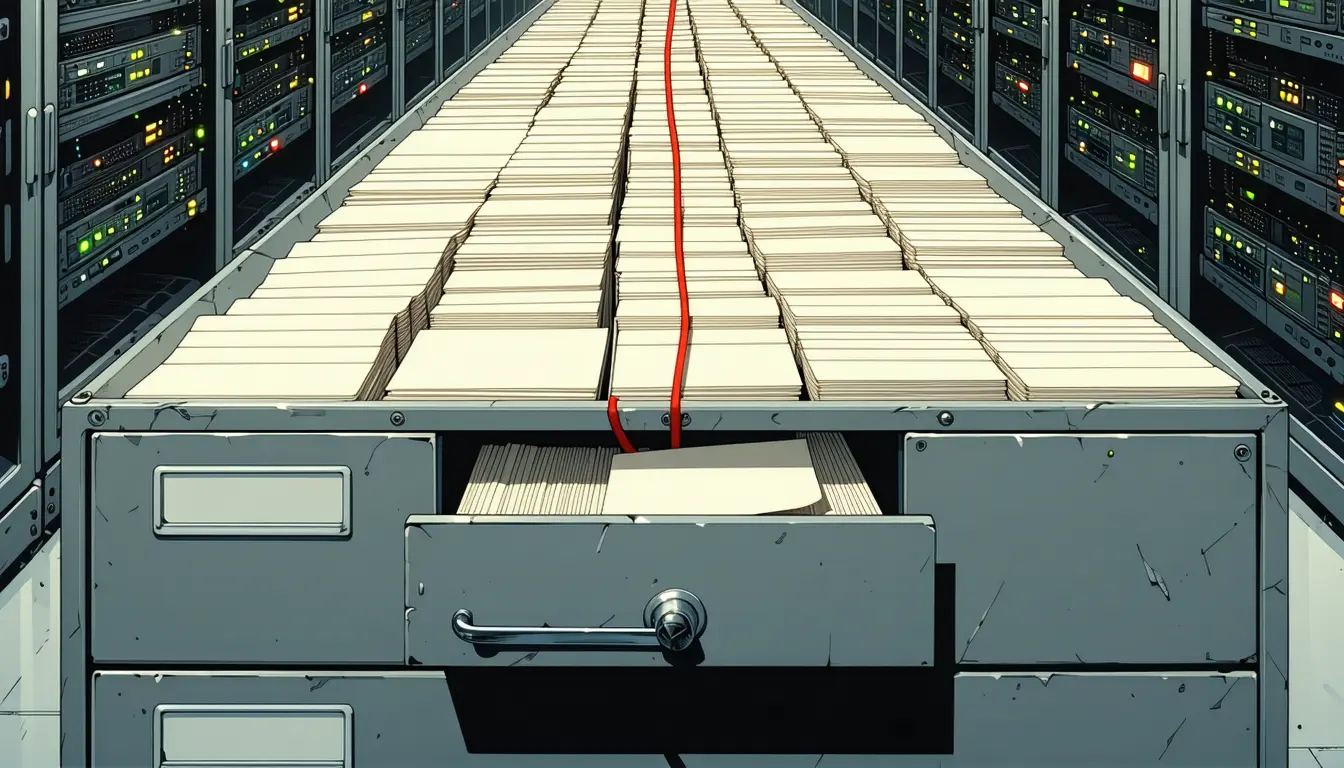
The essay argues neither layer can answer the question: this change that is about to land, which projects does it affect, who approved it, and where is the evidence. The catalog cannot answer because it governs inventory rather than change; the agent gateway cannot answer because it governs actions rather than intent.
The essay says an agent gateway can allow or deny a tool call, require a human to approve a sensitive action, and log every request an agent makes, and that this is genuinely useful but scoped to the granularity of a single action by a single agent.
A tool-call log can tell you an agent wrote to a file, but not which portfolio-level change that write belonged to, what the change was expected to affect, or whether anyone accepted responsibility for the whole of it.
The essay names the failure mode as not one bad change slipping through review but the organization losing the ability to answer after the fact which changes touched which projects on whose authority, because that information was never recorded as a first-class artifact and existed only as context in someone's head or in a discarded agent session.
What the essay says is still missing is the evidentiary form: an impact claim computed deterministically from an immutable, identified snapshot, and an approval bound to that exact computation in an append-only record that neither the platform nor the requester can rewrite.
The author states his vantage point up front as a single-person AI-native delivery practice, small but running into this gap at full speed, and says his own operation is one where agents produce most of the code.
Follow any of these and your For You feed starts watching them — no settings page required.
Evidence-backed comparisons of source perspectives and observed adoption signals. Read the methodology
Which Builder, Operator, and Investor concerns the observed source mix emphasized—not a truth score.
Evidence, demonstrated adoption, hype gap, incentives, and confidence are assessed independently, each on its own current evidence. How these are measured.
One essay carrying every claim
Everything here comes from a single self-published post, and the claims split cleanly by type. The definitional argument, that an inventory store cannot describe a change and a per-call log cannot describe intent, is checkable by reading it. The claim in the headline is not: Port's blast-radius field being overwritable by the next sync, and part of the score coming from an LLM, is asserted without a doc reference, a configuration example or a word from Port.
Only the author's own shop
No one is shown running change-intent governance, including the author. The single usage disclosure describes how his practice writes code, not that any record layer of the kind he specifies exists in production anywhere, and the named IDP and gateway products appear without a deployment, customer or install figure.
A portfolio rule drawn from a one-person sample
The essay is unusually restrained toward the products it critiques, granting that both layers are real and crediting Port's threshold gating before faulting where the prediction lands. The stretch is scope: a requirement for every portfolio is generalised from one practitioner's operation, and a mechanical charge against a named vendor is made without the vendor's documentation. Stating the vantage point up front narrows the gap rather than closing it.
The gap sits where the author works
A delivery practice defines a missing layer, specifies the properties its record would need, and points back to the author's earlier essay for the underlying argument. Nothing is offered for sale in the text and the vantage point is disclosed in the third paragraph, which is more than most category-defining posts do. The pull is still there: the requirements list reads like the spec of a product its author is positioned to supply.
Reasoning legible, product facts not
We can be fairly confident about what the essay argues and why the argument hangs together, because it is definitional and set out in the open. We cannot be confident about the two things a reader would act on: how Port actually stores that field, and at what change volume commit history stops being reconstructible. The text also ends mid-item, so the implementation it promises is not available to judge.
security
Anthropic's Compliance API now logs the Claude Code sessions running on inherited developer credentials1 publisher
build
Agent safety becomes a policy engine: AgentCore now polices tool-call sequences, not just arguments1 publisher
build
Vanta's agentic controls slot into the ISO program you already run1 publisher
build
Keycloak's metadata-document executor provisions clients that accept plain PKCE1 publisher
Publishers with included, body-backed reporting in this cluster.
1 article · September 6, 2026