Product1 distinct publisher3 min readPublished
Britain's permit route for cars with nobody in the driver's seat opened on 15 May, and nobody in London has cleared its first stage. So the fastest way to paying passengers was the licence that mandates a human.
The Product Desk · Product desk

Compiled by The Product DeskSomething wrong?How this is made
Olivia Solon rode one for Bloomberg on a wet morning and described the trip as an autonomous ride with hands still hovering over the steering wheel [18]. The hovering is a licensing artefact. Between the day the Automated Passenger Services route opened and the day the fare meter started, 111 days passed [1], and the first mover picked the door that ships sooner [7].
That choice is defensible on its own terms. Running supervised cars with real passengers builds exactly the operational record an APS application will eventually need [7], which is a better use of a year than waiting in a queue. The price is that every kilometre is staffed.
Then there is the number the launch offered as proof of appetite. Wayve says more than 140,000 Londoners have opted in through Uber's trip preferences [11]. The fleet is 15 cars, covering everywhere in London except the airports [12]. That works out to roughly 9,300 opted-in riders per vehicle [2]. Here is what a trip-preferences toggle actually records: a person said yes once, in a settings menu, to a car type they may never be matched with. Here is what teams tell themselves it records: demand. It does not tell you whether anyone rode twice, how deep into the week the novelty holds, or how often the licensed driver's hands came down onto the wheel.
Separate the thing being pitched from the thing being done. The pitch is an AI Driver that learns from experience instead of depending on HD maps and hand-coded rules, marketed as AV2.0 [13], trained on London roads since 2018 [14], funded by roughly $1.5bn in a Series D that valued the company near $8.6bn on the promise of generalising across cities rather than surveying each one [15]. Chief executive Alex Kendall framed the launch as the start of a global rollout with Uber [19]. The thing being done is a small supervised fleet on private hire plates, where a licensed human is legally answerable for what the software decides [4].
The grid worth drawing, if you are shipping the supervised version of anything: does the legal or contractual route available to you today require a human in the loop, and does your value proposition depend on removing that human. Wayve sits in the required-and-depends box, which is the expensive corner, and the only exit is that supervised operation produces the evidence a permit demands. Supervision keeps the labour cost and shifts the liability onto the person in the seat; what it buys is time on real roads. Waymo, which has signalled its London cars may carry no driver from the start [16] and already runs fully driverless in more than a dozen American cities [17], is betting the other way in the same city.
What settles the comparison is the share of trips the software finishes without help, and that is a permit-file number rather than an app-menu one.
Ranked by verification strength, evidence, and original report placement.
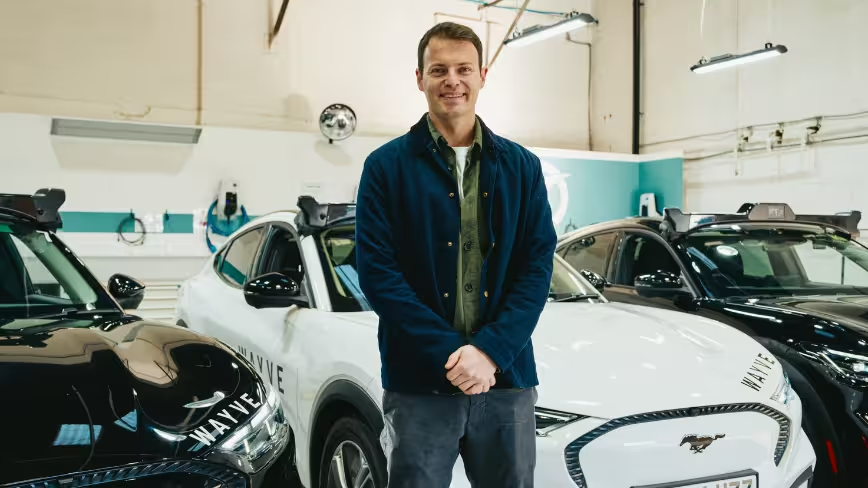
Uber and Wayve began carrying paying passengers in London on 3 September, with a trained, TfL-licensed private hire driver on board every car.
Wayve described the launch in a statement as the UK's first autonomous ride-hailing service.
Transport for London licensed the vehicles as private hire vehicles, not as automated vehicles.
Under the private hire vehicle route a licensed driver must occupy the driver's seat, remain ready to intervene and stay legally responsible for the car throughout every journey, even while software is doing the driving.
Part 5 of the Automated Vehicles Act 2024 came into force on 15 May alongside the Automated Passenger Services permit regulations, creating a scheme run by the Driver and Vehicle Standards Agency that expressly allows trials with or without a safety driver.
The Department for Transport is working towards a broader framework in 2027, with full implementation of the Automated Vehicles Act scheduled for the second half of that year.
Distinct publishers with included, body-backed reporting in this cluster.
thenextweb.com
1 article · September 4, 2026
Follow any of these and your For You feed starts watching them — no settings page required.
invest
Uber and Wayve open London to robotaxis with fewer than 20 supervised cars3 distinct publishers
build
Wayve puts map-light autonomy on Uber's London app with a licensed driver in every seat1 distinct publisher
leadership
Uber aims a 3,300-role cut at its coordination and management layers4 distinct publishers
product
Uber's London licence caps the robotaxi fleet at 15 cars, each with a paid supervisor7 distinct publishers
Evidence-backed comparisons of source perspectives and observed adoption signals. Read the methodology
Which Builder, Operator, and Investor concerns the observed source mix emphasized—not a truth score.
Evidence, demonstrated adoption, hype gap, incentives, and confidence are assessed independently, each on its own current evidence. How these are measured.
One outlet, verifiable statute
TheNextWeb is the only publication carrying this, and it scores as well as it does because its spine is public record rather than briefing: a commencement date of 15 May for the permit route, TfL's private hire licensing and the duty it puts on the person in the seat. Anyone can check those. What cannot be checked from here is the sentence the headline rests on — that nobody in London has finished stage one — which arrives with no regulator, register or filing behind it. The 140,000 opt-ins are Wayve's own count, and the only description of what riding in the car feels like is quoted from Bloomberg rather than gathered.
Paying riders, fifteen cars
Fares are being taken from members of the public in ordinary Uber tiers, which is more than a demo — but the whole thing is fifteen vehicles, no airports, and a licensed human legally in charge of each one. The 140,000 opt-ins are the real signal of appetite and also the awkward ratio: about 9,300 interested riders per car, so almost nobody who opted in will meet one. Real service, rounding-error scale, and none of it driverless.
"Autonomous" is doing some work
The phrase "the UK's first autonomous ride-hailing service" is Wayve's, and it sits directly on top of a licence that legally requires a person ready to take the wheel; the spring expectation of driverless cars for hire by the end of 2026 has quietly become a framework in 2027. So yes, the marketing runs ahead of the vehicle. The gap is modest rather than large because this reporting is the thing puncturing the label — it says plainly that the driver tells you about paperwork, not performance, and that interventions are the number to watch.
The launch-day megaphone
Trace who benefits from each number and the pattern is tidy: Wayve supplies the superlative, the chief executive's quote, the opt-in count and the readiness narrative, with roughly $8.6bn of valuation resting on the claim that a mapless driver generalises from city to city. Uber wins on either legal route, as the piece itself notes when it says the platform can host whichever one prevails. Nobody quoted here has any interest in publishing the one statistic that would settle the argument — how often the driver takes over.
Sturdy law, single witness
Two legs hold: the statutory dates and the licensing duties can be verified independently of anyone's press office. Two wobble: a lone publication and an unsourced assertion about the state of an application queue, which is precisely the claim the whole framing turns on. Day-after launch reporting also has no time to test what it is told, and the Waymo-in-London material is signalling rather than schedule.