Science1 publisher3 min readPublished
Microscopic wave-plate flaws steer leaked laser light away from the detector
A TU Darmstadt-led team found that sub-visible flaws in a quarter-wave plate reshape the light leaking through crossed polarizers into two lobes that mostly miss the detector, which is where the very large suppression numbers come from.
The Scientist · Science desk
What happened
- A research team led by TU Darmstadt reported in Nature Communications that tiny manufacturing imperfections in optical components alter not only a beam's polarization but its spatial shape.
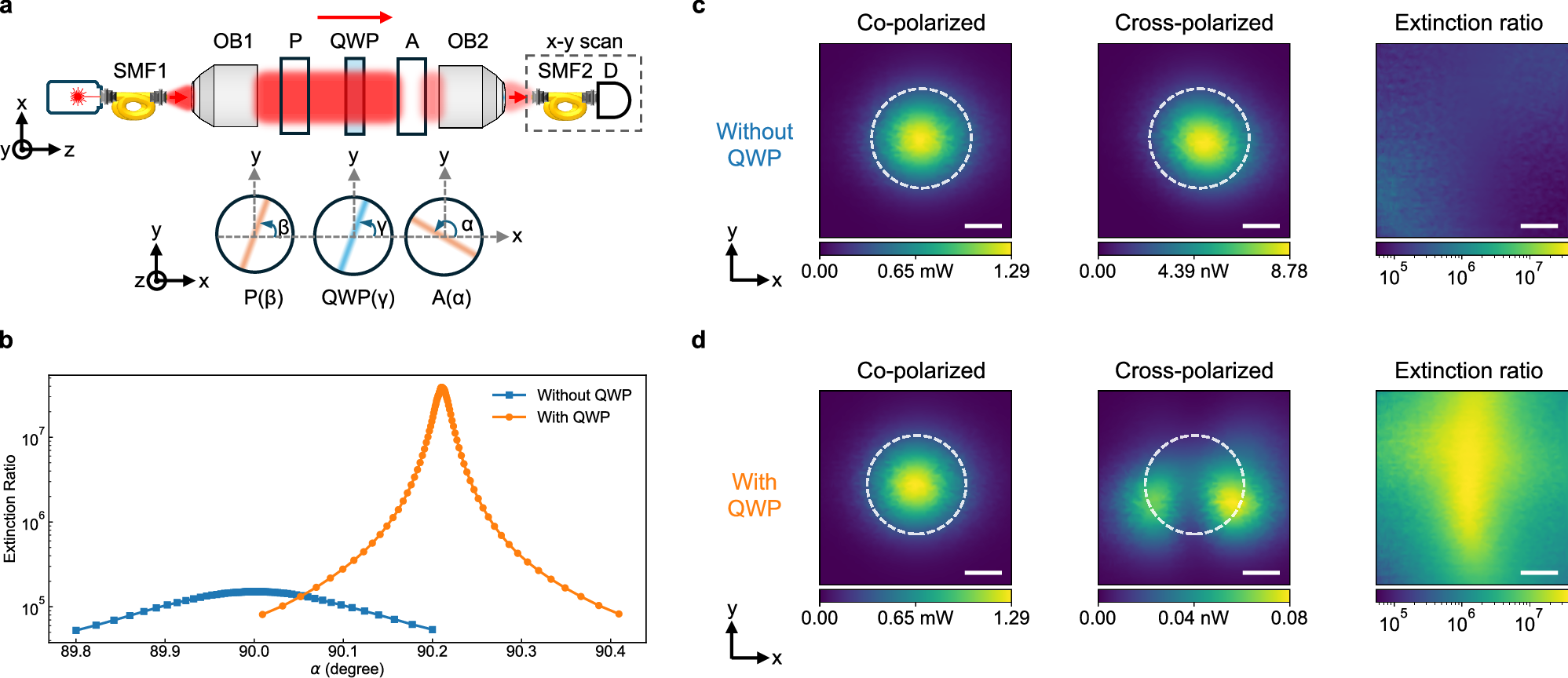
- With a quarter-wave plate inserted between two crossed polarizers, the light that leaked through arrived as a two-lobed dumbbell with a dark centre, and the pattern turned as the plate was turned.
- Widening the laser beam made the pattern stronger rather than weaker, the signature the team had predicted for surface manufacturing imperfections rather than for an already-known optical effect.
Compiled by The ScientistSomething wrong?How this is made
Why it matters
- capability Groups chasing single quantum emitters can gain orders of magnitude of laser rejection from a component already in the beam path, with no new hardware in the budget.
- constraint The headline suppression factor travels badly: it was earned by a mismatch between the leak's shape and the detector, so it belongs to a plate-plus-detection pairing rather than to the optics alone.
- decision Since the behaviour comes from imperfections that do nothing in ordinary use, a lab that wants it has to screen individual plates rather than order the property from a catalogue.
- exposure Any crossed-polarizer experiment that treats a wave plate as mode-neutral now has a named, position-dependent coupling it must rule out before trusting a faint signal's shape.
Crossed polarizers alone left roughly one part in 100,000 of the laser coming through, and inserting a quartz quarter-wave plate between them took that to about one part in 10 million, a gain of a factor of 100 [7][1]. The polymer plate did better than one part in a billion, which is more than 10,000 times the bare-polarizer figure and more than 100 times what the quartz plate managed [8][2][3].
The mechanism behind those gains is geometric. The light that still got through arrived as two lobes with a dark gap between them, and the pattern turned when the plate turned [5]. That shape barely overlapped the detector meant to catch it, so very little of it registered, and the measured suppression improved accordingly [6].
The thing the suppression figure does not measure is how much light left the wave plate. It describes the pairing of one plate with one detection geometry, because the improvement came from a mismatch between the leak's spatial mode and the detector [6]. Read as a specification for polarization rejection, it would be the wrong number.
The part of the work that earns the causal conclusion is the beam-diameter scan. An already-known optical effect predicted the pattern would weaken as the beam grew wider, while imperfections on the plate surface predicted the opposite [10]. The pattern grew more pronounced with wider beams [11], and that is the useful kind of test: the two candidate causes disagree about the sign, not merely the magnitude. Plates of other materials, other wavelengths and numerical simulations pointed the same way [12].
For anyone running crossed-polarizer optics, the load-bearing sentence in the paper is the one about position. The coupling between polarization and spatial mode depends not only on the direction the light travels but on the precise spot where it crosses the component [13]. The leak mode is therefore a function of alignment and beam width, and these effects stay invisible until the main polarization is suppressed hard [14]. That is a real systematic to characterise rather than inherit.
It is also not yet a demonstrated error in anyone's data. The reported account gives the suppression gain and the tests that identified its cause; it does not quantify a weak-signal measurement that this coupling distorted [17]. The team's own framing runs the other way, presenting the effect as a route to better laser rejection in single-emitter work and specialised microscopy [15]. So the suggestion that groups hunting single photons have been quietly absorbing a mode distortion is consistent with the mechanism they identified, and it is an implication of the physics, not a result in the paper.
The practical residue is smaller and firmer: two orders of magnitude of extinction, or more, may already be sitting in components on the bench [7][8][1], available to whoever measures the shape of their leak rather than only its power.
What to watch
- Whether a follow-up measures how the suppression factor changes with detection geometry, such as single-mode fibre coupling or a larger detector.
- Whether the polymer plate's advantage holds across parts, or was a property of the one plate the team happened to have.
- Whether any single-emitter or microscopy group reports this coupling distorting a signal rather than helping to reject a laser.