Invest1 publisher3 min readPublished
Klarna answers spoofed caller ID with an in-app banner in four Nordic markets
Call Status Detection is live in Sweden, Norway, Finland and Denmark, switched on by default on iPhone and opt-in on Android, and Klarna pointed to the ECB's estimate of more than 4 billion euros a year in European fraud to explain why.
The Investor · Invest desk
What happened
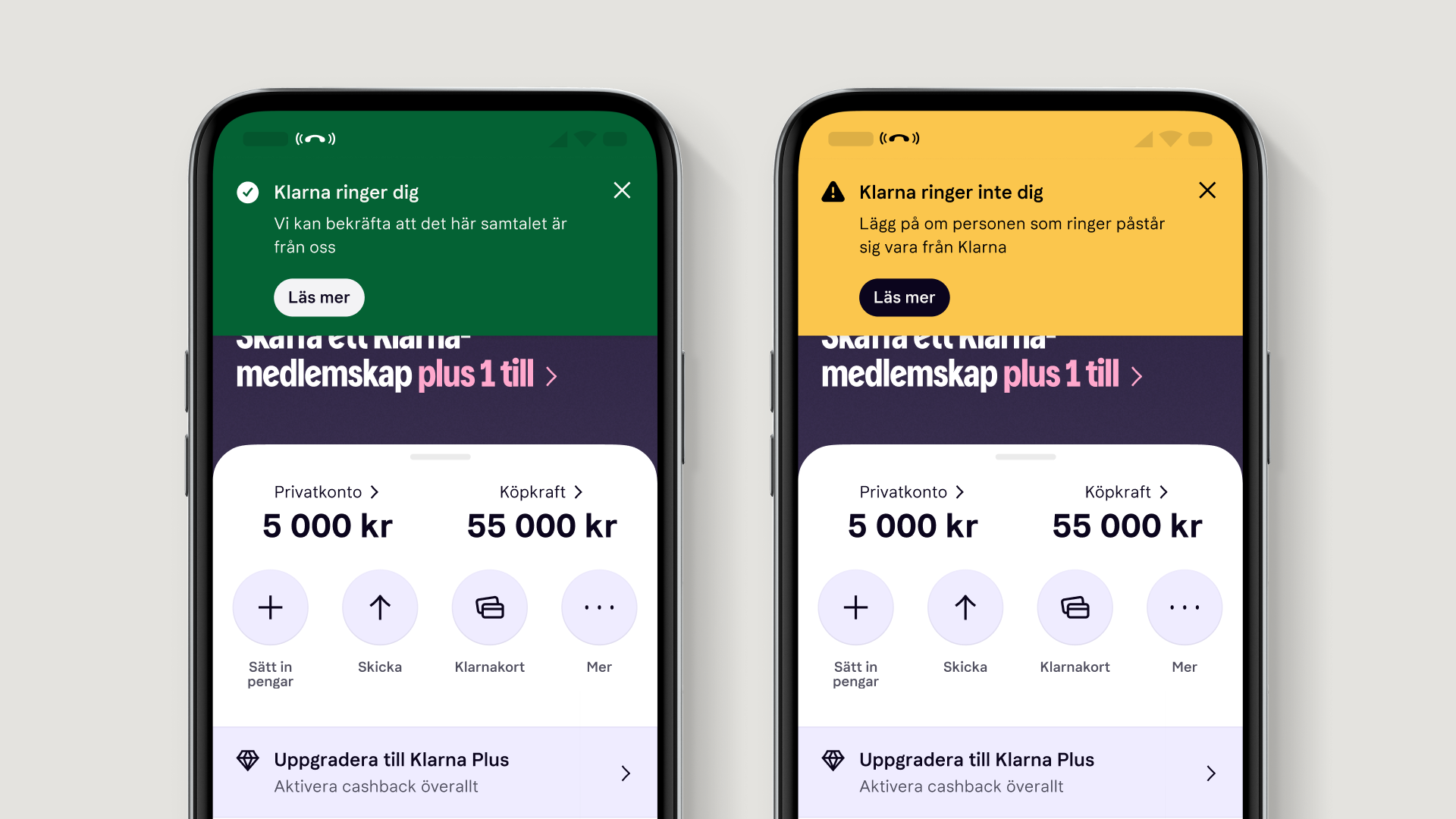
- Klarna's Call Status Detection is live in Sweden, Norway, Finland and Denmark, letting customers check inside the app whether an incoming phone call claiming to come from the company is genuine.
- A green banner means Klarna has confirmed the call and it is safe to continue, while amber means Klarna cannot verify the caller and the customer is advised to hang up.
- Klarna cited the European Central Bank's figure of more than 4 billion euros stolen by fraudsters each year across Europe when explaining the move from written messages into live voice.
Compiled by The InvestorSomething wrong?How this is made
Why it matters
- constraint The protected share of Klarna's Nordic base depends on how many Android owners go into settings, so coverage is an adoption figure and needs reporting separately from the launch.
- capability A customer can test a caller's claim during the call. Klarna's standing policy of never cold-calling for logins becomes checkable while the caller is still talking.
- exposure With green, Klarna vouches for one specific live call. A wrong green is the company's own assurance, given in the moment, about a caller it did not place.
- decision Klarna said more countries will get the feature, so each next market brings the same default-on and opt-in split plus the requirement to confirm its own outbound calls in real time.
Green is the harder half of the design. For a banner to tell a customer that a live call is genuine, Klarna has to know at that second that the person dialling is its own. That means a link between whatever placed the call and the signed-in app session [4]. The company did not describe how that link works. It has also told customers for years that it does not use unsolicited robocalls and does not ask for logins or personal details by phone [9]. So the set of calls that can honestly go green is narrow: the ones the customer was already expecting.
The 4 billion euros Klarna cited is European fraud across the payments system, not Klarna's bill [6]. It works out at roughly 11 million euros a day [15]. Divide it instead by the more than 120 million active users Klarna reports worldwide and you get about 33 euros a head. The quotient measures nothing, since the numerator is Europe-wide and the denominator is global [16]. Klarna did not disclose its own losses to impersonation calls, or what the feature cost to build [17].
Woody Malouf, Klarna's head of financial crime, said impersonation tactics keep evolving and that the company wants to give customers a fast way to push back. Adding live call checks to the inbox, he argued, makes it easier for people to tell what is real and protect their money [8]. Reports in Sweden and neighbouring markets have described waves of fake "Klarna invoice" calls, some of them using AI-generated voices, that pushed people toward BankID logins or transfers [12].
Coverage is the operating decision here. iPhone users in the four markets have the check on by default, and Android users have to open the app's settings and switch it on [5]. Caller ID is easy to fake. That is why the app is the authority [13].
Klarna calls this the first public expansion of its anti-fraud communication tools into live phone verification, and said more countries will get it later [11]. Whether rival payment firms are pressed to match is a claim about competitors, and this rollout is evidence about Klarna. In my view it plays out one of three ways. It stays a trust feature that never appears in a disclosed number, because fraud losses move with whatever the criminals do next and nobody outside the company can attribute the difference. Or the green banner becomes an assurance Klarna has to stand behind, at which point verifying a caller becomes a liability question [4]. Or amber wins: customers hang up on enough unverified but legitimate contact that the phone stops working as a channel for Klarna too. Everything then moves into Klarna Inbox, the mirror of official emails, texts, push notifications and letters it launched earlier in 2026 [7].
The test that would settle the first of those is narrow and public. Klarna trades on the NYSE as KLAR [1], so a reported fall in impersonation-related losses in the four Nordic markets, set against markets without the banner, is the evidence. Finnish coverage of the rollout put the customer rule plainly: if the app cannot confirm the call, treat it as unverified and end it [14].
What to watch
- Which market Klarna names next and on what date. It has said more countries will get the feature but has not named them.
- Any Klarna disclosure of impersonation-related losses in the four Nordic markets before and after the banner went live.
- Whether Android enablement rates are published. With the setting off by default, enablement is what turns the launch into coverage.