Leadership1 publisher3 min readPublished Updated
The withdrawal cleared every control the Liquid Federation actually operates, which is why an 11-of-15 quorum released the bitcoin in 23 minutes. Recovery now depends on whoever holds the coins answering an email address.
The Board Room · Leadership desk

Compiled by The Board RoomSomething wrong?How this is made
Twenty-three minutes separated the order from the payout. SideSwap logged 4,000 L-BTC arriving at its peg-out service at 14:05 UTC, and the Liquid Federation paid 3,996 BTC to the customer's bitcoin address at 14:28 [3][1]. Mainchain funds require an 11-of-15 federation multisignature, and the Peg-out Authorization Key system is meant to confine payments to approved wallets [8]. By Blockstream's own account, neither of those broke: the SideSwap PAK used was not compromised, and nor was any other key [7]. What failed sat upstream of everything that held, because the L-BTC presented for burning had been created by a bug in the Elements software [4]. A quorum can only check the transaction in front of it, and this one was correctly authorised.
Onchain researcher Ergo BTC flagged the two linked transactions, including a follow-up that spent about 3,998.5 BTC and carried a message reading "we are whitehats. contact us on chain" [11][10]. As of roughly 3 p.m. EDT, neither Blockstream, Liquid nor Adam Back had addressed it publicly; the Liquid Network account confirmed the incident at 4:25 p.m. [20]. For more than an hour, the people deciding whether to halt L-BTC exposure were working from a sleuth's thread and a swap marketplace's post rather than the operator's.
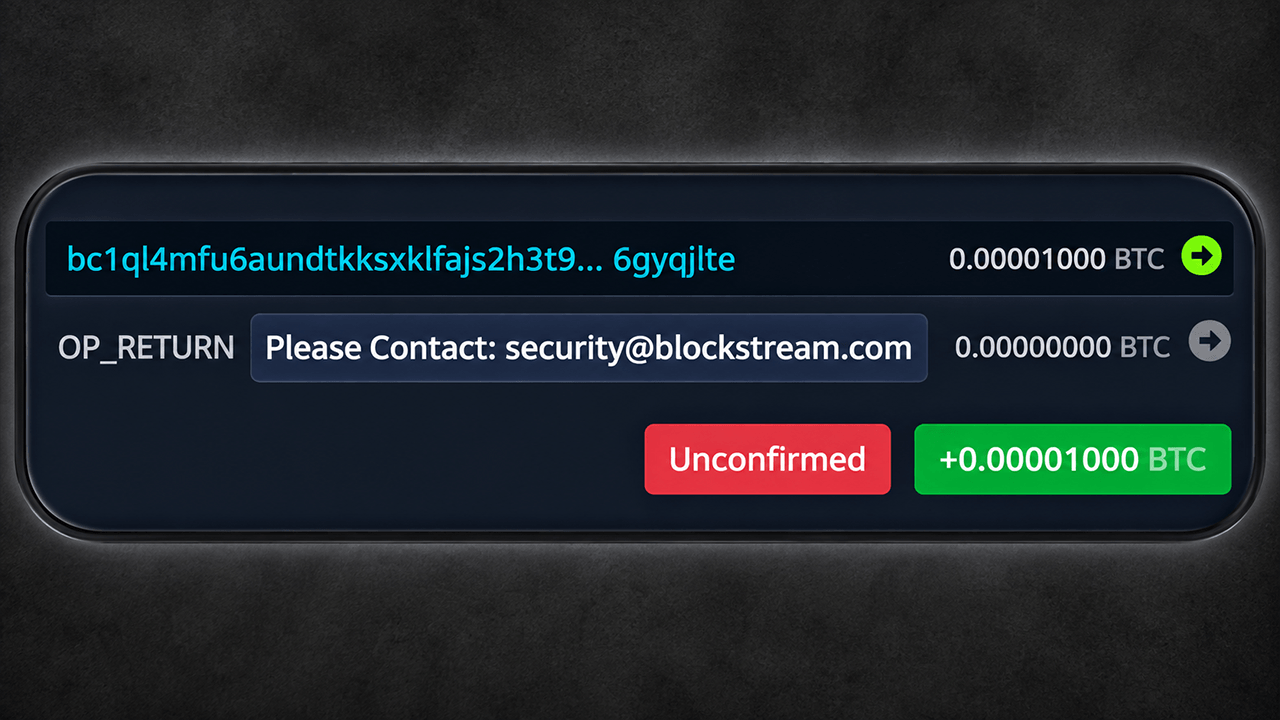
The operator's containment worked as designed, but recovery depends on a different instrument entirely. Bridge nodes were disabled so no new transactions can be submitted, exchanges were notified to pause L-BTC deposits and withdrawals, and unrelated Liquid assets including USDT and DePix were left running [15][6][16]. Blockstream's channel to the party holding the bitcoin is an OP_RETURN reading "Please contact [email protected]" [5], sent to an entity identified only by its own claim. Ledger CTO Charles Guillemet said the parties have asked to be reached on Signal, that this does not look like usual white hat practice, and that they might be well-intentioned people who played intensively with recent LLMs and are unused to responsible disclosure [12]. Bitcoin.com's own coverage warned that treating the message as proof of good intent gets ahead of the evidence, listing a compromised whitelisted wallet and abuse of Liquid's security mechanisms as unexcluded alternatives [18].
The coins are sitting in plain view on Bitcoin and had not obviously been mixed, which is how many white hat returns begin [17]. That is true, and visibility is not the same as recall. Blockstream's explorer showed 207.275 BTC where roughly 4,200 had backed the network for months, leaving about 5 percent of the reserve in place [9][2]. If nothing comes back, the $320 million is around a tenth of the $3.2 billion valuation attached to Blockstream [2][19][3]; a valuation is not cash, so that ratio sizes the hole against the firm without telling you a backstop exists.
What the record does not say is who owes the difference between 207.275 BTC and the L-BTC still outstanding. No statement from Blockstream, the federation or SideSwap in this material addresses it [7][3][9]. That silence is the part a treasury has to price, because it separates this week's problem from this decade's: this week the sidechain is paused and Aqua users have lost Liquid functionality while their bitcoin transactions keep working [14]; over a longer horizon, the question is whether a federated peg has a recovery step with an owner. On the evidence so far, its operator holds one lever, the pause, and the return is held by someone else.
Ranked by verification strength, evidence, and original report placement.
The Liquid Network, a Bitcoin layer-two sidechain, paused on Sunday following a so-called white hacker exploiting a bug in Blockstream's Elements software, according to the X account of Sideswap, Blockstream's atomic-swap marketplace.
Blockstream paused the Liquid network after roughly 4,000 BTC, worth $320 million, was withdrawn from the Liquid Federation wallet on Sept. 6 by so-called white hat hackers.
Blockstream said it is attempting to contact the white hats onchain and responded onchain with an OP_RETURN message reading "Please contact [email protected]".
Blockstream's Liquid Network said exchanges have been notified and have already paused, or will pause, LBTC deposits and withdrawals.
Onchain researcher Ergo BTC flagged two linked bitcoin transactions, including a large Liquid peg-out of roughly 4,000 BTC from a pool of about 4,200 BTC, with a follow-up transaction that spent approximately 3,998.5 BTC and included the "whitehats" message.
Blockstream said bridge nodes have been temporarily disabled so no new transactions can be submitted to the network, effectively pausing the Liquid sidechain until the issue is resolved.
Follow any of these and your For You feed starts watching them — no settings page required.
Evidence-backed comparisons of source perspectives and observed adoption signals. Read the methodology
Which Builder, Operator, and Investor concerns the observed source mix emphasized—not a truth score.
Evidence, demonstrated adoption, hype gap, incentives, and confidence are assessed independently, each on its own current evidence. How these are measured.
Chain data hard, causation secondhand
The quantities can be checked by anyone: Ergo BTC's flagged peg-out and follow-up spend were public before the parties spoke, and the 207.275 BTC balance sits in Blockstream's own explorer. Causation is a weaker layer. SideSwap's Elements finding, the assurance that the peg-out key survived intact, and the Confidential Transactions theory all come from the teams involved, and Mow himself says the developers cannot confirm where the flaw lives.
Halts on every Liquid surface
The consequences are already logged rather than projected: bridge nodes off so nothing new reaches the chain, LBTC deposits and withdrawals stopped at exchanges, and the Aqua wallet's Liquid side down while its bitcoin transactions continue. The blast radius is narrower than the headline number suggests, since Blockstream places USDT, DePix and tokenised assets on Liquid outside the incident.
'White hat' ahead of the proof
The phrase doing most of the work in this story is 'whitehats', and it originates with whoever holds the coins; Blockstream's own careful wording is 'purported'. Ledger's Charles Guillemet notes the withdrawers have since moved to asking for Signal contact, which is not how disclosure normally goes. news.bitcoin.com says plainly that the message proves nothing, then gives several paragraphs to an LLM-discovery theory it admits Blockstream never supported.
The affected parties are the sources
Blockstream, its own SideSwap marketplace, and JAN3 — whose Aqua wallet needs Liquid running — supply nearly every causal detail, including the reassuring ones: that no key was compromised and that the rest of Liquid's assets are safe. The reporting comes from a bitcoin-industry outlet whose two pieces lean on those X accounts, and no federation member, auditor or exchange is quoted independently.
Firm on the movement, open on the mechanism
What moved and what is switched off can be stated without hedging. The mechanism, the identity and intent of the withdrawers, and whether any bitcoin returns are all unsettled, and the only recovery channel described anywhere in this reporting is an email address written into an OP_RETURN message.
invest
Bitcoin's cross-layer plumbing had one supplier, and the stand-in is still invite-only1 publisher
invest
4,200 BTC walked off Liquid behind an on-chain note claiming white-hat intent1 publisher
invest
Coinkite now makes Coldcard owners roll dice, after $130M walked out of air-gapped wallets1 publisher
invest
Liquid's $320M peg-out ran on an authorization key reported unbreached1 publisher
Publishers with included, body-backed reporting in this cluster.
2 articles · September 6, 2026