Product1 distinct publisher3 min readPublished
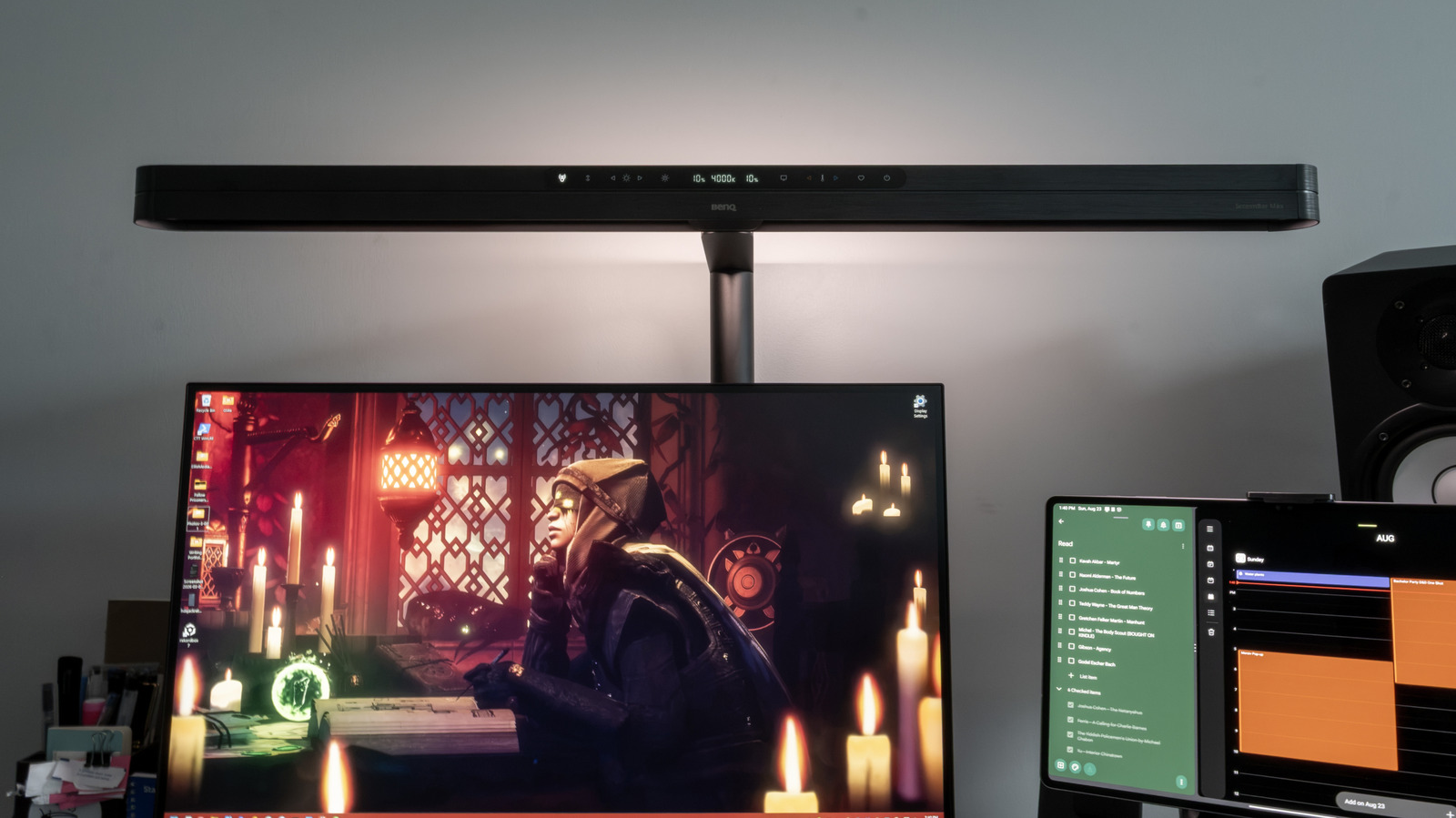
The ScreenBar Max is the first ScreenBar built to span two monitors. At $289, plus $39 for the stand, it moves desk lighting out of the accessory bin and into the expense-approval queue.
The Product Desk · Product desk

Compiled by The Product DeskSomething wrong?How this is made
Engadget's reviewer put the trade plainly: for the price of one ScreenBar Max you could buy four or five cheaper lamps that would deliver most of the same functionality, minus the premium feel [6]. Run the division and that comparison quietly sets a ceiling on the alternatives, somewhere around $58 to $72 each [7]. That is the figure the Max has to beat, and not per lamp but per desk: one fixture spanning two screens against two ordinary bars whose brightness and colour you match by hand, forever.
What the money buys that a cheap bar does not is the mmWave presence sensor, which brings the lamp up as you arrive at the workstation [8]. The review is specific about the failure modes it went looking for and did not find: a desk beside a door, foot traffic in and out, a chair pushed in from behind, none of which triggered it, with illumination arriving only once the reviewer sat down [9]. It ramps rather than snapping on [10]. That is the one feature here described as working in practice rather than as a spec line.
The seams show in the control scheme. Bias light and desk light have independent brightness, but they share a single colour temperature across a 2,700K to 6,000K range [4][5], and changing either one means cycling a single mode selector through bias, desk and both until you land on the right target, which the reviewer called a step or two more than necessary [11]. So the product sold as two lights is one light with two outputs: no warm wash on the wall behind a cool task pool, and no direct route to the setting you want.
The optical claim is BenQ's own. Ra at 95 or better, Rf above 96, Rg near 100 [12], which the reviewer said he could find no cause to doubt, having seen no harshness, flicker or heat [13][14]. That is an honest read, but it is a five-day preliminary impression from one publication [15], not a meter. Anyone buying a dozen of these for a colour-critical team is buying on the vendor's rating and a favourable first look.
The pitch that actually carries the price is medical, not aesthetic. The mechanism the source describes is contrast: light from the screen against the dark wall behind it, aggravating strain and, over time, computer vision syndrome [16]. That is the argument that survives a purchasing conversation, and BenQ has built the first ScreenBar wide enough to cover two monitors at once [2] on the assumption that the two-screen desk is now the thing worth covering. If that assumption holds, the interesting part is not the lamp. It is that a category which lived at accessory prices now has a $289 top end [3], and a sensor doing work that cheaper bars have no answer to.
Ranked by verification strength, evidence, and original report placement.
BenQ is launching two new monitor light bars, the most notable of which is the ScreenBar Max.
The ScreenBar Max is the first ScreenBar designed for dual-monitor setups, and is large enough to stretch across two monitors while also illuminating a large desk.
The ScreenBar Max costs $289, with another $39 for the optional stand, making it far and away the most expensive ScreenBar product from BenQ to date.
The ScreenBar Max allows the brightness of the bias light and the desk light to be controlled independently of one another.
Colour temperature, with a range of 2,700 to 6,000 Kelvin, is fixed across both the bias light and the desk light.
Engadget's reviewer wrote that for the price of the ScreenBar Max you could buy four or five cheaper lamps which, while they might not feel as premium, would offer most of the functionality.
Follow any of these and your For You feed starts watching them — no settings page required.
Evidence-backed comparisons of source perspectives and observed adoption signals. Read the methodology
Which Builder, Operator, and Investor concerns the observed source mix emphasized—not a truth score.
Evidence, demonstrated adoption, hype gap, incentives, and confidence are assessed independently, each on its own current evidence. How these are measured.
One hands-on, vendor spec unmeasured
Hardware behaviour claims come from direct first-party use - presence sensing, ramp-up, glare, control layout, 700-lux auto-dim - which is real evidence but from a single reviewer over five days with a supplied sample. The headline quality claim (Ra >=95, Rf >96, Rg ~100) is BenQ's own specification accepted on subjective agreement, with no instrument measurement, and no competing product is named or tested.
Launch-day availability only
The only adoption datapoint is the product's launch with published pricing plus one reviewer sample in use. No sales figures, retail channels, deployment counts, workplace standardisation or third-party purchase evidence appear in the supplied material.
Mildly overstated
The framing - 'studio grade', 'pristine', 'heavenly', 'I've rarely felt more like Tony Stark' - runs ahead of what is actually demonstrated: an unmeasured vendor colour spec, five days of use, and the reviewer's own concession that four or five cheaper lamps would cover most of the functionality. The gap is modest rather than large because the article is unusually explicit about its price scepticism, its preliminary status and its adjustability and control-flow complaints.
Affiliate revenue plus vendor sample
The article carries an explicit disclosure that the publisher may receive a commission on purchases made from its links, and the assessment is based on a review sample supplied for a same-day launch story. Both point to commercial alignment between coverage and purchase conversion; the disclosure itself and the frank price criticism are mitigating factors.
Single publisher, single tester
Product facts such as price, dimensions of use case, sensor type and control features are straightforward and consistently reported, so the descriptive layer is reliable. But there is exactly one publisher, one tester, one desk configuration and one five-day window, no measurement instrumentation and no adoption data, so judgements about quality-per-dollar and durability carry low confidence.
product
Pixel's Bluetooth diagnostics changes the triage order, not the fix list1 distinct publisher
product
Asus fixes the one OLED flaw desk buyers cared about, then coats it in a mirror1 distinct publisher
product
Newegg's GPU trade-in charges 24 to 63 percent for the privilege of not listing on eBay1 distinct publisher
build
China's accelerator swap makes Cambricon supply, not export policy, your ship-date risk1 distinct publisher
Distinct publishers with included, body-backed reporting in this cluster.
1 article · August 25, 2026