Build1 publisher3 min readPublished
Astra's shortest chain-task traces can shrink to a list of intermediate numbers, but not all runs do
A LessWrong analysis of Neel Nanda's nocot-bench finds Astra using far fewer reasoning tokens than Luna, Terra and Sol at reasoning_effort=low, with its shortest chain runs landing 4 to 7 tokens above a minimal answer.
The Engineer · Build desk
What happened
- Astra spent significantly fewer reasoning tokens than the earlier models it was compared with, across five nocot-bench task types run at reasoning_effort=low.
- On chain tasks, Astra's shortest run at each step count came in 4 to 7 tokens above a minimal answer list, which the author takes as evidence each rule was applied inside one forward pass.
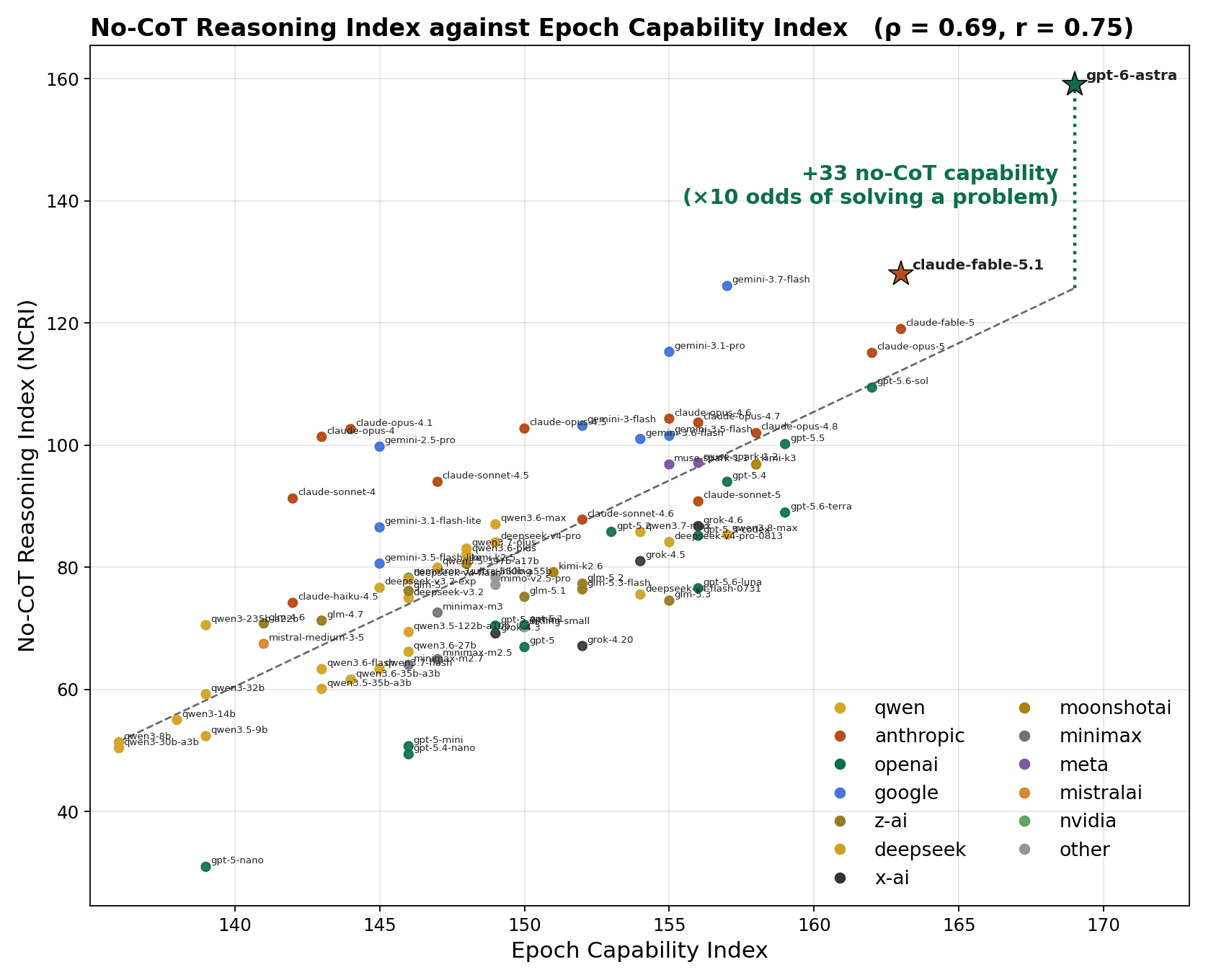
- Nanda's no-CoT results have Astra solving chain tasks of up to 6 steps correctly with no trace, and the post concludes it is not fully using that capability at the low effort setting.
Compiled by The EngineerSomething wrong?How this is made
Why it matters
- constraint A trace that lists only the value after each step hands a monitor the state and leaves the operation to be inferred. Any check keyed on the operation the model describes loses resolution at this setting.
- decision The comparison exists only for the cheapest reasoning mode inside one provider's family. A team running agents at medium or high effort has to re-measure before treating trace length as stable.
- contradiction The two readings pull apart: token counts collapse, and the same runs still print every intermediate value. A general claim about traces going dark overstates what was measured here.
A chain task in nocot-bench is a starting number, an ordered list of rules, and a wraparound applied after every step: if the number is bigger than 20, subtract 20; if it is smaller than 1, add 20 [6]. Rules come in three flavours: halve and round up, a parity rule, and a threshold rule that subtracts a constant when the value is above 10 and doubles it otherwise [7]. The minimal solution to the post's 3-step example writes the start and the value after each step, "14, 7, 14, 7", counted at 10 tokens, or 7 with the spaces taken out [8].
Astra's shortest run at each step count sits 4 to 7 tokens above the compressed baseline [10]. For the 3-step case that puts the shortest trace at about 11 to 14 tokens against a 7-token version of the same list [1]. Framing text accounts for the difference. The comparison against 10, the subtraction, the doubling and the wraparound check never reach the text, so on those runs each rule was applied inside a single forward pass [10].
Nanda's post last week reported Astra scoring significantly higher than previous models on no-CoT benchmarks [15]. The analysis asks how much of that capability shows up in practice, and the setup pushed toward short traces. Models were told to output only their answer, at reasoning_effort=low, with no other attempt to steer the chain of thought [4]. The stated reason for looking at that setting is training pressure toward token-efficient CoTs, which should be strongest in Astra's cheapest and fastest reasoning mode [3]. The three siblings did not respond the same way; their token counts suggest they verbalized the work behind each rule instead of only the values, apart from five runs where Sol emitted no CoT at all [11].
Whether any of this transfers to a monitored agent depends on things the analysis did not test. The tasks are programmatically generated with a difficulty parameter [2]. Five task types were used, two serial, two parallel and one search, each with at least 20 tasks at the highest difficulty [4]. Each model ran twice per chain task [9]. The whole comparison sits inside one provider's family, picked because those four models share the same reasoning effort options [1]. No tool call appears anywhere in it, and no run went above reasoning_effort=low.
The post's own conclusion cuts against the strong reading. Nanda's no-CoT results have Astra answering chain tasks of up to 6 steps correctly with no CoT at all [12], so at reasoning_effort=low it is writing down values it can hold internally [13]. The author puts that down to error rate: working at the no-CoT capability boundary may carry a higher risk of errors, and errors "multiply" in many-step reasoning [14].
In my view the finding worth carrying is narrower than a general claim about opaque traces. On this task type at this setting, the trace still fixes the model's state after every step, and a reader can verify the final number while inferring each rule from the jump between values. A monitor keyed to the state sequence gets what it always got, while one keyed to the operation the model describes gets less than it got from Sol [11].
What to watch
- Whether the same token-count gap appears at medium and high reasoning effort on these five task types.
- Whether Astra's CoTs shorten the same way on agent traces with tool calls, not just programmatically generated bench tasks.
- More than two runs per chain task, which would show whether the shortest traces are typical or outliers.