Invest1 publisher3 min readPublished
Anthropic cuts Opus 5.5 prices 20% on tokens, 60% on cache reads, citing fewer tokens burned for 40% total savings
Every token price on Claude Opus 5.5 fell 20% except cache reads, which dropped 60% to 20 cents a million. For the advertised 40% saving to come from price alone, half a buyer's Opus 5 bill has to be cache reads.
The Investor · Invest desk
What happened
- Anthropic released Claude Opus 5.5 on Tuesday, saying it matches its pricier Fable 5.1 on most work and costs about 40% less than Opus 5 on typical workloads.
- Input tokens fell to $4 per million and output to $20, each 20% below Opus 5's $5 and $25, with cache writes down to $5 from $6.25.
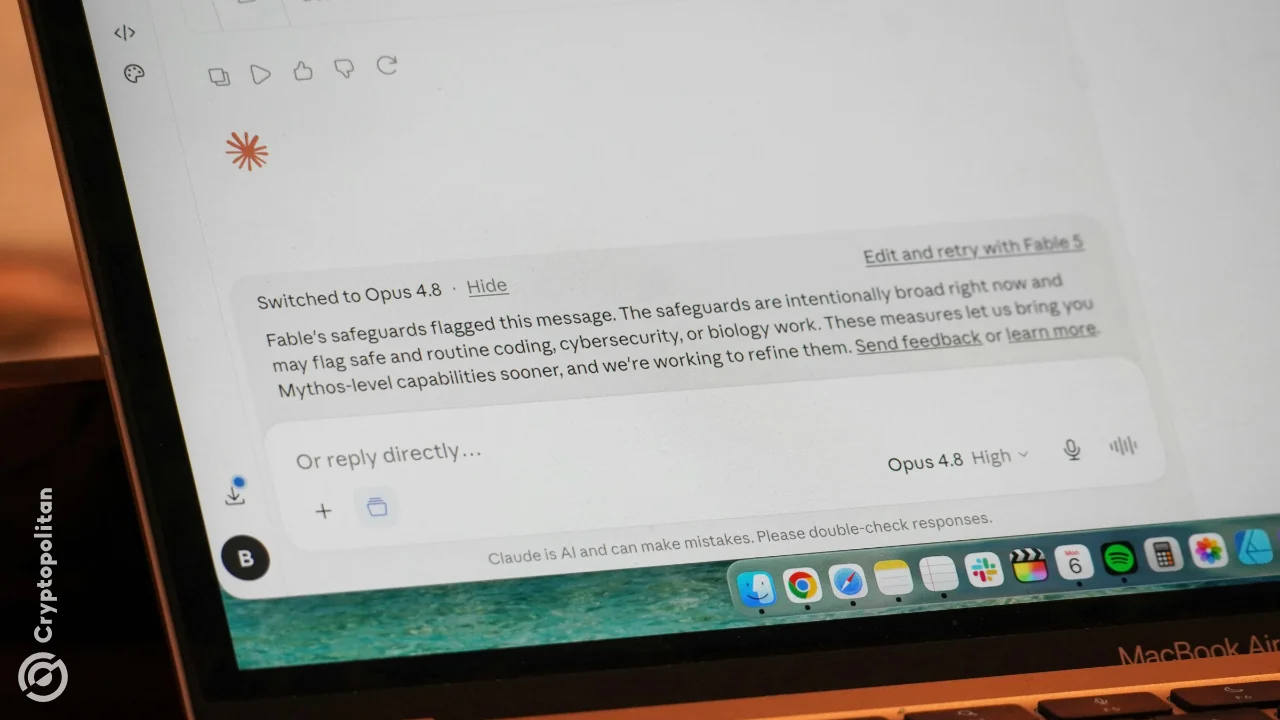
- Most cybersecurity tasks sent to Opus 5.5 are rerouted to the older Opus 4.8, and biology work runs through a new Life Sciences Verification Program for vetted organizations.
Compiled by The InvestorSomething wrong?How this is made
Why it matters
- decision Anyone sizing an agentic budget has to pull its cache-read share before crediting the 40%: at half the bill in cache reads the headline holds, and well below that the cut is nearer a fifth.
- cost Paying for Opus 5.5's eight-point AutomationBench lead costs about 94 cents more per task than GPT-6 Sol, roughly 12 cents a point, and buyers on volume work will feel that per-task gap before they feel the token discount.
- constraint A team that picked Opus 5.5 for security automation is served by Opus 4.8 on most of that work, so the capability it chose is not the one running the job.
- contradiction Token prices down 20 to 60% sit against the forecast Cryptopolitan reported of inference cost per agentic workflow rising more than fivefold by 2028, which puts consumption rather than list price in charge of the bill.
Every line on the new price sheet moved 20% except one: input from $5 to $4 per million, output from $25 to $20, cache writes from $6.25 to $5, and cache reads from $0.50 to $0.20, which is 60% [2][3][4][1]. Anthropic says the saving comes from two places, cheaper tokens and the model burning fewer tokens per job [5].
Take the price half on its own. Half the bill in cache reads gets you to the headline: 0.5 times 0.4 plus 0.5 times 0.8 is 0.6, a 40% cut [2]. Below that share the saving slides toward 20%, so a team whose spend is mostly output tokens gets a fifth off [2].
The consumption half carries the bigger numbers. Anthropic said a tester audited and repaired a 200,000-line codebase in under three hours, work that took Opus 5 more than 20 hours and 2.5 times the tokens [11]. At 40% of the tokens and 80% of the price, that job runs at 32% of the old cost, and 16% if it is cache-read heavy [3]. Another tester migrated 680,000 lines of code in less than a day [12].
Against Fable 5.1 at $10 and $50 per million, Opus 5.5's base rates are 60% lower on both lines [6][6]. An internal test translated the HAProxy load balancer from C to Rust in 9.5 hours against Fable's 12, at 51% less cost [13].
The OpenAI comparison runs the other way. GPT-6 Sol launched the same Tuesday at $2 and $10 per million, half Opus 5.5's base rates [18]. On Zapier's AutomationBench, Cryptopolitan reported Opus 5.5 at 40.0% for about $1.28 a task and Sol at 32.0% for $0.34 [19], which is 31 points of score per dollar against 94 [4]. Anthropic said benchmark margins are a weaker guide to real differences at this capability level [10].
In my view the cache-read line is the one that will show up in bills, because Anthropic says cache reads drive most of the cost in coding and agentic work [4]. The counter-case is plain: a shop whose spend is mostly output tokens sees 20% and stops there [1][2]. Anthropic did not disclose what serving those tokens costs it, and a cut of this shape is consistent with cheaper inference and with buying share at a thinner margin.
Consumption is what would undo the budget case. Cryptopolitan has reported a forecast that inference cost per agentic workflow climbs more than five times by 2028 [20]. Cheaper tokens do not contradict that forecast; they lower the rate at which a longer loop bills. Opus 5.5 is on the API as claude-opus-5-5 and on Amazon Web Services, Google Cloud and Microsoft Azure [21].
What to watch
- Pricing for Claude Sonnet 5.5 and Haiku 5.5, due in the next few weeks, which sets the floor for routing cheap agent steps.
- Whether OpenAI moves GPT-6 Sol below $2 and $10 per million after Anthropic's cut.
- Whether Anthropic lifts the cybersecurity routing to Opus 4.8 once further external evaluation is done.