Loading today’s stories
Invest1 distinct publisher2 min readUpdated
Anthropic's $2T target prices a run rate, and the run rate needs permits
The $65B figure is one month's revenue times twelve; the quarter that closed produced $11.6B. Seven in ten Americans say they don't want a data center near them.
The Investor · Invest desk
What happened
- Anthropic could seek a valuation of about $2 trillion in its planned IPO.
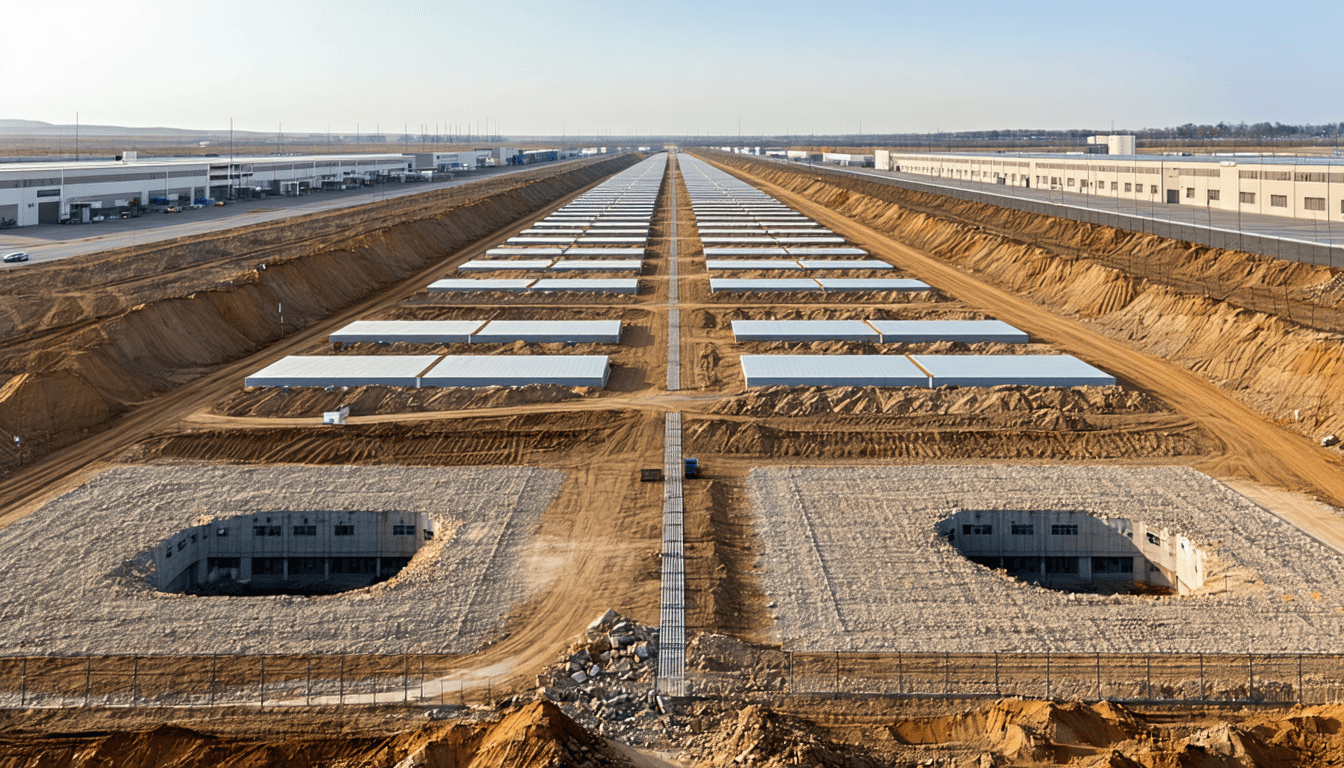
- Public opposition to AI data centers is emerging as a major risk for Anthropic and is expected to appear as a serious risk in the company's IPO papers.
- Last month Anthropic moved above $65 billion in annualized revenue.
- Anthropic made $11.6 billion in revenue during the second quarter.
- Anthropic quietly filed to go public in June, with an offering that could become one of the biggest public stock listings ever.
Compiled by The InvestorSomething wrong?How this is made
Why it matters
The quarter that has actually closed produced $11.6 billion [c3b], which annualizes to $46.4 billion [2]. To hold a $65 billion run rate you need roughly $5.4 billion in a single month, against a Q2 average of about $3.9 billion, so the exit month sits some 40 percent above the quarter it followed [5]. Both numbers can be honest. They are not interchangeable inside a multiple: $2 trillion is about 31 times the run rate and about 43 times the annualized quarter [3][4].
The growth claim has the same seam. Two investors told the New York Times to expect Anthropic to point to more than tenfold revenue growth against the prior year [10]. The two run-rate figures on the record, $9 billion at the end of last year and $65 billion last month [16], divide to 7.2 times [1]. Either a different pair of numbers is doing the work, or the pitch is ahead of the disclosure.
That gap matters because of where the compute is actually decided. Anthropic does not build the sites; it pushes its infrastructure partners to build faster, as OpenAI does [11]. So the constraint never appears as an Anthropic capital line. It appears as a partner's schedule slipping, over questions about how much electricity, land and infrastructure a site needs [18]. Gallup's May figures put local opposition at close to three to one against local support [6], with almost half of respondents strongly opposed [7] and roughly a quarter in favour [8].
The benchmark Cryptopolitan reaches for is SpaceX, whose listing last month it reports raised $85.7 billion, the largest IPO ever conducted [12], with Anthropic expected to clear that if the valuation holds [13]. Those are different quantities. One is cash raised, the other a target market value, and nothing disclosed says what fraction of the $2 trillion is for sale.
The pricing assumption is where the two risks meet. Anthropic has told early investors that stronger models will let it keep charging more while rivals go cheaper [14], and investors are already asking how that holds as open-weight models spread and undercut it [15]. A compute shortfall attacks that assumption at the root, because the premium is paid for capability, and capability is bought at sites somebody local has to approve.
Loading topic controls
Loading related stories