Science1 distinct publisher3 min readPublished
After four or five years of cultures that would not grow, a UNSW-led team finally had something it could image. The result gives eukaryogenesis a living analogue for the stage before one cell ended up inside another.
The Scientist · Science desk

Compiled by The ScientistSomething wrong?How this is made
The tubes belong to the bacterium. That sits oddly against the account the Current Biology paper is testing, in which the archaeon becomes the host and the bacterium becomes the organelle that turns into mitochondria [7]: in these tomograms the structure doing the reaching is the partner slated to be engulfed [3]. Nothing in the pictures forbids the usual reading, but what they show is a geometry of contact and trade between the two cells.
Electron cryotomography answers the geometry question well and the traffic question not at all. The method resolves structure at a millionth of a millimeter [11], which is one nanometer [12], fine enough to show whether a tube's lumen runs continuously between two cells. It also works on cells frozen mid-life, so each tomogram is a still. The chemical half of the claim is described in the release as apparent rather than measured [14]; watching material actually move, and establishing which way it goes, is a labeling experiment rather than an imaging one.
Then the control. The dependence reading of the failed pure culture is Burns's [10]; mine is narrower. No growth under the media and conditions tried over four or five years [9] is consistent with obligate dependence, and also with a nutritional requirement nobody has guessed yet. Asgard archaea are known to be hard to cultivate away from their habitats [19], which is exactly why absence of growth is weak evidence about need. The distinction matters because the co-culture is now the experimental system, and it has no partner-free arm to compare against.
What the work does deliver is the thing the field genuinely lacked: a documented case of what an early archaeon-bacterium partnership looked like, rather than a reconstruction pieced together after the fact. Direct evidence of what an early archaeon-bacterium partnership looked like has not existed [8], and this group's members have mostly been known from DNA pulled out of samples by sequencing rather than from cells in hand [15]. Burns calls the pair "a little model for how these kinds of partnerships started and ultimately formed eukaryotes" [16]. That is about the right size of claim: it says a mechanism was physically available, illustrated by this one pairing, even though the group is thought to sit close to eukaryote origins [6].
What remains unknown is how common the arrangement is. The University of New South Wales release, dated September 3, does not report in how many cells or tomograms the connection appeared [18][17], so a junction between two species in one Western Australian mat [4] stays a single observation until somebody counts. The lead I would chase is the archaeon's own output: chains of budded vesicles and elaborate tube-like structures of its own making [13]. Vesicle traffic is a eukaryotic habit, and it is worth knowing whether these are standing architecture or a response to being cultured. Stromatolites already earned their place in the oxygen story [20]; whether they preserve a working version of the next transition depends on numbers nobody has published.
Ranked by verification strength, evidence, and original report placement.
The study of a newly discovered microbe living in close association with another organism inside stromatolite communities was published in Current Biology.
Researchers captured the first direct images of an Asgard archaeon physically connected to a bacterium, with the two microbes appearing to exchange nutrients and other compounds.
The images showed the archaeon and the bacterium physically connected by extremely thin, tube-like connections called bacterial nanotubes.
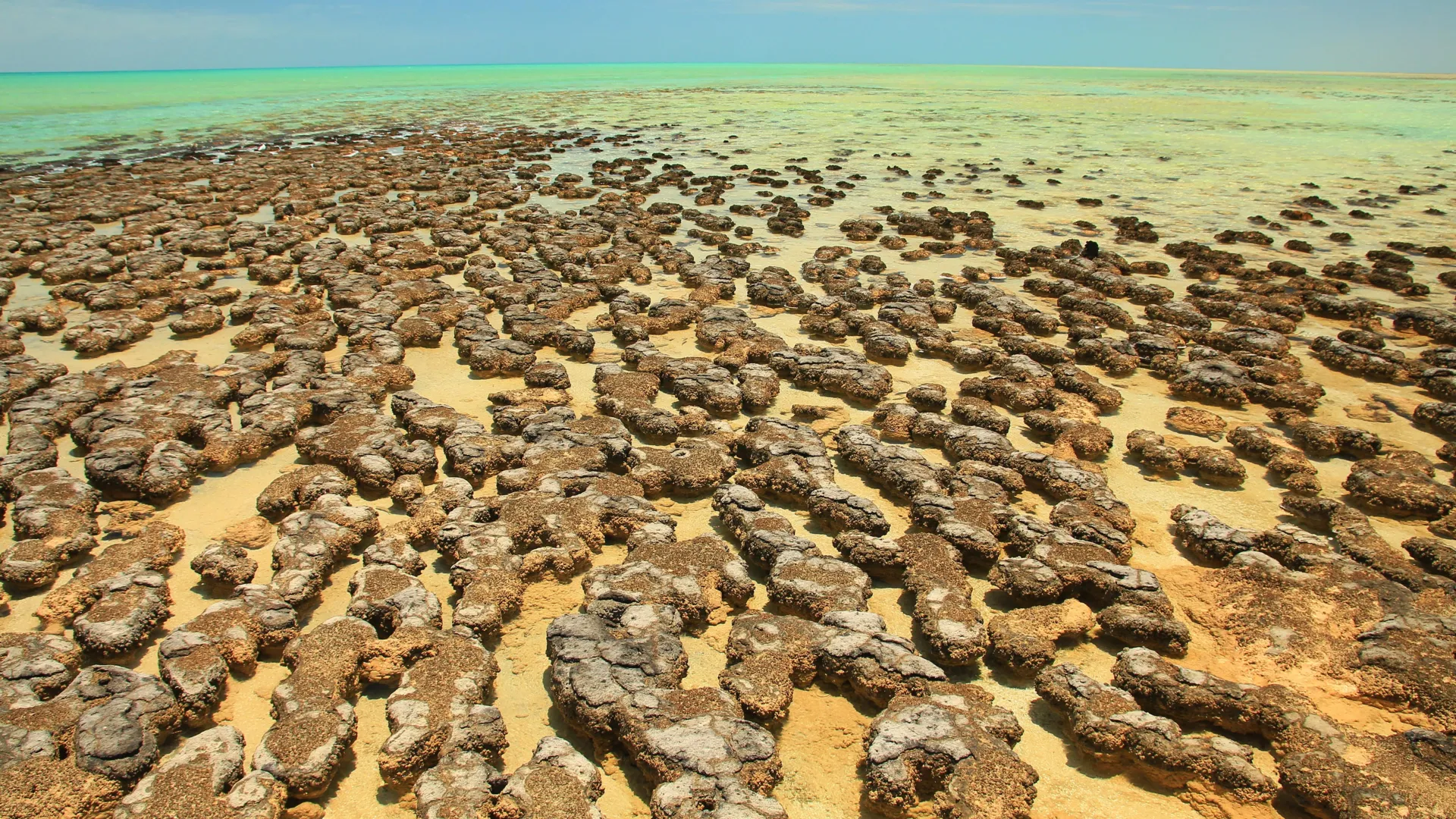
Samples were collected at Shark Bay, a World Heritage-listed site in Western Australia where stromatolites and microbial mats still form today, and led the team to isolate a member of the Asgard archaea.
Associate Professor Brendan Burns, an evolutionary microbiologist at UNSW Sydney, is part of the research team; the project was co-led with researchers from the University of Technology Sydney and The University of Melbourne.
Asgard archaea are believed to be closely related to the ancestors of eukaryotes, the cells that make up all plants and animals.
Distinct publishers with included, body-backed reporting in this cluster.
1 article · September 3, 2026
Follow any of these and your For You feed starts watching them — no settings page required.
science
Cats leave a 13-compound calling card in urine, and the kidney may be the warehouse3 distinct publishers
science
Tagged blue whales pinpoint their feeding along the ocean's narrow thermal fronts1 distinct publisher
science
Queens survive pesticides by loading their eggs, which makes queen survival a useless endpoint1 distinct publisher
science
Salk's fly driver lines narrow octopamine access to single pairs of neurons1 distinct publisher
Evidence-backed comparisons of source perspectives and observed adoption signals. Read the methodology
Which Builder, Operator, and Investor concerns the observed source mix emphasized—not a truth score.
Evidence, demonstrated adoption, hype gap, incentives, and confidence are assessed independently, each on its own current evidence. How these are measured.
One release, and no numbers in it
The underlying work is peer-reviewed and four coauthors are quoted by name, which puts this well above a bare announcement. But everything a reader can actually check arrives through a single University of New South Wales release, and the release is qualitative where it matters most: it never says how many cells or tomograms showed the archaeon joined to the bacterium, and the traffic in vitamins, nutrients and hydrogen is something the pair 'appeared' to do. The images look like the solid part; the partnership is the interpretation drawn around them.
Published is not the same as picked up
A paper and its press release are the start of uptake, not a measure of it. Nothing in this reporting shows another group imaging the same association, building on the structures, or working with Nerearchaeum marumarumayae — and because the team says it never reached pure culture, no one can simply request the organism and repeat the experiment. There is nothing to score yet.
The headline reaches further than the microscope
'May reveal how complex life began' asks a pair of connected cells to stand in for the single most consequential transition in cell biology. What was seen is narrower and still remarkable: nanotubes, chains of budded vesicles, and a chemical division of labour inferred rather than tracked. No one watched an archaeon engulf anything, and Burns himself only offers 'a little model'. The stretch is mostly in the packaging around the scientists' careful words, which is why the gap is moderate rather than large.
The issuer is the only witness
This is UNSW announcing a first from UNSW, complete with a new genus name it plainly wants remembered and quotes from partners at Melbourne and UTS who share the credit. ScienceDaily's role is republication, not interrogation, so no one who touched this text had any reason to test the priority claim or ask about replicate counts. Nor is there a funding line anywhere — an omission that matters more when the announcing party is also the sole source.
Clear on what was claimed, less clear on how firm
We know precisely who said what, and the release is unusually forthcoming about failure — five years of dead ends, never a pure culture — which reads as candour rather than polish and raises our confidence in the account's honesty. Whether the archaeon-bacterium contact is a robust, repeated observation or one photogenic tomogram is a question this reporting cannot answer; that answer sits in the Current Biology paper, which we do not have in front of us.