Build1 distinct publisher2 min readPublished
A Hyderabad order puts Rubin-class capacity in India by Q1 2027 at a 40-80% premium over Blackwell. The break-even on that premium is 1.4x, not 10x.
The Engineer · Build desk

Compiled by The EngineerSomething wrong?How this is made
The two figures Economic Times printed next to each other are worth dividing. Ten-to-one on agent throughput [3] against 1.4-to-1.8 on price [4] implies between 5.6 and 7.1 times the throughput per dollar of silicon [8]. That is silicon only. Power, interconnect, cooling and utilisation all sit outside the ratio, and none of them appear in the source [7], so treat it as the ceiling of the read rather than the number a finance team should sign.
The more useful figure is smaller. To justify paying 40 to 80 percent more, a buyer needs 1.4x to 1.8x of real improvement on the workload they actually run [9]. Everything between 1.8x and 10x is margin of safety, which is why the premium is not the risky part of this purchase. The risk is in the words "up to" [3]: agent throughput is measured against a specific workload, and the report names neither the workload nor a per-chip price [7]. A team whose inference pattern gets 1.2x out of the part has bought the premium and not the gain.
What the order buys the rest of the region is a date. Mahesh Kolli, president of AM Group, framed it as visibility and credibility, and said the Rubin capacity will be operating by Q1 2027 [5]. For anyone in India costing an agent product for that year, a named site with a named quarter behaves differently in a model than a launch event in January did [6]. It converts a hardware generation from something you read about into something you can put a rental line against, even before the rental price exists.
The financing sits underneath all of it. Economic Times ran the order alongside a report on Nvidia facing a growth test as the Rubin debut meets scrutiny of AI financing [10]. Somebody has to carry the 40 to 80 percent before anybody can rent it back, and with no order value disclosed [7], the price a Hyderabad customer sees in 2027 will reflect AMI's cost of capital at least as much as Nvidia's die. That is the number to ask for next, and it is the one nobody has published.
Ranked by verification strength, evidence, and original report placement.
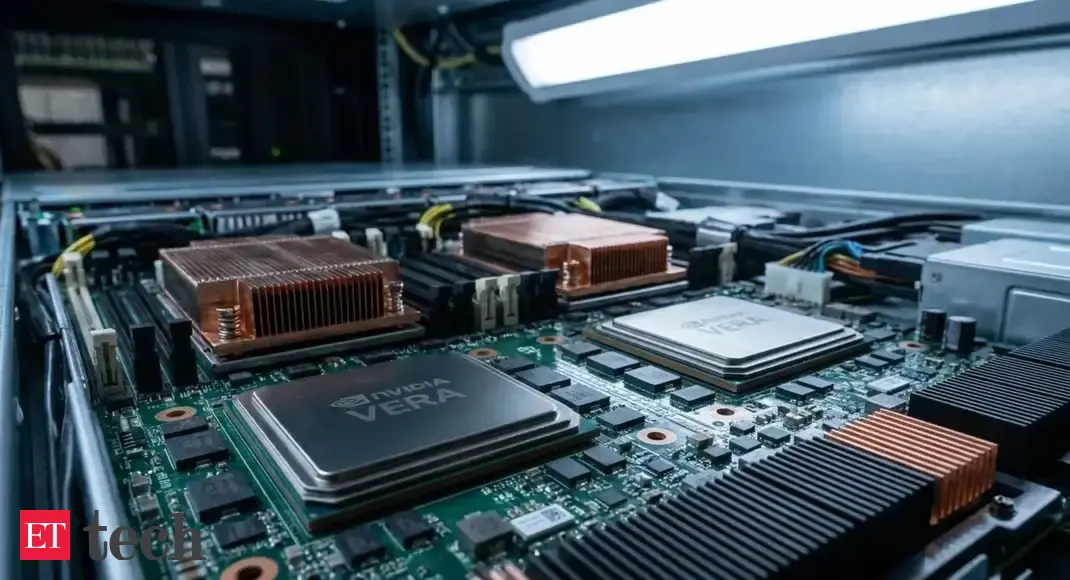
AI data centre firm AMI has ordered 9,000 Nvidia Vera Rubin chips and will be among Asia's first customers for Rubin.
The Hyderabad project is the first step towards AMI's planned 1 gigawatt compute-as-a-service capacity.
AM Group president Mahesh Kolli said: "The fact that we will have Vera Rubin operating by Q1 2027 gives us the visibility, credibility and capability to operate one of the world's most advanced AI architectures."
Nvidia unveiled the Vera Rubin chips in January.
The report does not disclose an order value, a per-chip price, the workload behind the agent throughput comparison, or any power, networking or utilisation figures for the Hyderabad site.
The break-even improvement a buyer needs on their own workload to justify Rubin's price premium is 1.4x to 1.8x.
Follow any of these and your For You feed starts watching them — no settings page required.
Evidence-backed comparisons of source perspectives and observed adoption signals. Read the methodology
Which Builder, Operator, and Investor concerns the observed source mix emphasized—not a truth score.
Evidence, demonstrated adoption, hype gap, incentives, and confidence are assessed independently, each on its own current evidence. How these are measured.
Single-publisher announcement, key figures undisclosed
Everything rests on one ETtech newsletter brief containing an executive quote and vendor-style comparison figures. There is no primary Nvidia or AMI document, no second outlet, no order value or per-chip price, and no workload behind the throughput multiple. The chip count, site and Q1 2027 date are specific and attributable; the performance and pricing figures are not verifiable from what is supplied.
One named order, nothing deployed
There is a concrete, named commitment - 9,000 chips by a specific buyer for a specific site - which is more than intent, but no capacity is live. First operation is claimed for Q1 2027 and the wider 200MW/1GW/5GW figures are roadmap only, with no financing or delivery confirmation.
10x headline, 1.4x threshold
The story's most quotable figure - up to 10x Blackwell agent throughput - is a best-case ceiling with no disclosed workload, while the disclosed 40-80% price premium implies a break-even of only 1.4x-1.8x. The economics work at a fraction of the advertised gain, so the 10x framing overstates what the evidence supports; the concrete order and date keep the gap from being larger.
Buyer-quoted, vendor-framed announcement
The performance and price figures are relayed without independent verification, and the only named voice is the buyer's own president, whose quote is explicitly about gaining 'visibility, credibility and capability'. The buyer is raising the profile of an $8bn build plan and the chip vendor benefits from early-demand signalling; the publisher's companion link on AI financing scrutiny is the only offsetting framing.
Low - one brief, mostly forward-looking
Confidence is limited by single-publisher sourcing, an announcement-plus-quote structure, undisclosed commercial terms, and the fact that the substantive outcomes sit in 2027-2028. The order's existence and the stated timeline are reasonably firm; the performance, pricing and capacity economics are not.
invest
NVIDIA banks $81.6B, authorises $118.5B of buybacks, and guides growth down by half1 distinct publisher
invest
Nvidia is brokering the Nordic build-out, not just supplying it2 distinct publishers
build
Fifty hops, one budget: why more GPU capacity won't fix agent latency1 distinct publisher
security
Influence Operations Now Target Construction Schedules, Not Just Elections1 distinct publisher
Distinct publishers with included, body-backed reporting in this cluster.
1 article · August 25, 2026