Product1 publisher3 min readPublished
Amazon anticipates nearly $24 an hour from contractors that set their own driver pay
Amazon said it will add $1.9bn to its Delivery Service Partner programme in 2027 and expects a national average of nearly $24 an hour. The DSPs are the employers, and the release leaves each of them to decide how the money is spent.
The Product Desk · Product desk
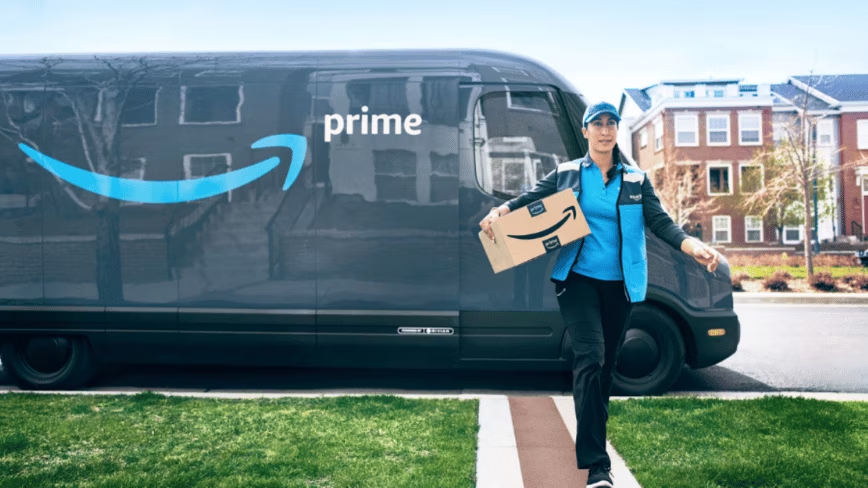
What happened
- Amazon said at Ignite Live, its annual DSP conference in Las Vegas, that it will put another $1.9bn into its Delivery Service Partner programme in 2027.
- The headline figure attached to that money is a national average of nearly $24 an hour for the drivers running Amazon delivery routes.
- Amazon pays the Delivery Service Partners, and the DSPs are the employers who hire the drivers and set their wages.
- The release puts cumulative investment in the programme at $21.7bn across its eight years.
- The company said serious vehicle crashes fell more than 23% across its network last year, and that it has spent more than $543m on safety since 2022.
Compiled by The Product DeskSomething wrong?How this is made
Why it matters
- cost Amazon books the $1.9bn as its own spending. The DSP owner books the pay decision, and answers for it when a driver holds a paycheck up against the press release.
- exposure A driver's crash-risk profile now reaches the small business that signs the check, in a country where the OECD counts software-based sanctioning of workers at sixteen times the European rate.
- constraint Amazon's safety claims arrive on moving baselines, so a DSP owner comparing this year's 23% with the earlier 48% camera figure has no common measure to compare them on.
- precedent The annual release now sets the wage number the whole network gets judged by a year before the payroll decisions that would produce it, exactly as the nearly $22 forecast did in January 2024.
A DSP owner flying home from Las Vegas has a number to repeat to drivers and a sentence telling him the number is his to fund. "Specifics will vary by DSP and geography, as each DSP determines how best to invest in their business and teams," Amazon wrote on Monday [3]. In the release, that line sits four lines under the headline wage figure [4].
Amazon also said every DSP provides healthcare coverage and paid time off for full-time delivery associates, that many add 401(k) plans and tuition reimbursement, and that those are decisions DSP owners make as employers [21].
The direction in Amazon's own numbers holds up. It said three years of investment helped DSP owners raise driver pay by an average of 16% nationwide [8]. A 16% rise landing at nearly $24 starts from about $20.70 an hour [3], and the January 2024 programme explainer agrees with that: nearly $22 described as a 7% rise implies about $20.55 the year before [10][4]. Since that explainer, the average has gained about $2, or roughly 9% [2], including roughly $1 this year [9].
Against the same 2024 baseline of more than $12.3bn [12], at most about $9.4bn has been added to the stated programme total in the two years since [1]. Safety is a small share of the whole: more than $543m since 2022 [14], about 2.5% of the eight-year figure [5].
Amazon's 2024 explainer said in-vehicle camera technology had cut accident rates 48% across the US network since rolling out in 2020, and distracted driving by 93% among DSPs using it [15]. This year's claim covers a different window and a different measure, and both counts are the company's own [13].
What is new is where the driving data goes. Netradyne's cameras already run across the network, and Amazon said it is applying more advanced AI to spot patterns more likely to end in a crash [16]. Those insights go to the DSP owner, not only to the driver, for early coaching [17]. The employer who decides the wage also receives the risk flag. The OECD calls this category algorithmic management, and its survey of 6,047 firms across six countries found US employers use software to sanction workers at sixteen times the European rate [18].
Amazon expects more than 20,000 of its Smart Delivery Glasses in the field by the end of 2027 [19]. The release does not say what they record or how long anything is kept [20].
The test for any supplier commitment that arrives attached to a worker outcome takes two lines. Write down who makes the decision the headline number describes, then write down what the commitment obliges that party to do. When the second line is empty, the number is a forecast of a third party's behaviour, and the supplier normally says so a few lines below the headline. Amazon's word for what its money will do to pay is "anticipate" [7].
What to watch
- Whether Amazon publishes what the Smart Delivery Glasses record on shift and how long footage is kept before the fleet reaches 20,000 devices.
- Any crash or injury figure for the DSP network from a regulator or an outside researcher that can be set beside Amazon's own counts.
- Whether the 2027 average is reported at or near $24, and whether Amazon breaks it out by geography now that it has flagged the variation.