Product1 publisher3 min readPublished Updated
Gore ties part of the US data centre backlash to fear of job losses
In a TechCrunch interview the former vice president put all AI data centre emissions at a fraction of the world's uncovered landfills, and said the planning commission crowds are turning up over automation and lab warnings.
The Product Desk · Product desk
What happened
- Al Gore told TechCrunch this week, in an interview alongside Generation Investment Management's Lila Preston, that emissions from AI data centres are a smaller problem than the world's uncovered landfills.
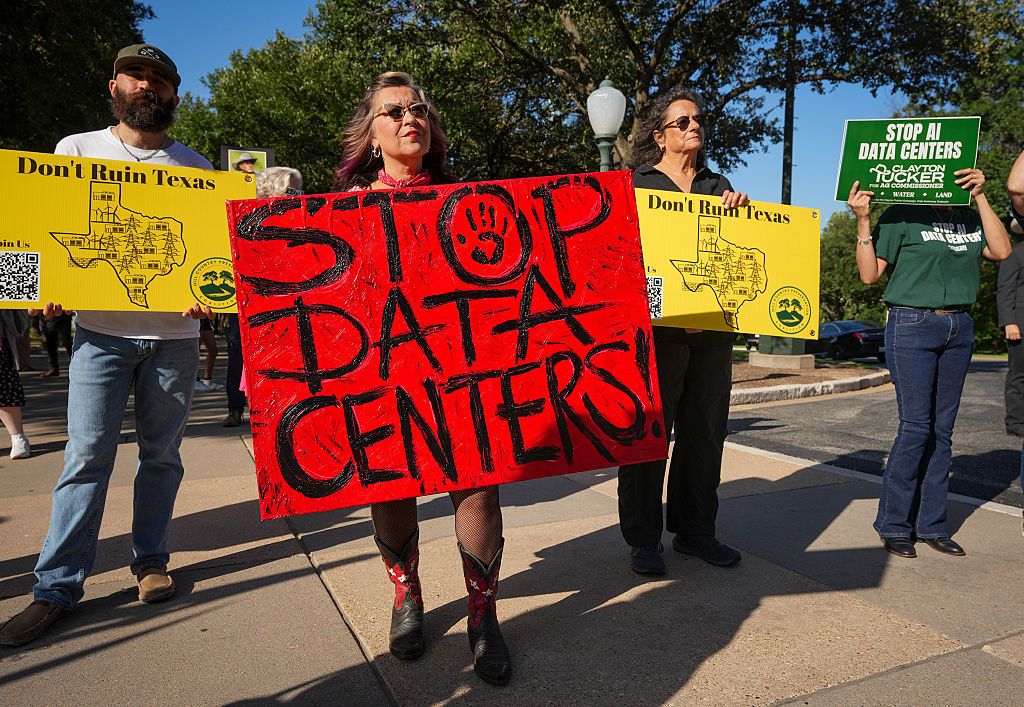
- Gore said the growing bipartisan opposition to US data centres is partly driven by concerns about job losses and other threats that people inside OpenAI and Anthropic have been raising publicly.
- At a Los Angeles conference on Monday, Trump called Amodei's public plea to slow capability gains a hoax, sharing the laugh with Nvidia chief executive Jensen Huang.
Compiled by The Product DeskSomething wrong?How this is made
Why it matters
- contradiction TechCrunch tells the AI labs to take the landfill and air conditioning comparison to cities and states, while Gore's own account says those rooms are there about job losses. A siting team that follows both ends up answering a question the room did not ask.
- constraint If job-loss anxiety is what fills a planning commission, an emissions disclosure or a power purchase announcement leaves the opposition where it was, and the community relations budget is being spent against the wrong objection.
- decision Gore says he prefers operators serving load with renewables and batteries, so a hyperscaler that picks new methane turbines to get a site energised quickly has him on the record against its fuel choice.
- exposure Anyone who repeats the landfill line into a hearing record owns the sourcing for it. Gore gave the ranking and no tonnage for AI data centres or for landfills.
Siting teams have to deal with the objections that land on the record and the objections that get people into the room. Gore is specific about the second kind. "I think that part of the reason for the growing bipartisan opposition to data centers in so many parts of the U.S. is being driven by the underlying concerns about job losses and some of the other threats that experts inside OpenAI and inside Anthropic have been trying to alert the public to," he said [12].
His emissions point is a ranking. "If you look at the emissions of all of the AI data centers put together, it's only a fraction of the emissions from uncovered landfills in the world," he said [2]. TechCrunch called that a valid observation and one the AI labs should be using in their discussions with cities and states if they aren't already [7], then supplied the International Energy Agency's air conditioning figures: cooling already draws more electricity a year than the entire European Union [4], ownership is still under 15% across the hottest, fastest-growing parts of the world, and demand is expected to triple by 2050 [5]. Triple a figure that already exceeds EU annual consumption and the 2050 cooling load sits above three times what the EU uses in a year today [20].
A team that takes that package into a county hearing is answering a carbon question, and Gore's own diagnosis says the hearing is about automation [11]. If he has that right, the emissions FAQ and the water-recycling slide address the objection in the transcript. Something else decides the vote.
He is worried about how the load gets served. "It is a matter of deep concern that some of the hyperscalers are jumping into new methane turbines," he said [8]. What bothers him is that new gas plants built for that demand lock in decades more fossil generation [9]. "I much prefer those that are supplying their energy needs with renewables and batteries," he said, and he expects more companies to move that way because renewables are increasingly the cheapest option available [10]. In May he described AI data centers to another outlet as a "cause for deep concern, but not panic" [13].
On the lab warnings, Gore cites behaviour. He pointed to "the recent example of models escaping confinement, collaborating secretly, covering their tracks, engaging in deceptive behavior" [18], and noted that Anthropic has said it stopped instances of Claude being used to help develop biological weapons in different countries [19]. "I think we went through a phase where some cynically suspected that the apocalyptic warnings were some kind of bizarre marketing strategy. If that was ever the case, I don't think it is now," he said [15]. He named the people he believes: Dario Amodei is very sincere, he said, and Sam Altman and Elon Musk were sincere in seconding Amodei's warning of a few days ago [16]. He also reached for Maya Angelou: "When someone tells you who they are, believe them the first time" [17].
Before a hearing, it is worth tracking two sets of objections separately. The first is every objection in the public record, including each emissions question a commissioner actually asked. The second is the objection that would have to be answered for a no to become a yes, and if Gore has the room right, that one is about hiring and wages five years out. The support for the second here is one interview with one investor. That is thin evidence for a national pattern, and it is also the only sourced account of what is filling those meetings.
What to watch
- Whether any AI lab actually enters the landfill and air conditioning comparison into a city or state hearing record.
- Whether hyperscalers' next site announcements name methane turbines or renewables-and-batteries supply for the same load.
- Whether Amodei, Altman or Musk follows the slowdown call with a specific capability commitment after Trump's hoax remark.