Product1 distinct publisher3 min readPublished
Fambot's launch shows what consumer agents are actually bought for: triage of the email, calendars and group chats a household already has. The rival startups named alongside it are selling that same job.
The Product Desk · Product desk

Compiled by The Product DeskSomething wrong?How this is made
Reich's example of the problem is a 12-page school newsletter, adorable throughout, with an early release day and a chaperone signup sitting near the bottom [9]. Getting those two lines out is mostly plumbing: reach the document, then pull the dates. Fambot's answer is parsing built specifically for email and PDF school newsletters [8].
Reich says he gets 20 to 40 kid-related emails a day and sits in about 10 WhatsApp groups [6]. Over a month that is roughly 600 to 1,200 messages arriving at one household [17], and the output is one digest a day [4], a compression of somewhere between 20 and 40 to one [18]. The input number comes from the founder's own family, not from a measurement across the roughly 1,000 households that signed up [6][2], which is worth asking about in a demo.
The label on the box is chief of staff, and some of the shipped behaviour fits that: suggested grocery lists for a cookout, prep for a theme park visit. Fast Company notes those could likely come from a general-purpose AI tool or an ordinary web search [10], and Sam Altman has pitched ChatGPT itself as a parenting tool [11]. What does not travel to a general assistant is the connector list [3]. So the user here is narrower than the marketing: the one adult who has become the household's default router for everything institutional.
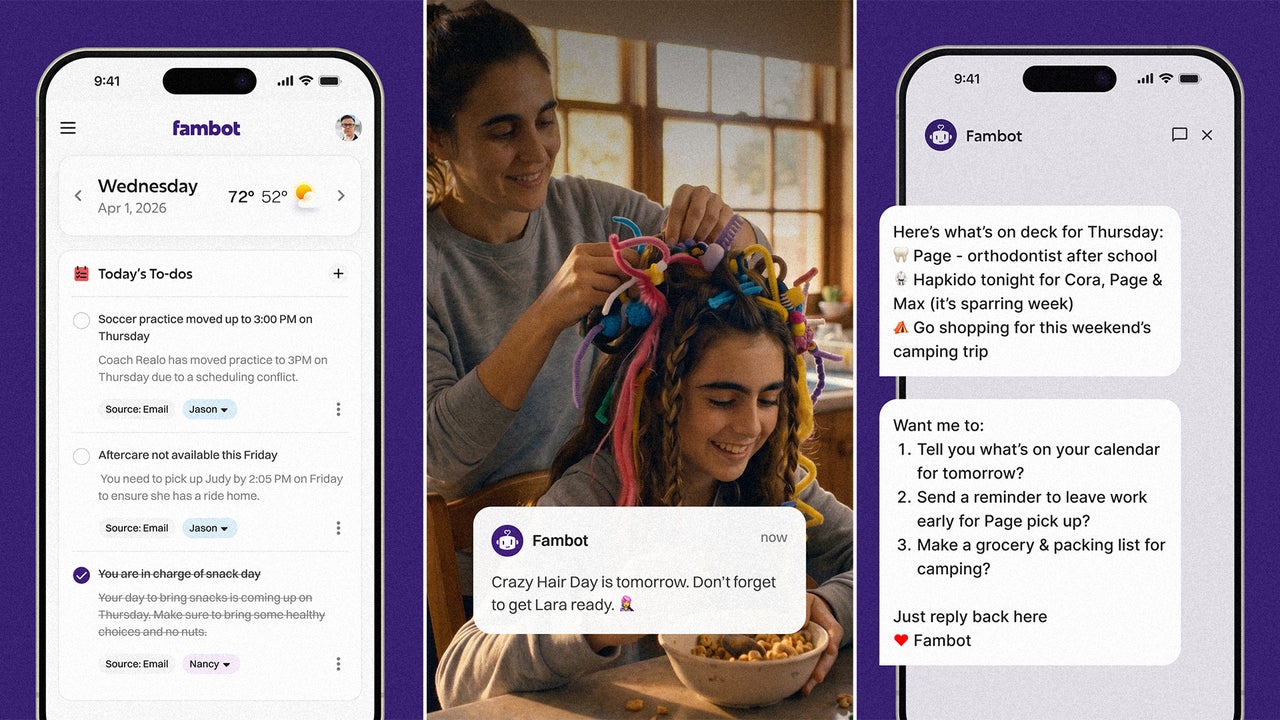
Fambot also lets parents tick items off a to-do list and coordinate who is taking which task [5]. Whether that changes who carries the admin is a question about completions by the adult who was not already doing it, and the experts Fast Company spoke to say it remains unclear how much specialised AI will reduce or redistribute the burdens of parenthood [16]. The 1,000 figure is a count of signups taken before the app was live [20], which measures interest in the description rather than the second week of use.
The price of the triage is standing read access to a family's mail, calendars and chats [3]. The category's answer is per-source opt-in and control over retention, plus assurances that the model providers do not keep user data [14]; Ohai's Sheila Lirio Marcelo says her product lets families edit and delete stored memories [15]. Those are vendor statements, and a group chat is not one household's data. Ten WhatsApp groups means reading messages written by other parents who never chose a vendor [19].
The split worth drawing, whether you are building this or buying it on Monday: put every feature in one of two columns. Column one needs read access to a source the household already owns, such as the school mailing list or the shared calendar. Column two works from a blank prompt. Column two is rented from whoever ships the general assistant [10]. Then price the miss in each column. A mediocre cookout list costs nothing; a missed early release day leaves a child waiting outside a school [9]. That asymmetry sets a recall bar most chat products have never had to clear.
Ranked by verification strength, evidence, and original report placement.
Fambot, founded by CEO David Reich, launched its AI "chief of staff" for families on Tuesday.
Fambot had already signed up about 1,000 families before its launch.
Fambot can pull data from emails, online calendars, a newly launched WhatsApp integration, and a growing number of other apps.
Fambot generates a daily digest of what parents need to know, delivered by text or email or through new Android and iOS apps, and adds family events to online calendars upon request.
Parents can use the Fambot app to check off items from a to-do list or coordinate who is taking care of which tasks.
Reich says he gets anywhere from 20 to 40 emails related to kid stuff every single day and is in about 10 different WhatsApp groups.
Distinct publishers with included, body-backed reporting in this cluster.
1 article · September 1, 2026
Follow any of these and your For You feed starts watching them — no settings page required.
leadership
Small firms let big companies' AI mistakes pay for their shortlist of what works1 distinct publisher
invest
OpenAI's teen ChatGPT is a compliance product, and rivals will be measured against it1 distinct publisher
product
OpenAI's roadmap now fits inside one president's span of control1 distinct publisher
science
Text watermarks land on 2 December. The detection they imply does not.1 distinct publisher
Evidence-backed comparisons of source perspectives and observed adoption signals. Read the methodology
Which Builder, Operator, and Investor concerns the observed source mix emphasized—not a truth score.
Evidence, demonstrated adoption, hype gap, incentives, and confidence are assessed independently, each on its own current evidence. How these are measured.
One newsroom, four founders talking
Fast Company is the only outlet here, and inside it the factual spine belongs to the people selling: Reich on volumes and parsing, Shannon, Di Donna and Marcelo on what their own products do and retain. The two outside voices, Brandon McDaniel and Melissa Milkie, speak to relational cost, not to whether the digest catches the early-release day. What is well established is what everyone said; what is unestablished is whether any of it works.
A thousand signups and a launch day
The product genuinely shipped — WhatsApp integration, both mobile apps, digests going out — which is more than a waitlist. But the only number offered is 1,000 families who signed up before anything launched, and signups are the cheapest metric a consumer app has. Whether a single parent opened a second digest is not on the record.
"Chief of staff" is doing a lot of work
The phrase promises a delegate; the evidence supports a filter that reads your mail and school PDFs and mails you a summary. That gap is real but modest, and Fast Company narrows it itself — the reporter concedes that some of the planning output is a search query away, and the researchers it quotes say plainly that nobody yet knows whether specialised AI redistributes parental load at all.
Everyone quoted has something to sell
Fambot's founder is speaking in the same breath as a $3.5 million round announcement, and the three rivals brought in for the category framing — Ollie, Familymind, Ohai — are pitching competing products in a market that benefits when parental overload is described as an information problem. The privacy assurances are the sharpest case: the only people testifying that the data is safe are the people holding it.
Solid on the quotes, blank on the outcomes
We can stand behind who said what, the round, the syndicate and the shipped surfaces. We cannot stand behind the parsing accuracy, the retention, the price, or the identity of the labs behind the models — and with one publisher on the story, there is no second reading to lean on.