Leadership1 distinct publisher3 min readPublished
Benedict Evans argues the hard part of enterprise software was never writing it. If the build step collapses to five minutes while adoption still takes eighteen months, the estate grows faster than anyone can inventory it.
The Board Room · Leadership desk

product
Rillet's $100M reads as proof mid-market ERP is rip-and-replace, mostly at the cheap end1 distinct publisher
build
Four of six steps can bin a resume before a human sees it, and the worst is an image-only PDF1 distinct publisher
invest
Rillet's $1B mark puts a price on ERP displacement risk4 distinct publishers
leadership
Rent the ledger, build the screen: where AI actually moved the buy-versus-build line1 distinct publisher
Compiled by The Board RoomSomething wrong?How this is made
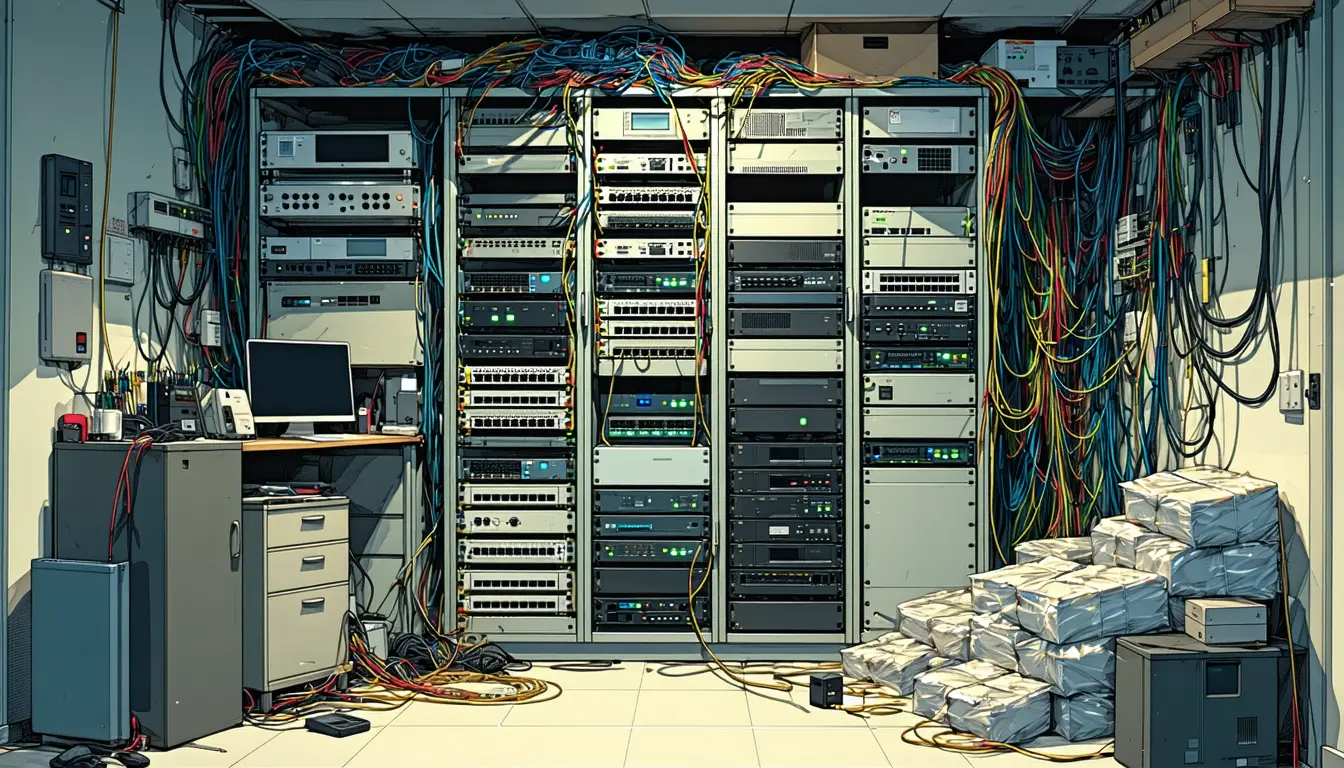
Sprawl of the kind Evans describes accumulates the way filing accumulates. Each vertical SaaS application, each script, each 10 meg spreadsheet running a department arrived because someone had a problem and a budget, and stayed because retiring it was nobody's job [2]. Evans notes that after all that accumulation the company is still full of boring, repetitive tasks [4], which is the shape you would expect if the estate were a residue of past decisions rather than a solution to present work. Cheaper production acts on the wrong variable.
Put the essay's two numbers on one clock. The joke version has an engineer spending an hour to automate ten minutes of work, and the AI version makes the same tool in five minutes with no engineer and no code, a twelvefold cut in build time [5][1]. Against that sits eighteen months for the purchase decision a cross-departmental workflow requires [12]. Eighteen months is roughly 777,600 minutes, so the generation step is about six ten-thousandths of one percent of the cycle [2]. Compressing it to zero moves the total by nothing a CFO could measure.
One answer to the assent problem is the forward-deployed engineer: a builder who walks a law firm or an architecture office and sees the automatable task the professional does not [8]. That addresses a real gap, since the great matrimonial lawyer spends the day on cases and clients, not on what discovery software might do [7]. It works one floor at a time with a person in the room, but it leaves the assent problem untouched. It also understates discovery: most of what got automated in recent decades was not obvious, and the fix usually meant redefining or unbundling the problem, with half a dozen failed attempts standing behind each company that found the right one [9][10].
The board-deck version reads: AI compresses the estate, licence spend falls, headcount follows. It is incomplete for a bookkeeping reason. Firms frequently cannot say how much software they have, what is actually used, or what they are paying for [3], and you cannot decommission an inventory you have never taken. A five-minute tool built by someone who is not an engineer produces an asset with no owner and no line in any register [5]. Generation adds rows before it removes any.
The ten-year question stays open. Whether dynamic, generated software eventually displaces packaged applications is not settled here, and the supplied text stops mid-sentence as Evans begins laying out his spectrum from institutionalised to improvised, so how he resolves it is not on the record we have [13][14]. The decidable question this quarter is narrower: who owns a generated tool, and when it gets retired. Answering it now means a firm can still count its estate next year. Leave it unanswered, and the count arrives anyway, by way of a licence audit.
Ranked by verification strength, evidence, and original report placement.
Evans argues the tempting conclusion that software becomes dynamic and generative, automating massively more tasks with massively less software, misunderstands where software comes from, how people use it, and how companies change.
Most people are not tool builders: a great matrimonial lawyer spends the day on cases and clients rather than on what legal discovery software could do, and a great enterprise salesperson thinks about product, clients and competitors rather than sales enablement software.
The gap leads to the idea of the forward-deployed engineer, a builder who knows what AI can build and can walk around a law firm or architecture office and see opportunities the lawyer or architect does not see.
Most of what has been automated in recent decades was not obvious and did not have an obvious solution; problems are often embedded, bundled or hidden inside something else, and the way to fix them is often to redefine or unbundle them.
Making it easier to write code does not solve the hard part, which is knowing that you need a tool in the first place and then knowing what the tool should do.
Evans frames software as bought, chosen or created on a spectrum from top-down to bottom-up (the company buys SAP, the user makes a spreadsheet), which he also reads as a spectrum from institutionalised to improvised.
Distinct publishers with included, body-backed reporting in this cluster.
1 article · September 3, 2026
Follow any of these and your For You feed starts watching them — no settings page required.
Evidence-backed comparisons of source perspectives and observed adoption signals. Read the methodology
Which Builder, Operator, and Investor concerns the observed source mix emphasized—not a truth score.
Evidence, demonstrated adoption, hype gap, incentives, and confidence are assessed independently, each on its own current evidence. How these are measured.
One essay, argued rather than sourced
Everything here traces to a single post on Evans's own site, and the numbers doing the work — hundreds or thousands of apps, five minutes to build, eighteen months to buy, half a dozen failures before each winner — arrive without a survey, a customer, or a named product behind them. What is genuinely strong is the internal logic: the spectrum from SAP to spreadsheet and the account of how repeated improvisation gets institutionalised hold up on their own terms. Reasoning that coherent is still not verification.
Not that kind of story
This reporting contains no release, deployment, benchmark or disclosed usage — no company saying it replaced an application with a generated tool, and no measure of whether estates are in fact growing or shrinking. We will not manufacture an uptake number out of an argument.
Anti-hype, told with borrowed precision
Evans is pushing against the excitement, not adding to it, so there is little overselling to discount. The small overhang comes from style: five minutes and eighteen months sound like measurements and function like measurements in the argument, when they are rhetorical placeholders. Our own arithmetic on them — five minutes against 777,600 — is vivid for the same reason it is fragile.
No vendor in the frame
Nobody in this piece has a product to sell you: it is self-published, names SAP, Workday, Carta and Rippling only as furniture, and takes a position that flatters no software company in particular. The pressure that does exist is reputational — an analyst whose standing rests on being the calm voice against Valley enthusiasm has a standing reason to find the enthusiasm mistaken, and there is no disclosure of advisory or investment relationships either way.
Take the frame, not the figures
One publisher, no corroboration, no adoption signal, and one detail we had to correct about where the text actually stops. That caps how far this can be trusted as fact. The structural claim — that cheap building meets unchanged institutional adoption — is coherent enough to plan around; the quantities in it are not.