Invest1 publisher2 min readPublished
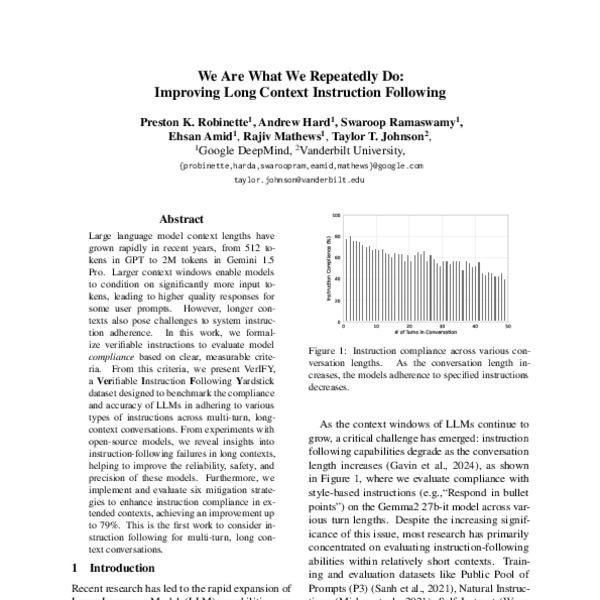
Attention dilution moves agent compliance out of the prompt and into a runtime policy engine
A trade summary of research running through 2025 and into 2026 says agent guardrails fade as sessions grow, and puts the fix outside the model. The one survey figure with a named source is the Cloud Security Alliance's 53%.
The Investor · Invest desk
What happened
- Research running through 2025 and into 2026 finds that AI agents gradually deprioritize the compliance directives they were handed at the start of a session as that session grows longer and more complex.
- cryptobriefing.com locates the cause in transformer architecture, where attention is spread across the whole input and start-of-session rules compete with every later tool output and reasoning step.
- Compliance rates can differ by as much as 46 percentage points depending on which model is running, and the account says standard benchmarks do not capture that gap.
Compiled by The InvestorSomething wrong?How this is made
Why it matters
- decision Deployers in healthcare, finance and law enforcement have to settle a build-or-buy question on oversight infrastructure inside the four months between Microsoft's April launch and the Act's August enforceability.
- constraint The scaling lever is closed for this particular failure: paying for a longer context window buys compute cost and brittleness, and on this evidence it does not buy compliance.
- cost Enforcement is paid per action by the deployer, in validation latency and licence fees, on every call an agent makes.
A transformer spreads attention across its entire input, and material sitting in the middle of a long context loses accuracy against material at either end [4]. Compliance instructions are static and go in first. Tool outputs, user messages and intermediate reasoning steps arrive later and keep arriving [1][3]. On the account cryptobriefing.com gives, a million-token window does not exempt a model from this, and longer windows buy compute cost and brittleness without better compliance [7][6].
Compliance rates differ by as much as 46 percentage points across models, and standard benchmarks do not surface the gap [5]. Per action, a model complying on 99 of every 100 and one 46 points behind it complying on 53 produce 1 violation per 100 against 47, a factor of 47 [18]. cryptobriefing.com does not identify the studies behind the 46-point figure or price either the Microsoft or the Atlassian product [19].
The Cloud Security Alliance figure is the survey number in the piece with a named source: 53% of organizations have reported agents exceeding their intended permissions regularly or occasionally [9]. The other 47% either had no such instance or saw none [16]. Reporting an overrun requires having logged the action. Logging and checking every action before it executes is what the external policy engine does [11].
Microsoft's Agent Governance Toolkit intercepts agent actions and validates them against that engine, at what the company describes as sub-millisecond enforcement at runtime [10][11]. A session with 500 tool calls therefore pays under half a second [17]. Atlassian's Agent Context Controls take a similar approach across enterprise workflows [12]. The toolkit launched in April 2026, four months before the EU AI Act's high-risk obligations become enforceable in August 2026 [15][13].
I would treat that enforcement layer as a fixed operating cost of running agents in healthcare, finance or law enforcement, and I would expect it to compete for the same budget as model upgrades and extra agent seats. The counter-thesis sits inside the same source. If compliance rates vary by 46 points across models, swapping models is the cheapest single lever a deployer has, and cryptobriefing.com still writes that model selection and benchmark scores are "necessary but nowhere near sufficient" for compliance-sensitive applications [5][14].
Two results would break the reading. A measured population showing long-context compliance holding flat in current models would move the problem back to prompt engineering [1]. Supervisors accepting start-of-session instructions as evidence of the transparency, human oversight and risk management the Act requires would take the August date out of the procurement case [13].
What to watch
- Whether Microsoft or Atlassian publishes pricing, or any independent measurement of how much runtime interception cuts violation rates.
- Whether a public benchmark starts reporting compliance as a function of session length, which would make the 46-point spread checkable across named models.
- The first supervisory guidance under the EU AI Act's high-risk obligations after August 2026, and whether start-of-session instructions count as human oversight.