Product1 publisher2 min readPublished
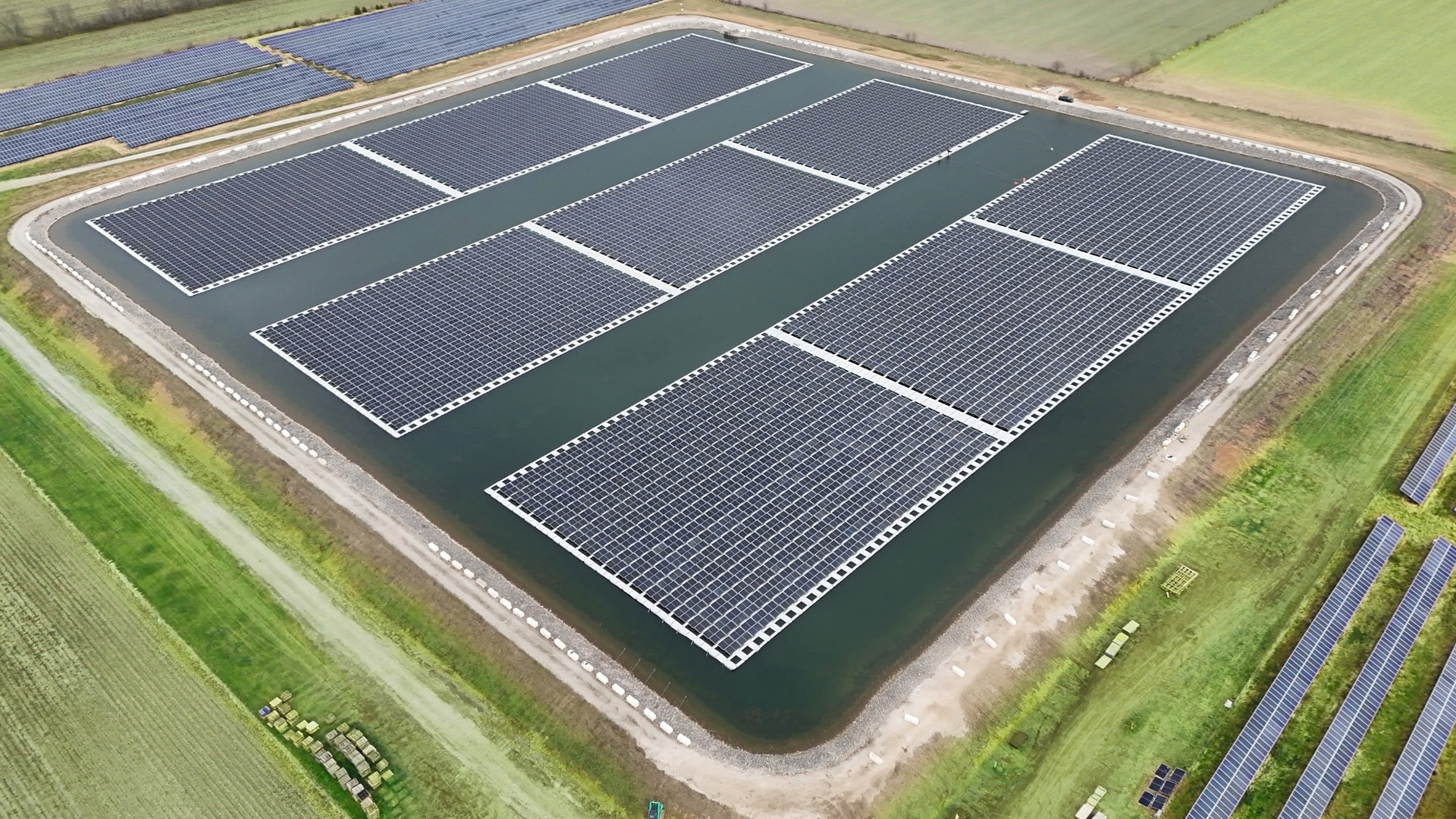
Monroeville floats 6MW on 12 acres of reservoir it already owned
The Ohio village's 9,222 modules sit on its own reservoir. Developer D3Energy says the same capacity on the ground would have taken about 30 acres, in a state where a third of counties now restrict large solar.
The Product Desk · Product desk
What happened
- A 6MW array of 9,222 modules on three floating islands is generating electricity on the Village of Monroeville's reservoir in Ohio and feeding the village's own distribution grid.
- The system covers about 12 acres of water and avoids the roughly 30 acres of farmland a similarly sized ground-mounted project would have required, according to developer D3Energy.
- About one-third of Ohio's 88 counties have restricted large solar installations since a 2021 law gave counties greater authority over such projects.
- Gardner Capital owns the system and sells its electricity to the village, with D3Energy as developer and an Ohio contractor doing the build.
- Ohio's operating floating solar capacity now totals nearly 10MW across three projects, all developed by D3Energy, including earlier arrays for Del-Co Water and the City of Lima.
Compiled by The Product DeskSomething wrong?How this is made
Why it matters
- constraint With roughly 29 Ohio counties able to restrict utility-scale solar, the list of parcels a developer can pitch shrinks, and surfaces a public body already controls become some of the few sites left.
- capability A utility or municipality that owns its water body can add generation without a land acquisition, because the site decision belongs to the same organisation that wants the power.
- decision A water district weighing a second solar project now chooses between paying for acreage and putting hardware on surface it already maintains, with the capital sitting on an outside owner's books.
- precedent About 60 percent of Ohio's floating capacity now sits behind one municipal reservoir, giving the next small-village board a nearby reference case to point at.
Every floating array D3Energy has finished in Ohio sits on water the host already owned [14]. Monroeville got to 6MW on land it already held for another purpose [6].
D3Energy's own land comparison works out to 0.5MW per acre of water against 0.2MW per acre of farmland, a factor of 2.5 [1]. The developer says the installation is the largest floating array in Ohio and among the five largest in the US [3], and that it has built more than half of the floating photovoltaic systems now operating in the country [17].
"Solar needs space, and in farm country there's no such thing as spare ground," said Stetson Tchividjian, D3Energy's managing director [7]. "Monroeville had water sitting right there doing one job. Now it does two," he said [8].
Monroeville has about 1,300 residents [10]. Its 4MW ground-mounted plant has been running since 2017 [9], so the two projects together give a village that size 10MW [3], or roughly 7.7 kW per resident [4]. D3Energy puts that at about 13 times Ohio's solar capacity per resident [11].
Ohio-based Appalachian Renewable Power was the contractor [16]. The price the village pays for the electricity was not disclosed, so the acreage saving cannot be set against a rate.
Tchividjian gave the credit to one person. "Tom Gray, the recently retired village administrator, drove this project from the first conversation to the day it energized. This one is his," he said [19].
Two conditions decide whether this repeats elsewhere: the organisation already controls the water surface, and the surface can keep serving its existing use with panels on it. Where a host has to buy the surface, the constraint sits somewhere other than footprint. In Monroeville the reservoir is still a water resource and now carries thousands of panels as well [18].
What to watch
- Whether D3Energy's next Ohio floating projects land on water owned by hosts other than water utilities and municipalities.
- Disclosure of the Monroeville power purchase rate, which would let the 30-acre saving be priced against a per-kWh cost.
- Whether counties that restricted ground-mounted solar under the 2021 law apply the same restrictions to reservoir projects.