Loading today’s stories
Product1 distinct publisher3 min readUpdated
Huawei puts the battery on the DC bus so a 720 kW charging site can live on a 50 kW connection
The bottleneck in European fast charging is interconnection, not amperes. Huawei's buffered DC design moves that constraint from peak power to how often a site can repeat the trick.
The Product Desk · Product desk
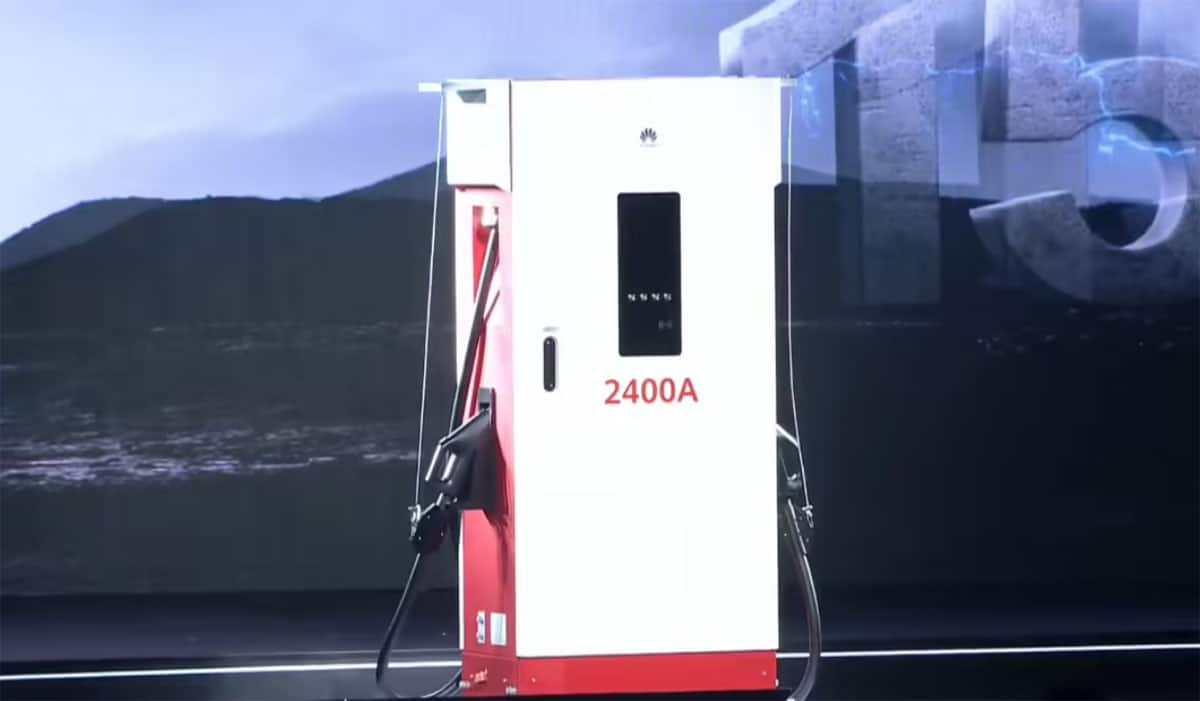
What happened
- Huawei's new ultra-fast charging platform promises up to 200 kilometres (125 miles) of driving range added in five minutes of charging.
- Huawei presented the technology at the Power2Drive event during the Smarter E exhibition in Munich.
- Huawei's platform connects its battery energy storage system directly to a DC bus, removing an entire power conversion stage and raising the storage unit's electrical efficiency to 92.1 percent.
- Conventional battery storage units use alternating current connections, which require multiple power conversion stages.
- Because the system draws power from its internal battery during peak charging periods, a charging site can run on a grid connection of just 50 kilowatts.
Compiled by The Product DeskSomething wrong?How this is made
Why it matters
The number worth reading in this launch is not 720 kilowatts, it is 50. A site rated for 720 kW of output behind a 50 kW connection is running at 14.4 times its supply [1], and the difference comes out of a battery sitting on the same DC bus as the dispensers rather than behind an AC inverter with its own conversion stages [3][4].
Now convert power into energy, because energy is what operators sell. Five minutes at full output is 60 kWh delivered, while a 50 kW connection contributes about 4.2 kWh over those same five minutes. The on-site battery covers the remaining 56 kWh, roughly 93 percent of the burst [2]. Refilling 56 kWh at 50 kW takes about 67 minutes [3]. So the grid constraint has not been removed, it has been relocated from peak power to duty cycle. The connection now sets how many full-power bursts a site can serve in a day, which is a live problem at a motorway stop on a Friday evening and close to irrelevant at a depot that sits idle overnight.
That is why the permitting claim, not the amperage, is the commercial core here. Huawei says operators can skip grid capacity expansion applications and cut build time from several months to a few weeks [7], and that the DC architecture stops energy feeding back into the external network [6], which is often exactly what a connection study is arguing about. Whether a distribution network operator agrees to assess a 720 kW installation as a 50 kW load is a regulatory judgement, and the source offers no evidence that one has.
The efficiency figures deserve the same caution. The 92.1 percent for storage after deleting a conversion stage [3] and 96 percent overall once the power-sharing matrix is scheduling across plugged-in cars [13] are Huawei's own numbers, presented at Power2Drive during the Smarter E exhibition in Munich [2]. Neither has been measured by anyone else under a working duty cycle.
The rest of the specification reads like an answer to tender checklists: dispensers at up to 800 amps with 600 amp boost units across a 150 to 1,000 volt window [9][8], enclosed liquid cooling on power units, dispensers and cables that Huawei credits with a ten-year service life and reduced maintenance [10], noise under 55 decibels [11], prime-level safety certification from TUV [12], and a modular route from fast to ultra-fast without replacing the core equipment [14]. A megawatt-class unit already exists in China and still has field testing ahead of it before Europe [15].
Demand for that much current is arriving on its own track. Hongqi, the luxury brand of China FAW Group, reports a prototype cell moving from 10 to 70 percent state of charge in three minutes 41 seconds, and from 10 to 97 percent in eight minutes three seconds [16][17]. Vehicles with curves like that are what turn an 800 amp dispenser from a spec line into a queue-clearing asset.
Loading topic controls
Loading related stories