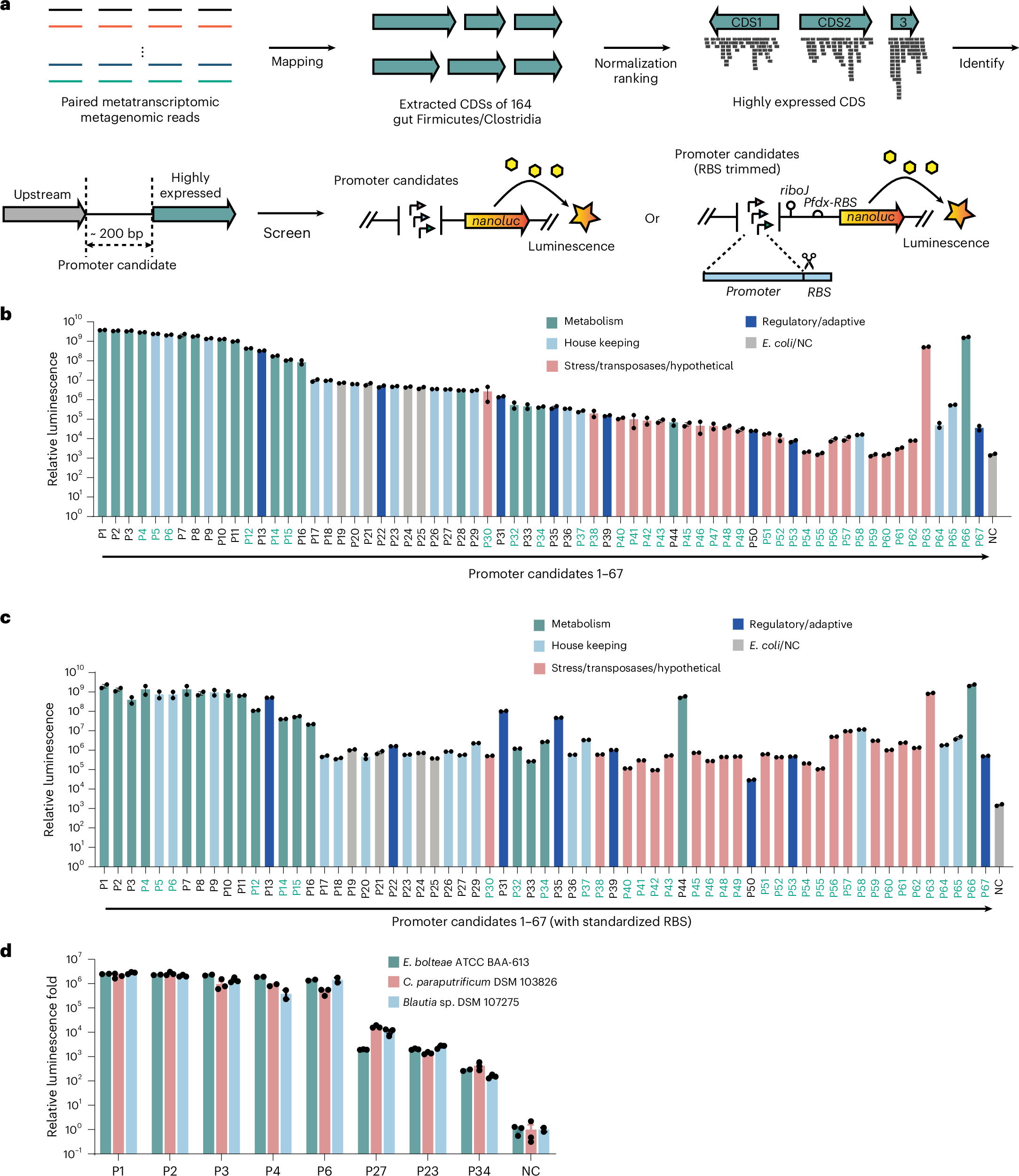
Reversibility is the part that does the work here. A deletion mutant tells you what a mouse looks like when a gene is absent from the start, and the comparison is always between animals. An inducible promoter that drives a metabolic pathway [5] lets the same animal go from producing to not producing and back, so the appearance and clearance of a metabolite can be timed against a host measurement rather than read off a difference between cages. The authors report exactly that kind of control over trimethylamine and deoxycholic acid in mice [6], both of which they tie to host lipid metabolism and disease [7].
Editing in Clostridium is not new. The reference list includes the ClosTron from 2010, CRISPR-Cas9 work in C. difficile in 2017 and 2018, and RiboCas in 2019 [9], plus a 2022 Cell study that manipulated gut microbes for single-gene interrogation inside a complex microbiome [10]. What those efforts mostly bought was a system per organism. The claim in this paper is a chassis: constitutive promoters that fire across diverse clostridial strains [4], with an inducible layer on top that also carries CRISPR-Cas deletions [5]. If that holds, the cost of studying a new commensal drops to getting the plasmid in and validating expression, and the awkward habit of testing hypotheses in whichever relative happens to be tractable becomes unnecessary. The authors frame the toolkit as covering commensal Clostridiaceae and Lachnospiraceae, families the paper credits with maintaining microbiota homeostasis, and they say adequate tools for these abundant nonmodel organisms were missing [2][3].
The asymmetry this addresses is easy to quantify from the same reference list. One cross-cohort analysis of type 2 diabetes signatures drew on 8,117 metagenomes [11]. Another paper named a specific mechanism, branched-chain amino acid production by Clostridium symbiosum acting on host cholesterol metabolism in colorectal tumorigenesis [12]. Candidate generation runs at cohort scale; causal confirmation has been running at one bespoke genetic system at a time. Trimethylamine and deoxycholic acid are sensible first targets precisely because their host links are already asserted, so the switch is being tested where a negative result would be informative.
What the abstract does not give is the strain list, the identity of the inducer, or how large the host effects were [15]. Those live in a paper that costs $39.95 to buy, which is about 21 percent more than 30 days of access to the whole Nature Portfolio at $32.99 [13][14]. For a toolkit whose value is measured in how many other labs adopt it, that is a peculiar toll gate.