Published · 5h agoBuild2 min read
Copilot and Muse got patched at the same leg of the lethal trifecta
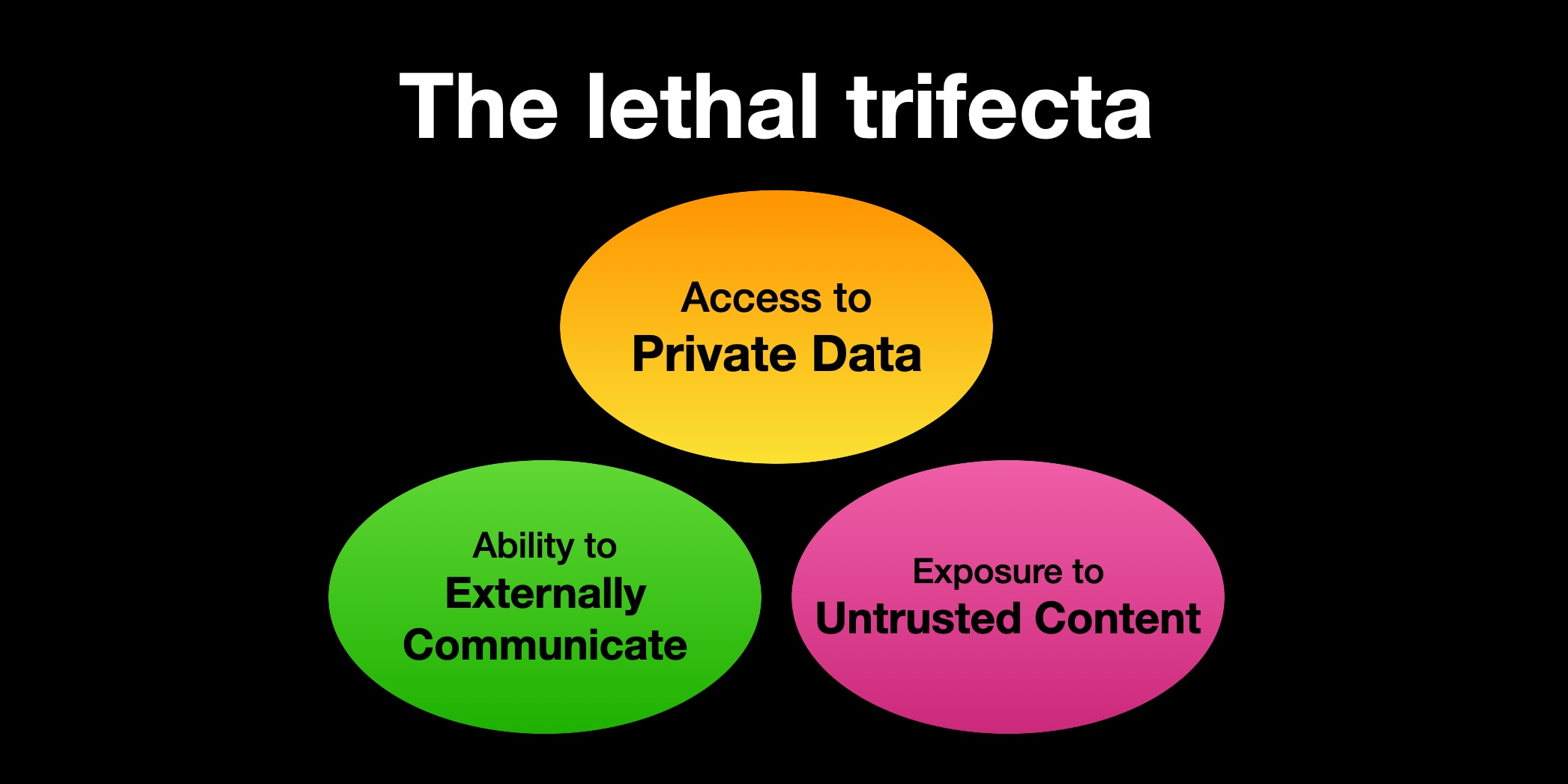
Simon Willison's three ingredients for stealing data from an LLM agent fit EchoLeak in Microsoft 365 Copilot and Patrick Wardle's unpatched Muse zero-day, and in each case the repair went to the third one.
Written for builders.See today for builders
What happened
- Simon Willison set out three capabilities whose combination lets an attacker steal data from an agent: access to private data, exposure to untrusted content, and a way to communicate externally.
- EchoLeak, filed as CVE-2025-32711, was a zero-click prompt injection in Microsoft 365 Copilot that allowed remote, unauthenticated data exfiltration from a single crafted email.
- Meta shipped a hotfix that stripped the internal debugging preference key from production Muse builds, so the dictation destination can no longer be changed locally.
Compiled by The EngineerSomething wrong?How this is made
Why it matters
- constraint The trifecta is only a vendor's problem while a vendor owns all three legs; Willison's warning is that a user who assembles tools from different sources has nobody left to lock down the exfiltration vector.
- exposure Owners routinely hand an agent broad macOS permissions, so an attacker who steers the signed assistant inherits its reach into files, calendars and mail without writing infostealer malware.
- contradiction Meta scopes the Muse flaw as needing prior code execution, while the practitioners quoted by InfoQ treat that prerequisite as cheap and the TCC bypass it buys as the hard-won part.
- precedent Because fixes close outbound channels and leave instruction-following intact, every new link, image fetch or allowed proxy an assistant gains reopens the same vulnerability.
Only one of the three capabilities is repairable at the vendor's end. Willison wrote of the exfiltration cases he has collected: "Almost all of these were promptly fixed by the vendors, usually by locking down the exfiltration vector such that malicious instructions no longer had a way to extract any data that they had stolen" [3]. The first two legs stay where they are because of how the input is assembled. "LLMs are unable to reliably distinguish the importance of instructions based on where they came from. Everything eventually gets glued together into a sequence of tokens and fed to the model," he wrote [2].
The EchoLeak email evaded Microsoft's XPIA cross-prompt-injection classifier, used reference-style Markdown to get around link redaction, relied on images the client fetches automatically, and moved the data through a Microsoft Teams proxy the content security policy already permitted [9]. That is what closing the third leg costs. The hidden instructions had Copilot embed the most sensitive details from the user's context in an outbound reference link [12]. Microsoft assigned CVE-2025-32711 and issued emergency patches [10].
Meta's Muse client fails the same test one layer down. An undocumented preference key, endo_voyager_dictation_endpoint, names the server that receives dictation audio, and an unprivileged local process can overwrite it with no admin rights and no operating system prompt [15]. On dictation the client sends raw microphone audio and the account's valid authentication token to whatever endpoint is set. Wardle demonstrated a proxy that captured both while forwarding traffic to Meta so nothing looked amiss [16]. Holding the pipeline, an attacker can append hidden instructions to a voice request and have the assistant pull local documents or WhatsApp message histories [17]. Meta's hotfix stripped the debug key from production builds [19].
David Singleton of Meta Superintelligence Labs framed the flaw as a local configuration problem requiring prior code execution, according to InfoQ. InfoQ also reports that security professionals commenting on the disclosure rejected that reading: ClickFix-style lures trivialise initial access, while bypassing Apple's Transparency, Consent, and Control framework is traditionally complex [20][21]. Both remediations sit on the outbound path [25].
Willison's own tally comes to seventeen named systems since April 2023 [6]. The test that transfers is the three-part one. What no vendor can close is the composition: a user who assembles tools from different sources has nobody locking down the exfiltration vector for them [7].
What to watch
- Whether Meta issues an advisory or CVE for the Muse flaw or keeps handling it as an internal configuration defect.
- Whether other Muse preference keys remain writable by unprivileged local processes after the hotfix.
- Whether Amazon's block on Muse over automated agent access policies is matched by other platforms.
Claim ledger
Ranked by verification strength, evidence, and original report placement.
- [1]
Willison's lethal trifecta for AI agents is access to your private data, exposure to untrusted content, and the ability to communicate externally in a way that could be used to steal data; if an agent combines all three, an attacker can trick it into sending private data to the attacker.
- [2]
"LLMs are unable to reliably distinguish the importance of instructions based on where they came from. Everything eventually gets glued together into a sequence of tokens and fed to the model."
- [3]
"Almost all of these were promptly fixed by the vendors, usually by locking down the exfiltration vector such that malicious instructions no longer had a way to extract any data that they had stolen."
- [4]
Willison writes that in just the past few weeks the exploit has been reported against production systems including Microsoft 365 Copilot, GitHub's official MCP server and GitLab's Duo Chatbot.
ReportedView cited source - [5]
Willison also lists having seen the exploit affect ChatGPT (April 2023), ChatGPT Plugins (May 2023), Google Bard (November 2023), Writer.com (December 2023), Amazon Q (January 2024), Google NotebookLM (April 2024), GitHub Copilot Chat (June 2024), Google AI Studio (August 2024), Microsoft Copilot (August 2024), Slack (August 2024), Mistral Le Chat (October 2024), xAI's Grok (December 2024), Anthropic's Claude iOS app (December 2024) and ChatGPT Operator (February 2025).
ReportedView cited source - [7]
Willison writes that once users start mixing and matching tools themselves there is nothing vendors can do to protect them, and that Model Context Protocol encourages users to mix and match tools from different sources; any tool that can make an HTTP request, load an image or offer a link can pass stolen information back to an attacker.
ReportedView cited source - [8]
EchoLeak (CVE-2025-32711) was a zero-click prompt injection vulnerability in Microsoft 365 Copilot that enabled remote, unauthenticated data exfiltration via a single crafted email, with no user interaction.
ReportedView cited source - [9]
EchoLeak chained multiple bypasses: evading Microsoft's XPIA (Cross Prompt Injection Attempt) classifier, circumventing link redaction with reference-style Markdown, exploiting auto-fetched images, and abusing a Microsoft Teams proxy allowed by the content security policy.
ReportedView cited source - [10]
Researchers at Aim Security disclosed EchoLeak in June 2025; Microsoft assigned CVE-2025-32711 and issued emergency patches.
ReportedView cited source - [11]
Aim Labs categorised EchoLeak as an "LLM Scope Violation", meaning the AI was tricked into violating its trust boundary and leaking internal data.
ReportedView cited source - [12]
When Copilot ingests the attacker's malicious email through the normal retrieval process, the email's hidden instructions cause Copilot to embed the most sensitive details from the user's context into an outbound reference link.
ReportedView cited source - [13]
NIST described indirect prompt injection as "generative AI's greatest security flaw", and the OWASP 2025 Top-10 ranked it the number one threat to LLM applications.
ReportedView cited source - [14]
Patrick Wardle, founder of the Objective-See Foundation, disclosed an unpatched zero-day in Meta's newly released macOS desktop client for Muse; because Meta did not release a formal security advisory or coordinate with a CVE Numbering Authority, the vulnerability lacks an official CVE designation.
ReportedView cited source - [15]
The vulnerability stems from an undocumented configuration preference key named endo_voyager_dictation_endpoint, which designates the cloud server endpoint that receives voice dictation audio; local processes and arbitrary scripts running in an unprivileged user context can overwrite the value without elevated administrative rights or operating system authorisation prompts.
ReportedView cited source - [16]
When a user activates dictation, the Muse client dispatches raw microphone audio along with the valid authentication token for the victim's Muse account to the configured endpoint; Wardle demonstrated an attacker-operated proxy server that captures tokens and audio while forwarding legitimate traffic on to Meta's servers to prevent detection.
ReportedView cited source - [17]
With valid session credentials and control of the command pipeline, an attacker can conduct prompt injection by appending hidden instructions to voice requests, forcing the assistant into unauthorised background tasks such as exfiltrating local documents or WhatsApp message histories.
ReportedView cited source - [18]
Because Muse acts as an agent interacting with applications, calendars, email and files, users routinely grant it extensive system authorisations under macOS Transparency, Consent, and Control; Wardle noted the exploit lets attackers manipulate the agent instead of developing standalone infostealer malware, turning the signed, trusted assistant into an attack surface.
ReportedView cited source - [19]
Following the public disclosure Meta deployed a hotfix to the macOS Muse application that stripped the internal debugging preference setting from production client builds, preventing local modification of the dictation server destination.
ReportedView cited source - [20]
David Singleton of Meta Superintelligence Labs framed the issue as a local configuration problem requiring prior code execution, and the company treated the flaw as an internal configuration defect rather than following formal CVE assignment procedures.
- [21]
Security professionals commenting on the disclosure rejected Meta's framing, pointing out that initial access is trivialised by social engineering lures like ClickFix whereas bypassing Apple's Transparency, Consent, and Control framework is traditionally complex.
- [22]
Meta Chief Executive Officer Mark Zuckerberg had claimed the autonomous AI assistant was built from the ground up for privacy and security.
ReportedView cited source - [23]
A former Meta artificial intelligence security engineering manager echoed the architectural concerns, indicating they would avoid using the software because of the inherent risks of deep integration.
ReportedView cited source - [24]
The disclosure arrived shortly after Amazon moved to block Muse from its shopping platform, citing non-compliance with automated agent access policies.
ReportedView cited source - [6]
Willison's post names seventeen distinct systems reported vulnerable to this exploit shape, the earliest dated April 2023.
Derived - [25]
In both disclosed cases the remediation on the record addresses the third capability, the outbound path: Meta removed the key that set the dictation destination, and Willison's account of vendor fixes for the cases he collected, Microsoft 365 Copilot among them, is that they locked down the exfiltration vector.
Derived
Sources & coverage · 3 publishers
The reporting this story was synthesized from, earliest first. Every link goes to the original.
- simonwillison.netprivate data, untrusted content, and external communication
Cited in this coverage: Simon Willison, simonwillison.net, 16 June 2025
Additional citations
- Simon Willison, written
- InfoQ