Loading today’s stories
Product1 distinct publisher3 min readUpdated
ATLANT 3D bets the materials bottleneck is now fabrication, and sells a tool for it
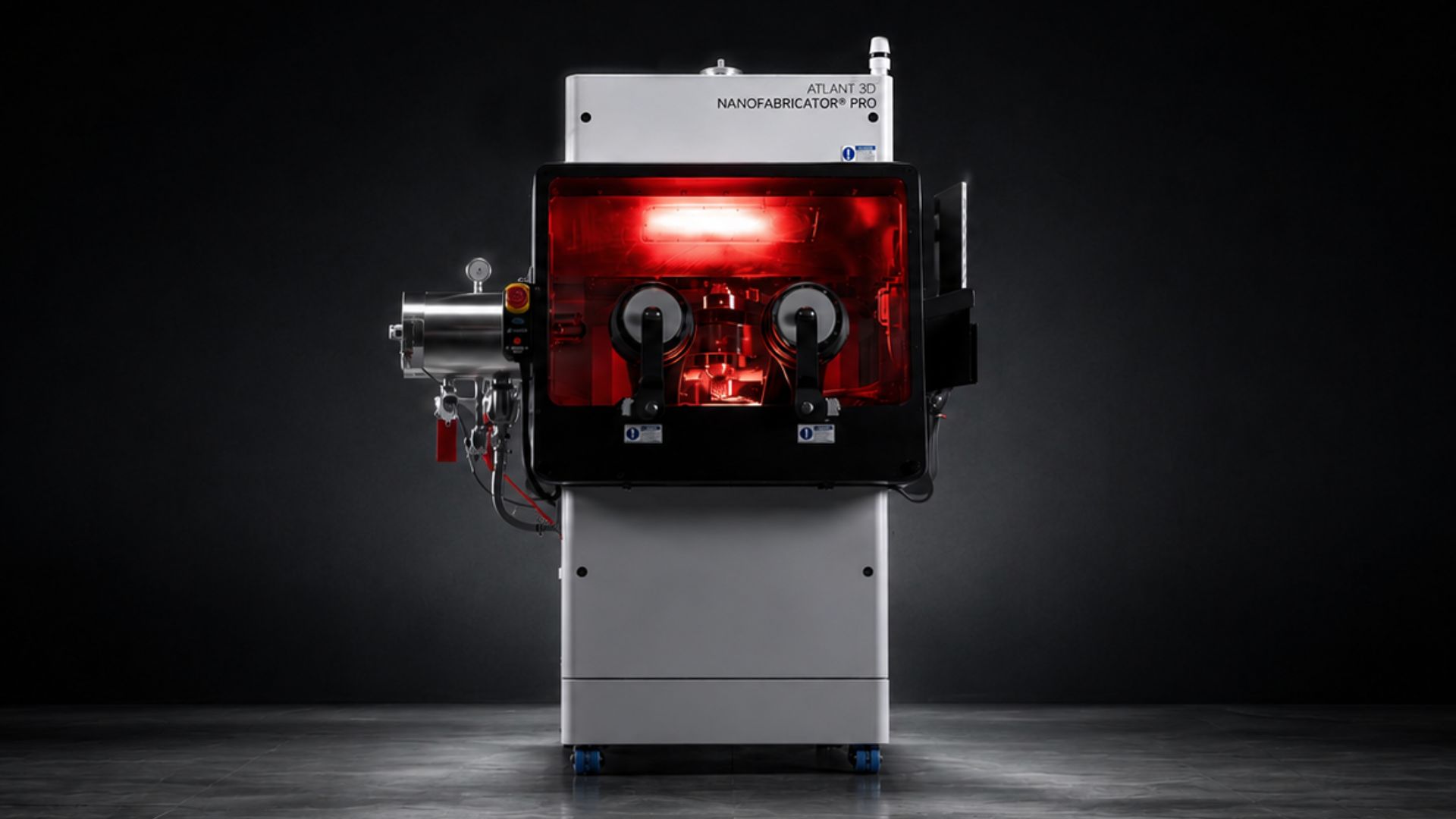
The Danish company's NANOFABRICATOR PRO is pitched as the physical half of AI materials discovery. The launch ships an argument about cycle time, but no cycle-time numbers.
The Product Desk · Product desk
What happened
- ATLANT 3D, a Danish technology company, has launched NANOFABRICATOR PRO, a semiconductor manufacturing platform built around its Direct Atomic Layer Processing technology.
- The source frames AI as increasingly useful for predicting materials with specific properties, while producing those materials is a separate engineering challenge: researchers still need to fabricate candidates under controlled conditions before they can determine whether a model accurately predicted their behaviour.
- ATLANT 3D says its approach can help connect computational predictions with physical experiments without separating those steps into entirely different workflows.
- ATLANT 3D CEO Maksym Plakhotnyuk said: "AI is fundamentally changing how new materials are discovered. The next frontier is turning those discoveries into real-world innovations."
- ATLANT 3D plans to incorporate integrated metrology as it develops more autonomous capabilities; measurements collected during fabrication could let automated equipment adjust later processing steps, an approach the source says could make experimental validation less dependent on separate testing cycles.
Compiled by The Product DeskSomething wrong?How this is made
Why it matters
ATLANT 3D has launched NANOFABRICATOR PRO, a semiconductor manufacturing platform built around its Direct Atomic Layer Processing technology [1]. The interesting part is not the tool but the premise underneath it: that prediction is no longer the scarce step in materials discovery, and that the constraint has moved to making and measuring the candidates a model proposes [2].
That premise is at least arguable on its own terms. As the company frames it, researchers still have to fabricate candidates under controlled conditions before anyone can say whether a model got the behaviour right [2]. ATLANT 3D says its approach connects computational predictions to physical experiments without splitting them into entirely separate workflows [3]. CEO Maksym Plakhotnyuk put it as a sequencing claim: "AI is fundamentally changing how new materials are discovered. The next frontier is turning those discoveries into real-world innovations" [4].
For anyone running a materials or device pipeline, the claim is testable, and it is worth testing with your own arithmetic rather than the vendor's framing. The relevant number is elapsed time from candidate list to a measured, trustworthy result, and the split inside it: how much is deposition, and how much is queue time, tool booking, metrology, and characterisation. A tool that compresses only the deposition slice of a loop dominated by measurement and analysis does not change the loop.
On that point the announcement is candid by omission. Integrated metrology is described as something the company plans to add as it develops more autonomous capabilities, with in-process measurements eventually feeding later processing steps [5]. In other words the closed loop is roadmap, and today validation still leans on separate testing cycles [5]. The launch material also carries no throughput figure, no price, no layer or sample rate, no named customer and no published cycle-time comparison [12], which means the central efficiency claim cannot be checked from outside the company.
The commercial groundwork is more concrete. ATLANT 3D describes the platform as SEMI-compliant and prepared for industrial semiconductor environments [6], and is manufacturing it in the United States through a partnership with Automated Industrial Robotics, giving it a domestic build route as it expands US operations [7]. AIR President Bob Fung said the partnership "combines advanced engineering with U.S. manufacturing capabilities to deliver NANOFABRICATOR PRO platform to enable next frontiers for future industries" [8]. The stated target markets are semiconductor manufacturing, advanced packaging and quantum technologies [9]. For a research tool trying to enter fabs, a US manufacturing base and a compliance claim matter more than the physics story, because they determine whether the thing can be installed at all.
The larger ambition is a proposed A-HUB Autonomous Materials Foundry, in which AI identifies candidates and the physical system returns experimental data that shapes the next round [10]. ATLANT 3D calls the broader concept Physical AI Infrastructure for Matter and is seeking strategic partners to develop it [11]. That is a fundraising and partnership posture, not a shipped capability.
Three things to watch. Whether integrated metrology actually ships in-tool, since without it the loop stays open [5]. Whether any named customer in advanced packaging or quantum publishes a before-and-after cycle time [9][12]. And whether the AIR partnership produces install numbers and lead times rather than a press line about domestic capability [7].
Loading topic controls
Loading related stories