Loading today’s stories
Product1 distinct publisher3 min readUpdated
A Jetson Orin in a Russian cruise missile is a distribution problem, not a chip problem
Ukraine's HUR says it found an Nvidia edge-AI module inside the S-71 Monochrome on August 12, one of 35 foreign components. The other 34 are the real story.
The Product Desk · Product desk
What happened
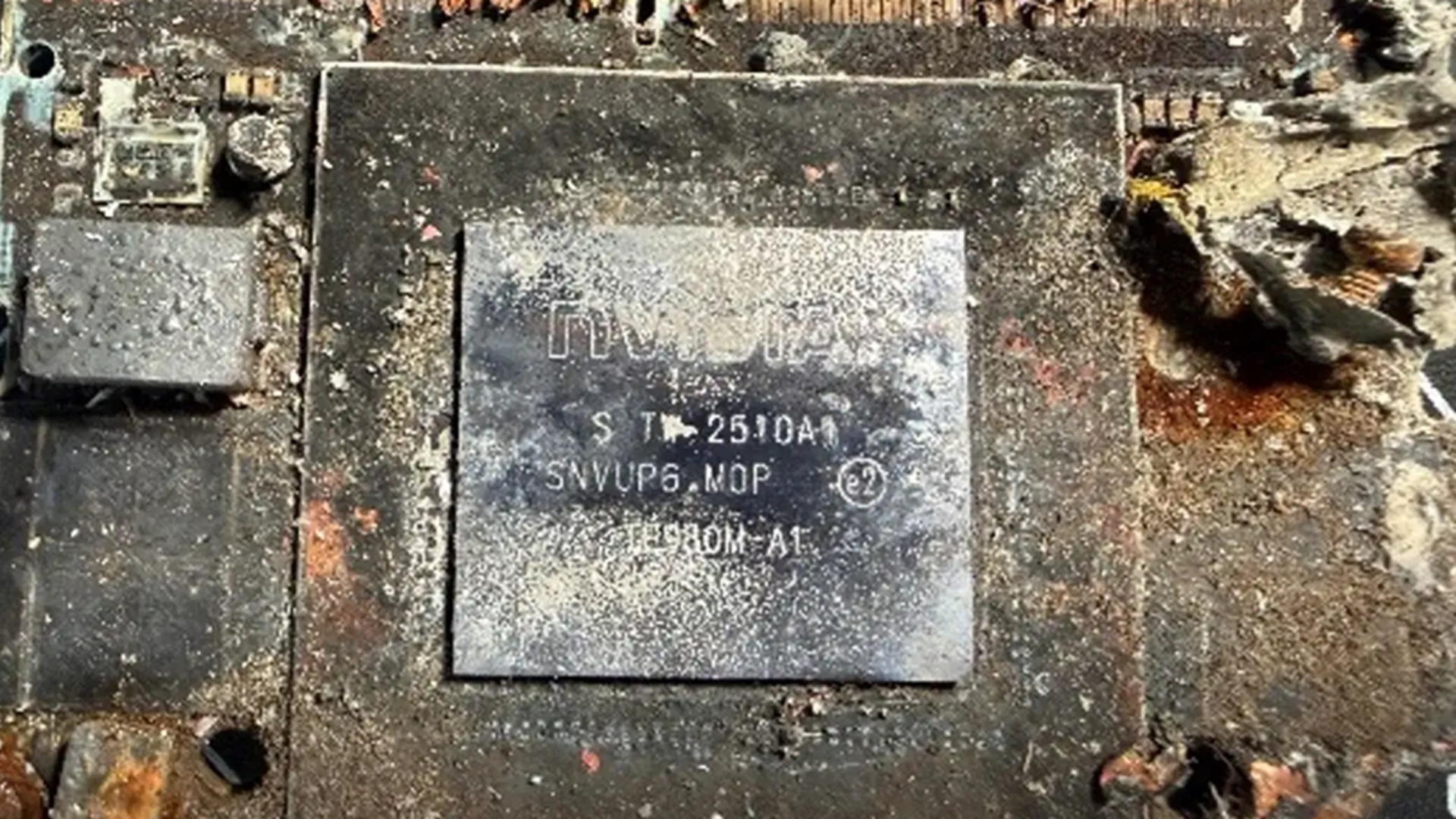
- Ukraine's Main Directorate of Intelligence (HUR) announced on August 12 the discovery of an Nvidia Jetson Orin computer inside Russia's new S-71 Monochrome air-launched cruise missile.
- The Nvidia hardware was among 35 foreign electronic components that Ukrainian experts identified in the Russian weapons they examined.
- Besides the Nvidia Jetson Orin module, 34 other foreign electronic components were identified in the examined Russian weapons.
- The Nvidia Jetson Orin family of computer modules are designed for AI, computer vision, and autonomous systems.
- The flagship Jetson AGX Orin delivers up to 275 trillion operations per second (TOPS) while using between 15 and 60 watts of power.
Compiled by The Product DeskSomething wrong?How this is made
Why it matters
Ukraine's Main Directorate of Intelligence said on August 12 that it had identified an Nvidia Jetson Orin computer module inside Russia's new S-71 Monochrome air-launched cruise missile [1]. The module was one of 35 foreign electronic components Ukrainian specialists logged in the Russian weapons they examined [2], which means the finding is not about one part but about 34 others sitting next to it [3].
The Jetson Orin is a catalogue product, not a defence article. The family is built for AI, computer vision and autonomous systems [4]. The flagship AGX Orin is rated at up to 275 trillion operations per second while drawing 15 to 60 watts [5]; the Orin NX reaches 157 TOPS at 10 to 40 watts [6]; the Orin Nano tops out at 67 TOPS at 7 to 25 watts [7]. It runs an Ampere GPU and Nvidia's JetPack software stack [8], and it is marketed for applications that need advanced onboard processing [9]. At its highest rated draw, the top module works out to roughly 4.6 TOPS per watt [10]. That efficiency is exactly why a robotics module is attractive to anyone building a thing that flies itself and does not come back.
HUR did not say how the Nvidia hardware is used or what it does during flight [11]. That restraint is worth respecting, because the surrounding detail invites a guess. The Monochrome is based on the S-71 Kovyor and is sized to fit inside the weapons bays of the Su-57 fighter and the S-70 Okhotnik drone [12], and it is described as harder to detect and reportedly able to search for targets on its own [13]. Autonomous target search is the workload an Orin-class module would plausibly serve. Ukrainian intelligence has not confirmed that link [11].
The rest of the batch is the more useful intelligence for anyone who ships components. HUR identified parts of a passive radar seeker Russia has begun fitting to Geran-2 drones, intended to let them find and strike Ukrainian surface-to-air missile systems and radar stations [14]. It logged a Chinese-made Honpho TS130C-01 camera pulled from a jet-powered Geran-4 [15], and components from the active seeker of the Kh-47M2 Kinzhal [16]. The entries are published through the Components in Weapons section of HUR's War-Sanctions portal [17]. Interesting Engineering's account notes that this dependence on foreign electronics persists despite years of international sanctions and restrictions on advanced electronics [18]. HUR frames the work as helping Ukraine and its partners identify critical foreign technologies and tighten measures against their supply [19].
The operator reading is narrow and specific. Nothing in the source says how the module reached Russia, when it was made, or through which intermediaries. What it does show is that a widely sold module with published performance figures ended up in a weapon whose designers evidently valued its compute-per-watt more than its warranty. Controls written around wafer capacity and datacentre accelerators do not touch that path. The control surface is the reseller channel and the serial number.
Watch whether HUR starts publishing lot and date codes rather than part names, since codes are what turn a teardown into a diversion investigation. Watch whether Components in Weapons accumulates more general-purpose inference modules over the coming months, or whether the Orin stays an outlier. And watch for any change in how edge-AI modules are distributed, from either the vendor or its regulators.
Loading claim ledger
Loading source directory links
Loading share composer
Loading topic controls
Loading related stories