Loading today’s stories
Science1 distinct publisher3 min readUpdated
NYC's school match undermatches by list, not by cutoff - and the fix is already in the mail
Cornell's Nature Cities paper puts a number on choice overload in a 60,000-student admissions system. A companion recommender is already running inside New York City Public Schools.
The Scientist · Science desk
What happened
- New Cornell research finds many New York City eighth-graders, particularly those from underserved communities, are not applying to academically competitive high schools where they could succeed.
- The paper "Connecting application behavior to undermatching in New York City school choice" was published in Nature Cities.
- New York City's public high school application process requires more than 60,000 eighth-graders to navigate hundreds of options, and is designed to give students access to schools across the city regardless of neighbourhood.
- Nikhil Garg, assistant professor of operations research and information engineering at Cornell Tech and the Cornell Duffield College of Engineering and a co-author, called it a complex process and said the challenge is figuring out how to navigate 900 options and decide which ones to apply to.
- The researchers analysed data from nearly 59,000 students who participated in New York City's high school admissions process during the 2022-23 school year.
Compiled by The ScientistSomething wrong?How this is made
Why it matters
A Cornell team reported in Nature Cities that New York City eighth-graders enrol in high schools far less selective than the ones their own applications would have won them, and identified the application list rather than the admissions rule as the binding constraint [2][6][7]. The same group, working with New York City Public Schools, has already shipped a countermeasure into the live admissions cycle, which makes this an operational test rather than a finding [13][20].
The setting is deliberately open. More than 60,000 students choose among hundreds of programs citywide, regardless of neighbourhood [3]. Co-author Nikhil Garg, of Cornell Tech, described the task as figuring out how to navigate 900 options and decide which ones to apply to [4].
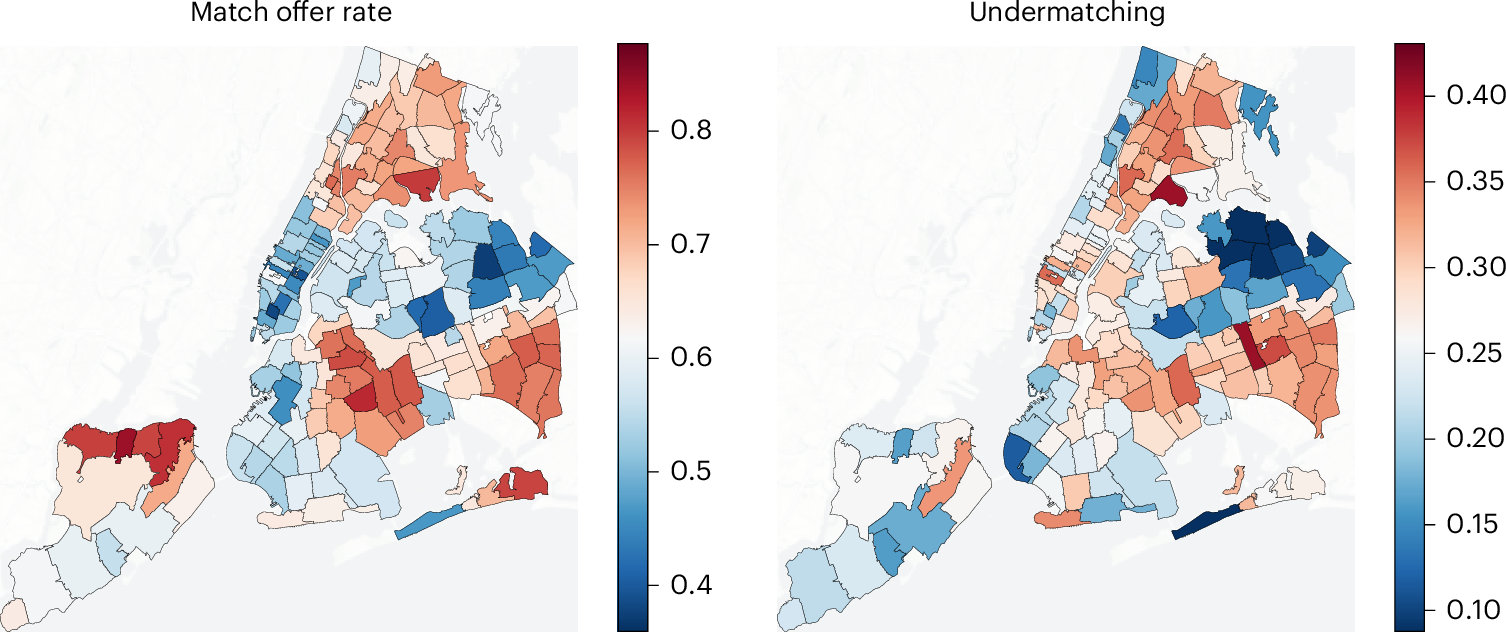
The measurement is the interesting part. Using data on nearly 59,000 students from the 2022-23 cycle, the team paired admissions records with a model of how students choose under uncertainty, then asked not only where students were admitted but where they could have been admitted had they applied elsewhere [5][6]. On average, students enrolled at schools that admit about 64% of applicants when they could have been admitted to schools admitting about 37% [7]. That is a 27 percentage point gap [17], or reachable schools roughly 1.7 times as selective on admit rate [18]. The gap was widest for the strongest applicants and for Black, Hispanic and lower-income students, which the authors say raises the question of whether process complexity is itself producing the inequity [8][9].
Two things follow. First, the counterfactual is model-dependent: the "could have been admitted" figure comes from a choice model layered on real admissions data, not from a second round of actual offers [6]. Kenny Peng, who led the paper with Emily Ryu, framed the exercise as quantifying on real data an effect the team already suspected [11][12]. Second, admit rate is standing in for school quality throughout, which is a convenient proxy and not the same thing [7].
The deployment side comes from a companion paper led by doctoral student Erica Chiang, who worked with the district as a Siegal PiTech Ph.D. Impact Fellow; the system was built by the researchers and run by NYCPS, sending personalised email recommendations during the 2025-26 admissions cycle [13]. Targeting was structural rather than individual: messages went to students at middle schools that historically sent few graduates to high-performing high schools, and highlighted nearby programs where the student had a strong predicted chance of admission [15]. In a randomised controlled trial, recipients were 59% more likely to apply to a recommended program [16]. The paper won the Best Paper with Student Lead Author Award at the ACM Conference on Economics and Computation on July 7 [14].
What to watch is whether behaviour change survives the market. The reported trial outcome is application to a recommended program, not enrolment or later achievement [19]. Seats at selective schools are fixed, so a district-wide nudge redistributes rather than creates them; the number that matters next is whether the average admit rate of enrolments falls, and for whom, once everyone is being advised to aim higher [7][10].
Loading topic controls
Loading related stories