Loading today’s stories
Product1 distinct publisher3 min readUpdated
At DIII-D, retraining cadence beat architecture: 80% less error from a model that keeps learning
A self-updating model of DIII-D's toroidal field coils cut prediction error by 80 percent against a static one. An uncertainty-weighted ensemble on top added about 10 percent more.
The Product Desk · Product desk
What happened
- Researchers at the DIII-D National Fusion Facility in San Diego developed a machine-learning system that can learn from changes in the machine's hardware as they happen and predict how the hardware will behave during the next experiment.
- When tested, the online-learning approach reduced prediction errors by 80 percent compared with a conventional static machine-learning model.
- The uncertainty-guided ensemble reduced error by approximately another 10 percent compared with standard single-model online learning, while also providing uncertainty estimates that could support operational decisions.
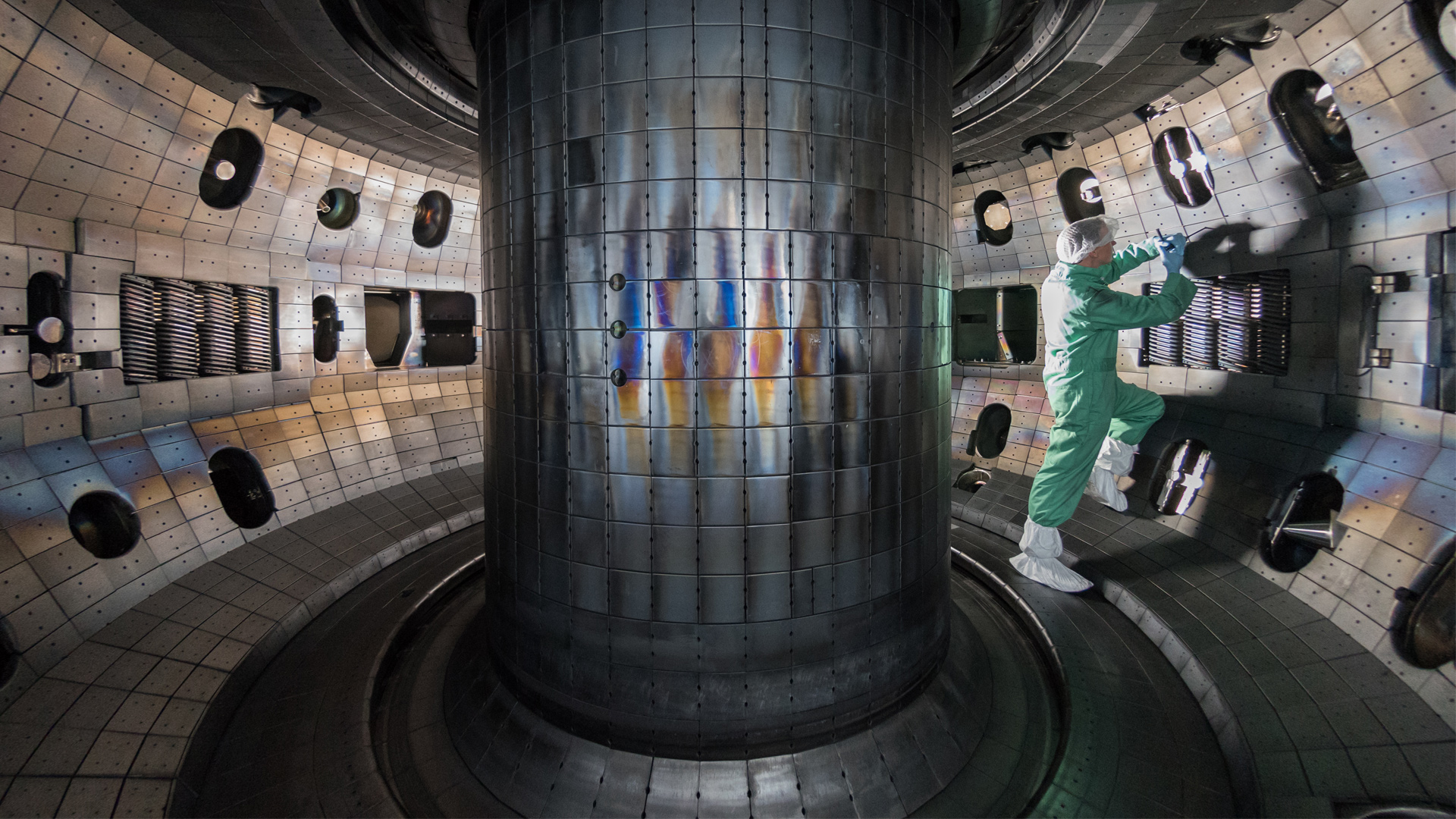
- DIII-D is a tokamak, a donut-shaped device that uses magnetic fields to confine plasma; its D-shaped cross-section is surrounded by a ring of large magnets called toroidal field (TF) coils.
- The TF coils are built and secured with tight engineering tolerances but are not completely motionless; as plasma stability changes from one shot to another, the coils can shift slightly.
Compiled by The Product DeskSomething wrong?How this is made
Why it matters
Researchers at the DIII-D National Fusion Facility in San Diego have built a machine-learning system that updates itself between plasma shots and forecasts how the machine's magnets will move during the next one, reducing prediction error by 80 percent against a conventional static model [1][2]. The result worth copying is not the network design but the schedule: the retraining cadence did most of the work, and the cleverer ensemble on top added roughly another 10 percent [2][3].
The thing being predicted is unglamorous and physical. DIII-D is a tokamak with a D-shaped cross-section ringed by large toroidal field coils [4]. Those coils are built and secured to tight engineering tolerances but are not motionless, and as plasma stability changes from shot to shot they shift slightly [5]. "You want to predict the movement of these coils during experiments to get a sense of how stable a particular shot would be and whether a problem may arise," said Kishan Rajput, a data scientist at Jefferson Lab and one of the researchers [12][11].
The failure mode of the usual approach is stated plainly by the team. According to Rajput, there is a lot of drift in the TF coil data shot to shot because the plasma's behavior is always changing, so a model trained only on historical data and used without updates would likely not be reliable [6]. That is the whole argument. A static model encodes an assumption that tomorrow's data distribution resembles yesterday's, and on a machine that deforms under its own operating conditions that assumption is simply false [15].
The team's answer is deep neural networks trained through online learning, with new information fed in continually so the system adjusts as conditions evolve [7]. They then ran an ensemble of models trained over different historical time horizons, on the reasoning that some drift is abrupt and some is gradual, with intermediate horizons covering the middle [8]. Because the system cannot know at prediction time whether it is right, each forecast carries an uncertainty estimate, and the ensemble gives more weight to models producing narrower, more reliable ranges [9]. The researchers describe the whole thing as a digital twin of the coil system, a virtual replica you can feed parameters into before running them on the physical machine [10].
Read the two numbers carefully. They are not measured from the same baseline: 80 percent is relative to a static model, and the roughly 10 percent is relative to standard single-model online learning [2][3][16]. Even so, the ordering is hard to miet aside: continuous updating was worth several times what the architectural elaboration was worth [13].
What to watch: whether the uncertainty bands actually change operator behavior rather than sitting in a dashboard, since that was the stated justification for the ensemble [9]; whether the 80 percent holds across a full campaign rather than a test window [2]; and whether the same cadence-first result reproduces on other drifting subsystems, given that the team frames this as moving AI toward an operational tool alongside real-time plasma control [14].
Loading topic controls
Loading related stories