Loading today’s stories
Product1 distinct publisher3 min readUpdated
Food-waste heat-storage membrane clears 1,000 cycles, though not as a membrane
Yonsei researchers report 93.1 J/g of latent heat and 90.2 percent retention after 1,000 cycles. The paper membrane keeps 80.2 percent of that capacity; its own cycle life is not reported.
The Product Desk · Product desk
What happened
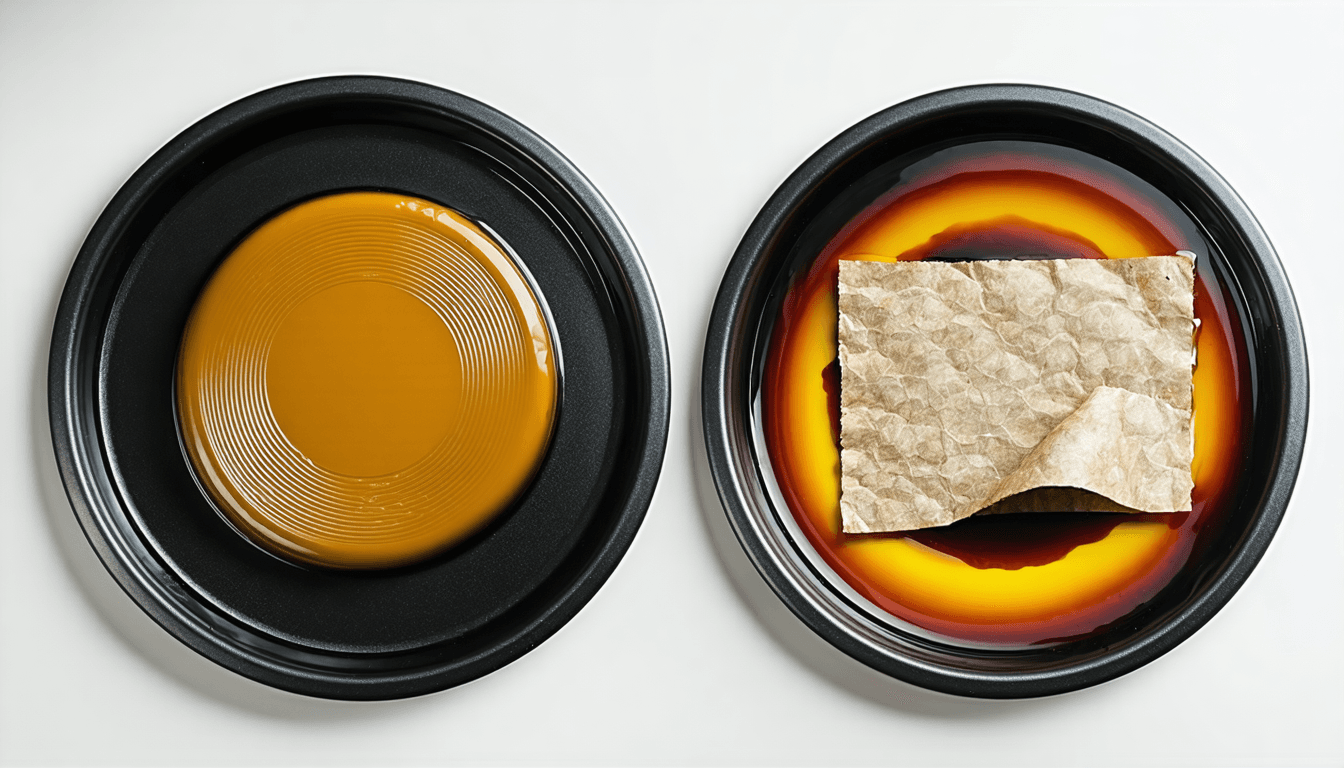
- Researchers combined food-waste-derived biochar, graphene and a phase-change material into a paper membrane designed for thermal management and energy recovery ventilation.
- Phase-change materials absorb heat when they melt and release it when they solidify; many have low thermal conductivity and can leak when they become liquid.
- The biochar was produced by carbonizing mixed food waste at 752F and activating it with potassium hydroxide at temperatures between 1,112F and 1,472F.
- The version activated at 1,292F developed a surface area of 323.1 square meters per gram with mesopores making up 82.8 percent of its pore structure; the pores provided space for the phase-change material while helping hold it in place.
- Graphene-engineered systems increased latent heat storage by as much as 72 percent compared with composites made using pristine engineered biochar.
Compiled by The Product DeskSomething wrong?How this is made
Why it matters
Multiply the two retention numbers and you get the figure a mechanical engineer would size against. Bulk enthalpy of 93.1 J/g, times the 80.2 percent the paper membrane retains, is about 74.7 J/g of latent capacity in the object you would actually install [1]. Everything else in the announcement is upstream of that number.
The cycling result is the one that decides whether thermal storage can be written into a specification, and it is attached to a different specimen than the membrane result. The 90.2 percent retention after 1,000 heating and cooling cycles was measured on the composite [7]. The 80.2 percent latent-heat retention and the heat-storage-rate gain were measured on the paper membrane [8]. Carry the composite's fade rate across anyway and you land near 67 J/g after a thousand melts [5], an average loss of about a hundredth of a percentage point per cycle [2]. That is a good rate, if the substrate does not change it. Docosane confined in mesopores [4] is not obviously the same system once those pores sit inside a commercial sheet that also has to pass water vapour, and the source reports no cycling of the sheet.
The vapour number is doing quiet work here: equivalent air-layer thickness of 0.71 against a critical threshold of 1.0, with ISO 12572 and ASTM criteria reported as met [9]. In energy recovery ventilation, the membrane has to move moisture between the two air streams as well as heat [12], with the phase-change layer buffering thermal energy and releasing it as conditions change [13]. A storage membrane that blocks vapour has given up half the duty it was built for.
Then temperature. The enthalpy is quoted at 116.1F, which is 46.7C [6][3]. The latent portion only engages when something crosses that line, and the material's list of intended homes - ventilation cores, facades, comfort systems [10] - contains conditions that would cross it often and conditions that never would. The source does not say which.
Cost runs the other way from the feedstock story. The carbon is free, but it is carbonised at 400C and then activated with potassium hydroxide between 600C and 800C, with the best-performing sample activated at 700C [3][4][4], and graphene is added on top, which the source credits with up to a 72 percent gain in latent heat storage over composites built on pristine engineered biochar [5]. The authors themselves defer production energy, manufacturing cost and techno-economic performance to later work [10]. Professor Sumin Kim of Yonsei University describes the result as combining storage, heat transfer, structural stability and moisture management in one membrane [11]. For procurement, the arithmetic that settles it is whether one membrane costs less than the separate layers it displaces, and that figure has not been published.
Loading topic controls
Loading related stories