Product2 publishers3 min readPublished
Heron Power bets $100m that the grid's binding constraint is a box, not a megawatt
A Morgan Hill factory will not ship at volume until late 2027, and the company's 40GW headline already discounts its own nameplate rating by a fifth.
The Product Desk · Product desk
Drafted by a language model from the sources cited here and checked against its claim ledger before publication. How we use AISend a correction
What happened
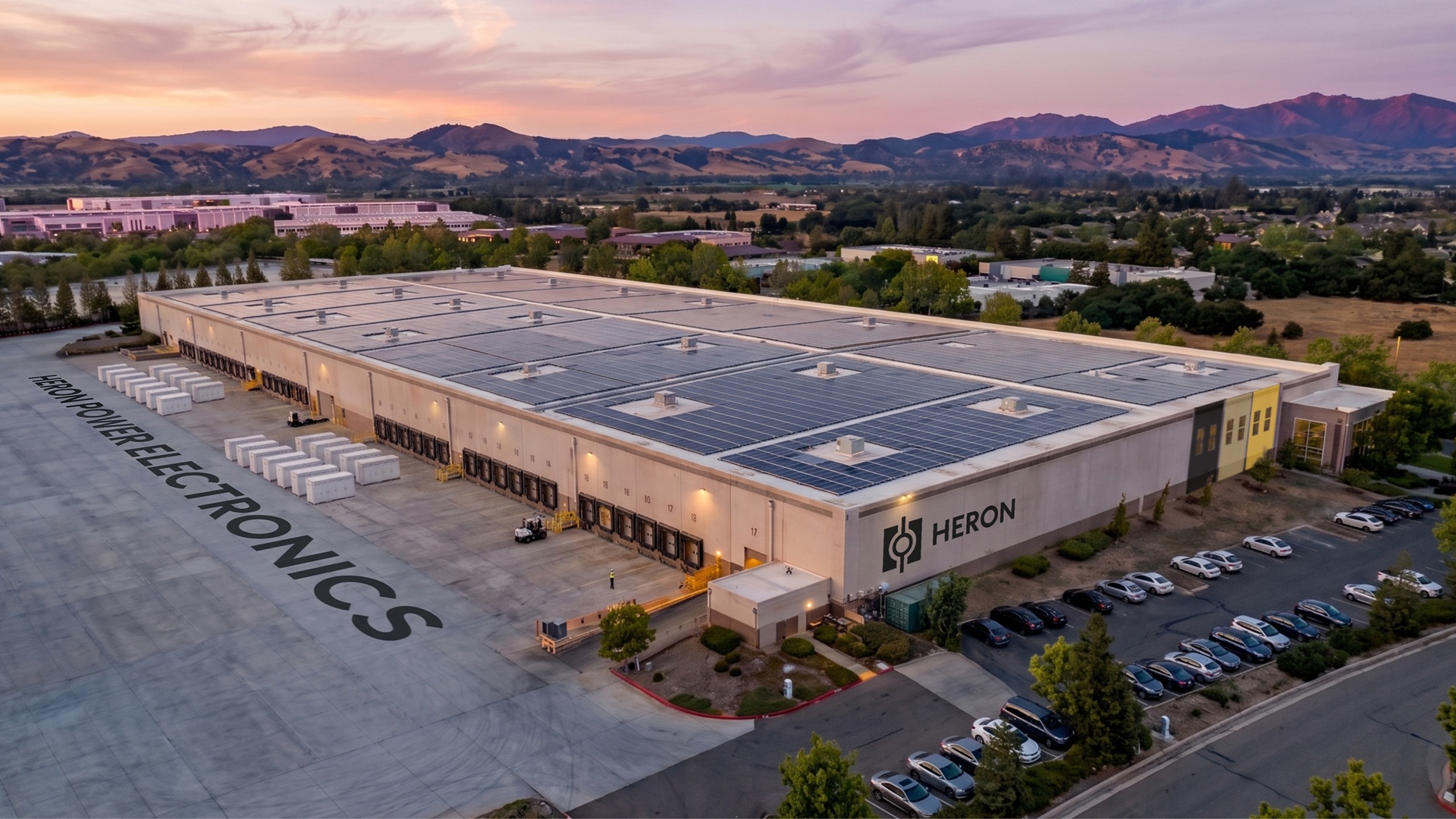
- Heron Power will invest more than $100 million to turn a former warehouse in Morgan Hill, California, into a large-scale factory for advanced grid equipment, with site preparation beginning immediately and mass production expected to begin in late 2027.
- The facility is a former 286,000 sq ft distribution warehouse located just south of San Jose.
- Heron Link is a 5MW medium-voltage power conversion system targeted at data center and large-scale energy projects.
- The company expects the factory to produce up to 10,000 Heron Links a year.
- Heron says that output would represent more than 40 gigawatts of annual capacity, roughly three-quarters of all new generating capacity added to the US grid in 2025.
Compiled by The Product DeskSomething wrong?How this is made
Why it matters
Heron Power said it will spend more than $100 million converting a former 286,000 square foot distribution warehouse just south of San Jose into its first large-scale factory, with site preparation starting immediately and mass production of its 5MW Heron Link medium-voltage converter slated for late 2027 [1][2][3]. The company is wagering that the scarce input for new data center and generation capacity is not electricity but the equipment that connects it, a constraint its own framing puts ahead of megawatts [9].
The product claim is consolidation. Heron says Heron Link replaces several pieces of conventional grid equipment with a single modular unit, using software-controlled wide-bandgap semiconductors to manage conversion, with higher power density and a smaller physical footprint [7][15]. The load-bearing assertion is narrower and more testable: that renewable, storage and data center projects can connect directly to medium-voltage transmission without a transformer [8]. If interconnection engineers accept that, it removes a discrete item from project scope, which matters given the company's claim that more than 80 percent of critical grid components such as transformers and inverters are imported [10].
The capacity arithmetic deserves a second look. Heron expects up to 10,000 units a year, which it describes as more than 40GW annually, or roughly three-quarters of all new generating capacity added to the US grid in 2025 [4][5]. That comparison implies 2025 additions of about 53GW [19]. It also sits a fifth below the plant's own nameplate: 10,000 units at 5MW each is 50GW, so the 40GW figure embeds a 20 percent discount [18]. That is a reasonable way to talk about real output, and it is the ratio, not the headline, worth holding onto.
The money is the more revealing number. California is contributing a $26.4 million California Competes tax credit through the Governor's Office of Business and Economic Development [12]. Heron evaluated sites in several states before choosing Morgan Hill for proximity to its engineering base and the Bay Area workforce, working with the city, PG&E and JLL [13]. Against a Series B of $140 million earlier this year and $183 million raised in total, a single factory commits more than half of every dollar the company has taken in [14][20]. It expects the plant to create more than 600 jobs [6]. Heron was founded in 2024 by Drew Baglino, a former senior Tesla executive, who said the equipment running the grid "hasn't changed in fifty years" and that the company is "manufacturing the leapfrog technology our grid needs, at scale, in America first" [17][11].
Three things to watch. Whether the letter of intent signed last June with Crusoe, for converters at the Stargate campus in Texas, converts into firm orders, noting that Crusoe is also an investor in Heron [16]. Whether utilities and interconnection queues actually permit transformerless medium-voltage connection at scale, since that is where the footprint savings live [8]. And whether the wide-bandgap semiconductors themselves are domestically sourced, which neither announcement states, against an import-substitution pitch [21][10]. Nothing ships at volume before late 2027 [1].