Loading today’s stories
Leadership1 distinct publisher3 min readUpdated
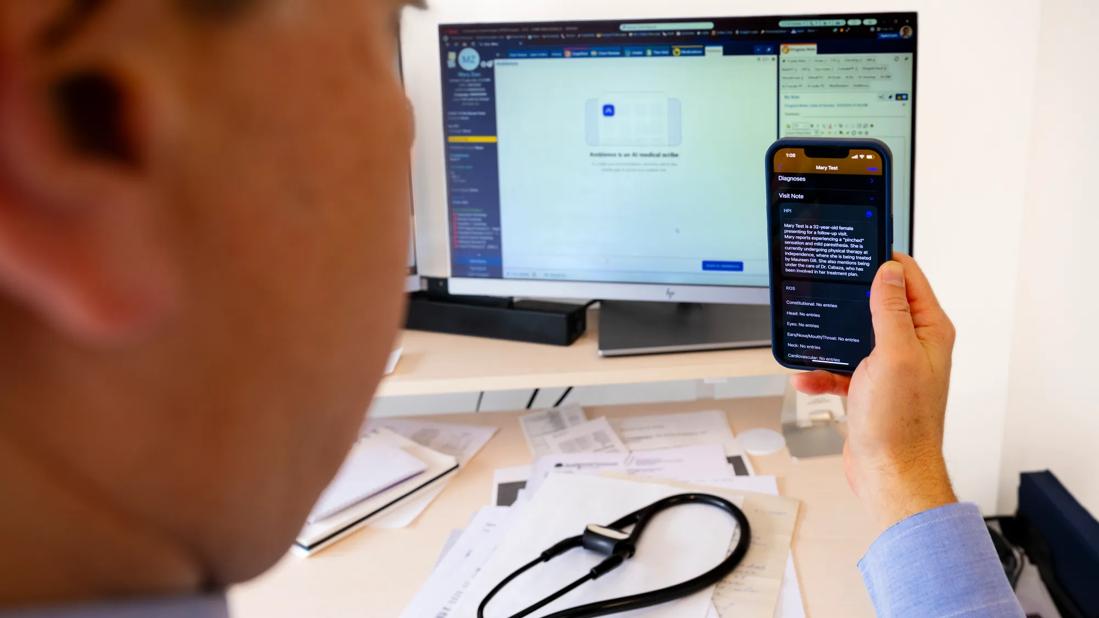
Ambient scribes save about 72 seconds a visit. Governance comes out of that
The efficiency question is answered. Full deployment turns the exam room into a continuous data stream, and that is a governance bill nobody has priced.
The Board Room · Leadership desk
What happened
- A JMIR paper published earlier this year found that ambient AI scribe use was associated with a statistically significant reduction in on-shift documentation time (P<.001), equivalent to approximately 24 minutes per 8-hour shift if used across 20 encounters.
- Hospital systems are moving away from the initial pilot phase of ambient AI and other AI systems toward full-scale deployment, and are encountering new hurdles that leadership must address.
- A paper in JMIR Medical Informatics says significant governance issues may arise from widespread ambient scribe incorporation, ranging from consent and trust issues for patients to cognitive deskilling for physicians.
- Authors of a paper in Cardiovascular Diagnosis & Therapy say ambient AI tools significantly reduce cognitive burdens for physicians, improve job satisfaction and improve practice-level efficiency, which could lead to measurable increases in access to care.
- The same Cardiovascular Diagnosis & Therapy paper states that studies also report frequent documentation omissions and occasional clinically significant hallucinations.
Compiled by The Board RoomSomething wrong?How this is made
Why it matters
The efficiency case is settled, and it is small. Divide the JMIR figure by the 20 encounters it assumes and the gain is roughly 72 seconds per visit [11], which is about 5 percent of an eight-hour shift [12]. Across a large medical group that adds up. It is also the entire budget from which the new obligations have to be paid: explaining the listener to a patient who asks, and reading the draft closely enough to catch what is not in it.
The error profile is the part that does not improve when a pilot becomes a platform. The authors writing in Cardiovascular Diagnosis & Therapy report frequent documentation omissions and occasional clinically significant hallucinations [5]. Omissions are the harder class. A hallucinated line is visible to a reader; a missing one is only visible to a clinician who remembers what was said, and that clinician has just been handed 72 seconds and a schedule that was already running late [10].
That is why the JMIR Medical Informatics paper's pairing of consent with cognitive deskilling is the more useful framing for a board [3]. Deskilling produces no incident report. It shows up over quarters as a reduced capacity to notice that the draft is wrong, which is precisely the control the omission risk depends on. Any organisation deploying at scale should be able to name the metric that would detect it, and most cannot.
The same paper set also asks for specialty-specific validation, on the grounds that in subspecialties where documentation needs precise and time-sensitive detail, AI errors carry greater risk [6]. Note the mismatch in units. An enterprise agreement is one decision made once; validation is per specialty, per workflow. Vendor rollout schedules and change-management programmes are built around the first unit, because that is the unit that was purchased.
Which leaves the pause. The instruction that leaders should keep a low threshold to halt rollout if patient safety or physician workflows suffer [8] is correct and, as written, unenforceable. A threshold is a number and a name: the signal that trips it, and the person whose authority survives the fact that the contract is signed and the training is done. Large-scale implementation is described as requiring strict thresholds to judge performance [7], and the honest version of that is agreed before go-live, because after go-live the cost of stopping is borne by whoever proposes it.
None of this argues against the tools. The documentation load is real, physician schedules do not accommodate it [10], and passive note generation has demonstrably cut after-hours charting [9]. The point is that the efficiency argument has stopped doing any work. Once every exam room is a continuous stream [2], what leadership is actually approving is a standing listening practice, priced against a minute per patient.
Topics and entities
Follow any of these and your For You feed starts watching them — no settings page required.
Topics
Loading related stories