Loading today’s stories
Science1 distinct publisher3 min readUpdated
Britain's burned moors green up in days. That tells you almost nothing about the peat.
The fastest regrowth after a moor fire comes from organs the flames never reached. Where peat burned deep, the same species can stay absent for a decade, and the surface does not distinguish the two.
The Scientist · Science desk
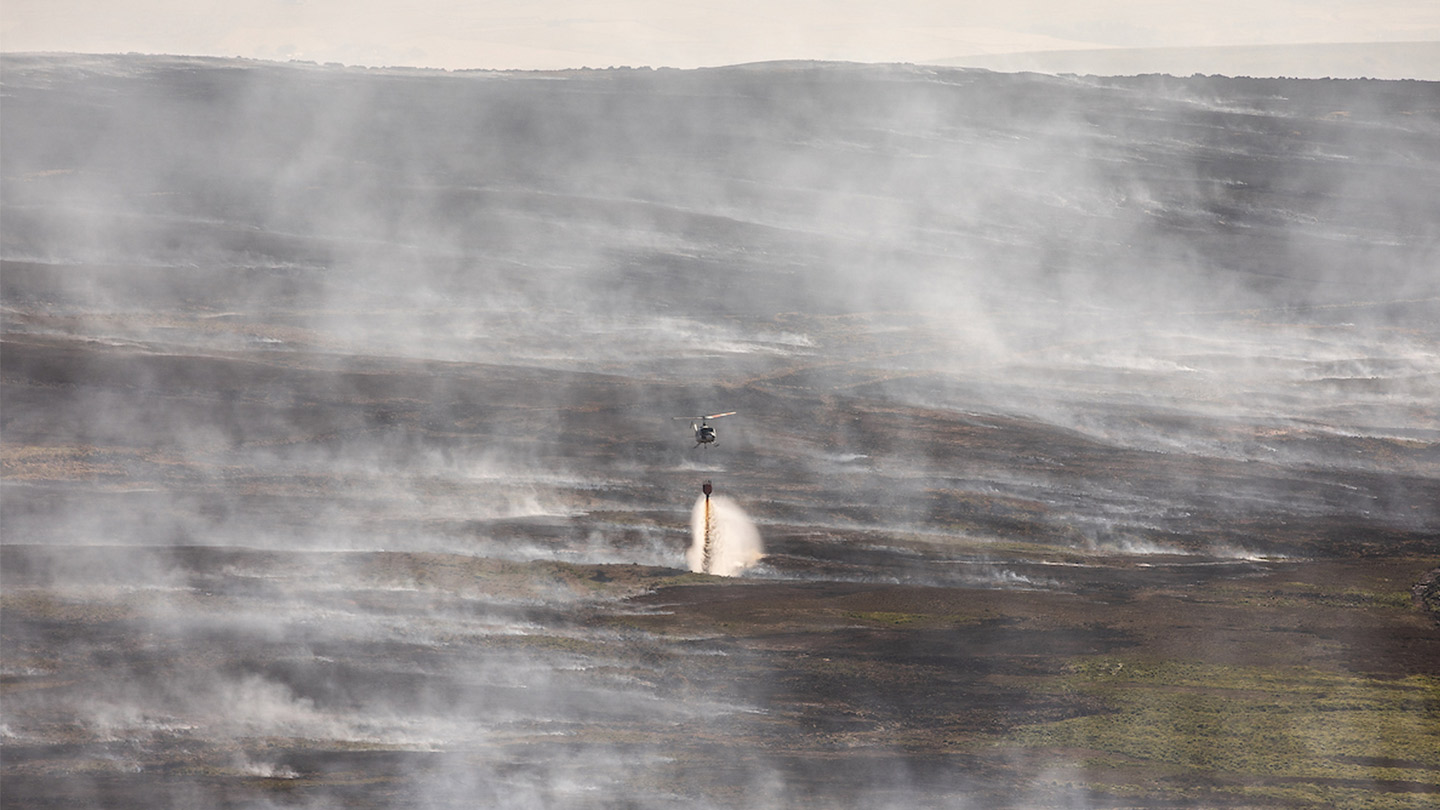
What happened
- Wildfires have swept across Britain's upland moors and lowland heaths in tinder-dry conditions, leaving expanses of smoking, blackened vegetation.
- Both heaths and moors contain several distinct habitats, each of which responds differently to fire.
- The first green shoots of recovery after a fire may emerge within days rather than weeks, months or decades.
- In wet heath, hare's-tail cotton grass and purple moor grass form dense fire-resistant tussocks from which new shoots emerge within days, and common cotton grass can regenerate rapidly from its protected root system.
- Dry lowland heaths are dominated by heather, whose fine woody tissue is excellent fuel; fire heat can stimulate germination of heather seeds buried just below the surface and protected from the worst of the flames.
Compiled by The ScientistSomething wrong?How this is made
Why it matters
Every fast-recovery pathway in the phys.org account runs through tissue the fire could not reach. Sphagnum survives surprisingly intense heat because its waterlogged tissue below the surface stays insulated, and even where the surface layer is burned away the living parts beneath can push fresh growing tips, slowly [8]. Cross-leaved heath, a more delicate heather, returns or does not depending partly on whether waterlogging protected its roots while the flames passed overhead [7]. Both of those are subsurface states. Neither is legible from above, which is the problem with grading a burn by its colour.
Put the two ends of the published range side by side. First shoots inside days at one end [3]; recolonisation of deeply burned bare peat in ten years or more at the other [10]. Taking ten days as a generous reading of "days", the slow outcome runs at least 365 times longer than the fast visible one [1]. The species overlap makes it worse for anyone doing the looking: heather and cotton grass are named both as the quickest regenerators and as the plants that may struggle to get back onto burned bare peat [2]. A flush of green cotton grass tells you that one tussock or root system came through. It says nothing about the peat under it.
There is a second way the visual read flatters. Familiar vegetation may return to upland moor within five to 10 years [12], but that vegetation is the product of the landscape already having been remade [11]. In their natural state, the account says, these uplands held far more wet bog and moss-rich temperate rainforest, slowed water on its way downstream, and resisted fire without being immune to it [16]. Scoring recovery on the return of familiar plants therefore scores the return of the drained, flammable configuration rather than the one that held water and slowed fire [3].
The counterweight in the same piece is procedural, not botanical. Left alone, severe degradation can take many decades to reverse; drain blocking and Sphagnum reintroduction can pull the peat-forming plants back inside a decade [14], which is the difference between one funding horizon and three or four [4]. Rainforest on the drier slopes takes longer and is already under way with government support [17]. The older mechanism was livestock and, since early medieval times, rabbits keeping heath open, with beavers maintaining the wet ground that acted as a fire barrier [18]; none of that is coming back on the schedule of a post-fire survey.
One caution about all of the figures above. They are habitat-typical ranges from an explainer covering several distinct habitats that respond differently to the same fire [2], not measurements from any named burn [1]. Applied to a specific site, they are interpolation, and the interpolation error is largest exactly where the stakes are: whether the fire got into the peat, and how wet that peat was when it did.
Loading topic controls
Loading related stories