Loading today’s stories
Science1 distinct publisher3 min readUpdated
Pollen in a Roman ship's tar turns hull sealant into a maintenance log
Researchers in France and Croatia analysed the coating on a 2,200-year-old Adriatic wreck and found pine tar, one beeswax patch, and pollen that points to where each coat was applied.
The Scientist · Science desk
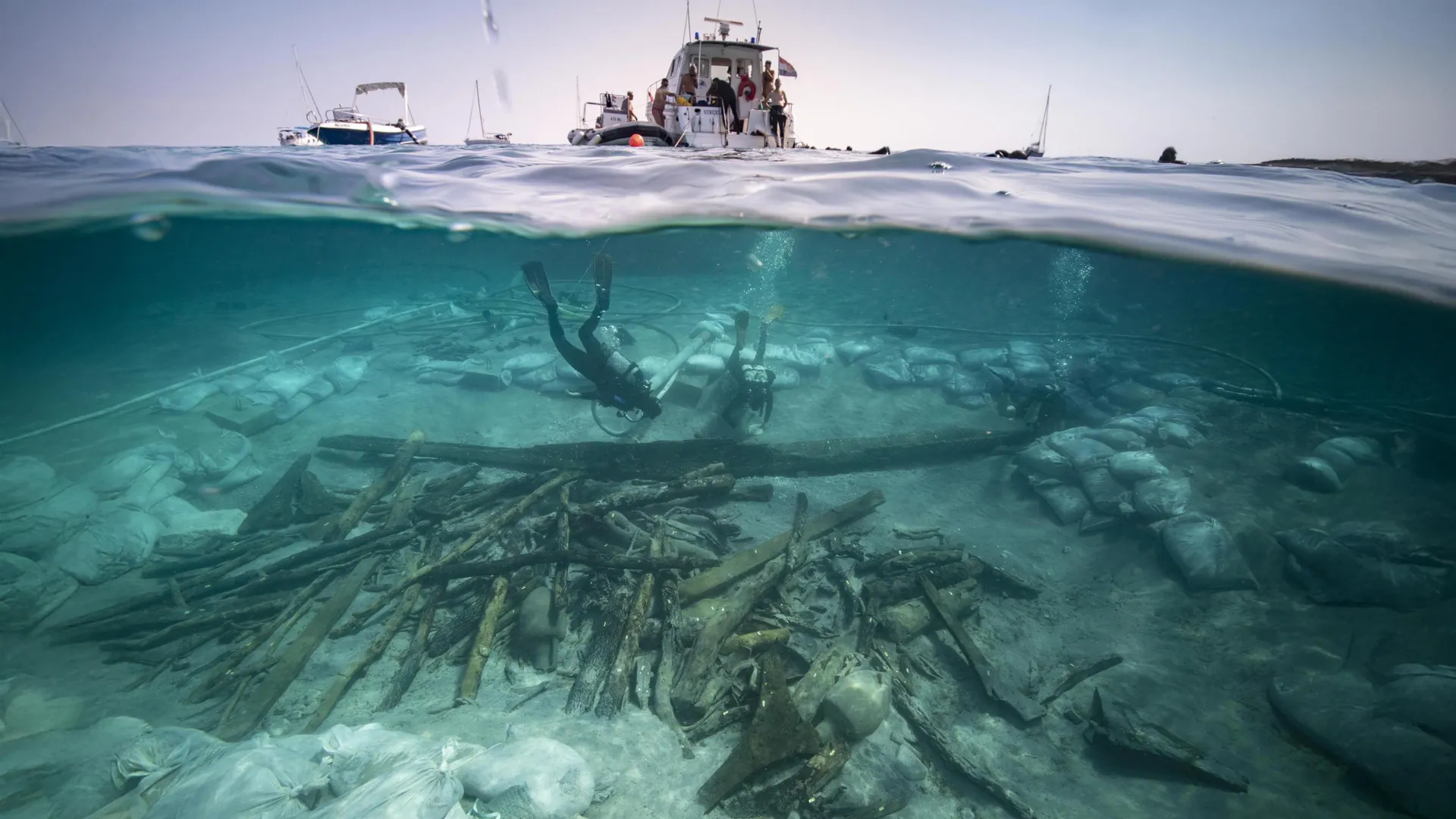
What happened
- A study published in Frontiers in Materials analysed the protective coating on the Roman Republic shipwreck Ilovik-Parzine 1, which sank about 2,200 years ago off the coast of what is now Croatia; researchers in France and Croatia carried out the work.
- Scientists found the hull was coated with pine tar and, in one area, a mixture of tar and beeswax; analysis of pollen in the coating made it possible to identify the plant taxa present in the immediate environment during the construction or repairs of the ship.
- Because pitch is naturally sticky, it can capture pollen from nearby vegetation and preserve it for long periods.
- Pollen trapped in the coatings acted like a geographic fingerprint, revealing the landscapes surrounding the ship when repairs were made.
- The team analysed 10 coating samples to determine the biological origins of the natural materials used on the vessel.
Compiled by The ScientistSomething wrong?How this is made
Why it matters
A study published in Frontiers in Materials reports that the hull of Ilovik-Paržine 1, a Roman Republic vessel that sank about 2,200 years ago off what is now Croatia, was coated with pine tar, and in one area with a mixture of pine tar and beeswax [1][2]. The useful part is not the recipe but the dust in it: because pitch is sticky, it captured pollen from the vegetation around the ship and preserved it, so a material normally treated as inert becomes a partial record of where the hull was worked on [3][4].
The team analysed 10 coating samples [5]. Molecular fingerprinting found pine-associated compounds in all of them, with every sample dominated by heated coniferous resin or coniferous tar [6]. One sample was a different formulation of beeswax and tar, a mixture the Greeks called zopissa, which makes the adhesive more flexible and easier to apply hot [7][8]. That is one sample in ten, or roughly 10 percent of the sampled coating, which is consistent with a localised patch rather than a whole-hull treatment [9].
The pollen assemblages point in several directions at once. Some came from landscapes typical of Mediterranean and Adriatic coasts and valleys: holly oak and pine forest, and matorral shrubland with olive and hazel [10]. Alder and ash indicate riverbank and seashore vegetation found along the coast and in the nearby hinterland [11]. Small amounts of fir and beech point to mountainous terrain characteristic of the north-eastern Adriatic, where the ranges of Istria and Dalmatia sit relatively close to the sea [12].
The claim the authors actually make is appropriately narrow: by identifying pollen taxa and their relative abundance, they could narrow down where some of the pitch may have been produced or reapplied during repairs [13]. That is a probabilistic constraint on a region's vegetation, not a fix on a harbour. It is still more than nothing, and the method is new to this wreck. The ship was found in 2016 and has been investigated several times since, but according to the release this is the first study to combine molecular and pollen analysis to identify its coatings and reconstruct the vegetation present when they were made and applied [14][15]. The work was done by the Croatian Conservation Institute's Department for Underwater Archaeology and the ADRIBOATS programme at Aix-Marseille University's Centre Camille Jullian [16].
The gap being filled is old. Until the mid-20th century, researchers paid relatively little attention to non-wood materials in ancient shipbuilding, and waterproofing materials remain understudied [17]. First author Armelle Charrié, an archaeometrist at the Laboratory of Mass Spectrometry of Interactions and Systems in Strasbourg, said organic waterproofing materials get little attention in archaeology despite being essential for navigation at sea or on rivers [18]. She also argues that parts of the Adriatic developed specific local shipbuilding styles, and that studies of this kind are what make those traditions visible [19].
What to watch: whether the pollen-in-pitch technique holds up when applied to more Adriatic wrecks under ADRIBOATS [16], and whether assemblages can be tied tightly enough to regional vegetation records to distinguish separate repair episodes rather than a blurred average of a route. Also worth watching is how much of the world's already-excavated pitch, sitting in stores since the 20th century, was collected in ways that preserve pollen at all. The material we were given does not report dates for the individual repairs, only that pollen reflects the environment during construction or repair [2].
Loading topic controls
Loading related stories