Published · 6d agoProduct3 min read
Diamond melts where the simulations said it would, and LLNL says that is worth three times the fusion gain
Not a builder's beat, but builders have a standing stake in it.See today for builders
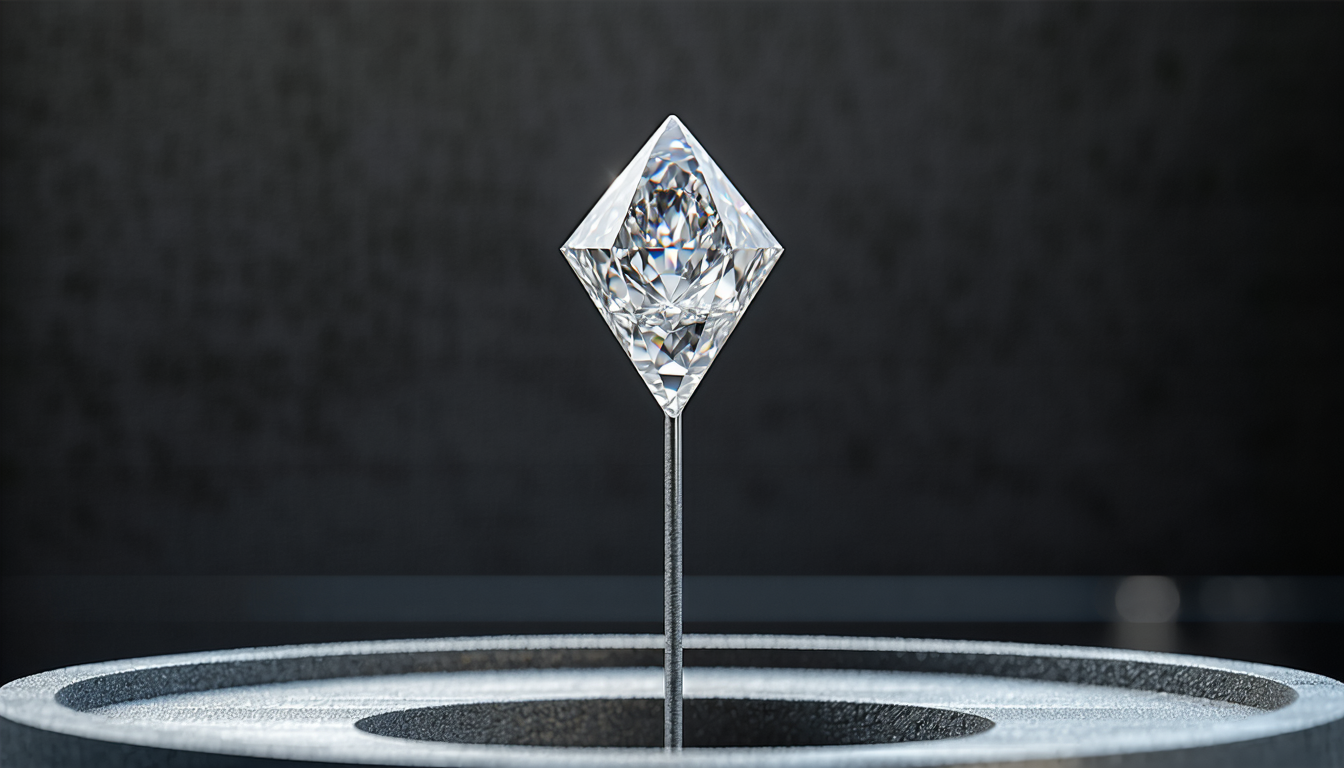
What happened
- Researchers at Lawrence Livermore National Laboratory published a study in Nature Physics documenting how diamond melts under pressures three times greater than conditions at Earth's core.
- The study resolves two long-standing discrepancies in the field, finally matching experimental results to simulations based on quantum mechanics.
- New diagnostics produced a new measurement of the melting temperature that agreed almost perfectly with simulations and closed a 20-year gap.
- Applying the findings to inertial confinement fusion could triple energy gain.
- Diamond, the extremely hard form of carbon, makes up the pellet that encases fuel for inertial confinement fusion.
Compiled by The Product DeskSomething wrong?How this is made
Why it matters
A new Nature Physics paper closes a 20-year gap between measured and predicted diamond melting temperatures by admitting the old thermometers were off by more than 1,000 degrees.
Lawrence Livermore National Laboratory has published measurements in Nature Physics of how diamond melts at pressures three times greater than those at Earth's core, and the new melting temperature agrees almost perfectly with simulations based on quantum mechanics that experiments had contradicted for two decades [1][2][3]. The operator-relevant part: applying the findings to inertial confinement fusion could triple energy gain, according to LLNL [4], and the material in question is the pellet that encases the fuel [5].
The gap being closed is specific. About 20 years ago LLNL scientist Jon Eggert and colleagues pioneered high-pressure melting experiments and found that diamond's density increases when it melts [6]. Millot's analogy is water: liquid water is denser than ice, which is why ice cubes float, so diamond would float in liquid carbon at high pressure [7]. The landmark result left a roughly 20% difference between observed and predicted melting temperatures [8], and according to Millot no theorist could reproduce the experiments even with the most advanced simulation techniques [9].
The resolution did not come from better theory. Eggert says the original temperature measurements were off by more than 1,000 degrees [10]. On the numbers as presented, the decades-long disagreement was an instrument problem, and the quantum simulations were right the whole time [1].
The new work used laser-driven dynamic compression at the University of Rochester's Laboratory for Laser Energetics, where the Omega Laser Facility vaporized the outer layer of a small sample and drove a shock wave through the diamond interior [11]. The compressed states lasted about a billionth of a second [12]. This was the first time shock-compressed diamond was probed with X-ray diffraction all the way up to melting [13], and the signal was faint because carbon is small and light and scatters very few X-rays [14]. LLE developed and maintained the enhanced diagnostics that made the measurement possible [15]. Millot says the team held tiny samples at temperatures hotter than the surface of the sun and pressures higher than the centers of Neptune and Uranus while still measuring atomic structure, temperature, density and optical reflectivity [16].
The second discrepancy resolved less tidily. Experiments at Sandia National Laboratories' Z machine produced fingerprints suggesting diamond passes through an additional crystalline structure before melting, and simulations agreed, but nobody could measure the atomic structure directly to confirm it [17]. LLNL's diffraction data show carbon staying in the diamond structure right up to melting, with no intermediate phase [18]. So the headline that experiment and quantum simulation now agree holds for the melting temperature and cuts the other way on the phase sequence, where simulation and the Sandia signature are the things now contradicted [2].
What the available material does not contain is the arithmetic behind the factor of three. There is no baseline gain figure, no described mechanism connecting the revised phase boundary to capsule performance, and no timeline. That is LLNL characterising the implications of LLNL's own measurement, and it should be read as a modelling claim until the capsule design work appears. The planetary claim is looser still: diamond is believed to rain deep inside ice giants such as Neptune and Uranus [19], and LLNL says the new understanding of diamond's high-pressure phases could reshape models of planetary interiors [20].
Claim ledger
Ranked by verification strength, evidence, and original report placement.
- [1]
Researchers at Lawrence Livermore National Laboratory published a study in Nature Physics documenting how diamond melts under pressures three times greater than conditions at Earth's core.
- [2]
The study resolves two long-standing discrepancies in the field, finally matching experimental results to simulations based on quantum mechanics.
ReportedView cited source - [3]
New diagnostics produced a new measurement of the melting temperature that agreed almost perfectly with simulations and closed a 20-year gap.
ReportedView cited source - [4]
Applying the findings to inertial confinement fusion could triple energy gain.
- [5]
Diamond, the extremely hard form of carbon, makes up the pellet that encases fuel for inertial confinement fusion.
ReportedView cited source - [6]
LLNL scientist Jon Eggert and colleagues pioneered high-pressure melting experiments about 20 years ago and observed that diamond's density increased when melting, which is unusual among most materials.
ReportedView cited source
Sources & coverage · 1 publisher
The reporting this story was synthesized from, earliest first. Every link goes to the original.
Cited in this coverage: phys.org report on LLNL study
Cited in this coverage: LLNL, via phys.org
Additional citations
- Marius Millot, LLNL
- Jon Eggert, LLNL