Published · 2d agoInvest8 min read
A $125bn Backstop, a Halved Guarantee, and the Number Nobody Has: What Old GPUs Are Worth
Nvidia says its compute has the longest life of any AI asset and lined up six firms to raise $500bn on that premise. Four days later, investors made it cut a guarantee in half.
Context for builders, not their beat.See today for builders
What happened
- On Aug. 10, 2026, NVIDIA announced strategic partnerships to establish independent compute financing platforms with Apollo, BlackRock, Blackstone, Brookfield, Goldman Sachs and KKR to mobilize over $500 billion of third-party capital for the buildout of AI infrastructure over time, via memorandums of understanding.
- Reuters reported on Aug. 10 that Nvidia said on Monday it had partnered with six major financial institutions to launch compute financing platforms aimed at raising over $500 billion in third-party capital for AI infrastructure.
- Nvidia CEO Jensen Huang said on X that the company has the option to backstop up to $125 billion, or 25% of the potential deals.
- Nvidia did not disclose the financial terms, investment commitments by individual firms or a timetable for deploying the planned $500 billion; the Financial Times reported the development first on Monday, later confirmed by Reuters.
- NVIDIA's release states: "NVIDIA compute is an investable asset - one which provides the lowest token cost, highest revenue and longest life along with a rich ecosystem of offtakers built upon NVIDIA's CUDA platform."
Compiled by The InvestorSomething wrong?How this is made
Why it matters
On August 10 Nvidia signed memorandums of understanding with Apollo, BlackRock, Blackstone, Brookfield, Goldman Sachs and KKR to establish independent compute financing platforms intended to mobilise more than $500 billion of third-party capital for AI infrastructure over time [1], and Jensen Huang said on X that Nvidia holds the option to backstop up to $125 billion of it, or 25% of the potential deals [3]. Four days later the Wall Street Journal reported that a different Nvidia guarantee, the one standing behind OpenAI's 10GW data centre project, had been cut to roughly half its original size, with the company reserving a decision on the remainder for later [7][1].
Those two items are usually read as separate stories: one a demand signal, one a risk-management retreat. They are the same variable seen from opposite ends of the capital structure. Both turn on how much a machine bought today is worth to somebody else in five or seven years, and by the end of the week each of the confident answers had lost something.
What the platforms are actually underwriting
Read Nvidia's own release closely and the pitch is not primarily about demand. The company describes its compute as "an investable asset - one which provides the lowest token cost, highest revenue and longest life along with a rich ecosystem of offtakers built upon NVIDIA's CUDA platform" [5]. Huang's quote goes further: "In AI, compute is revenue... It is broadly adopted, flexible across models and workloads, fungible and transferable across customers and operators, and continuously improved through CUDA software - extending its useful life and improving its economics over time" [6].
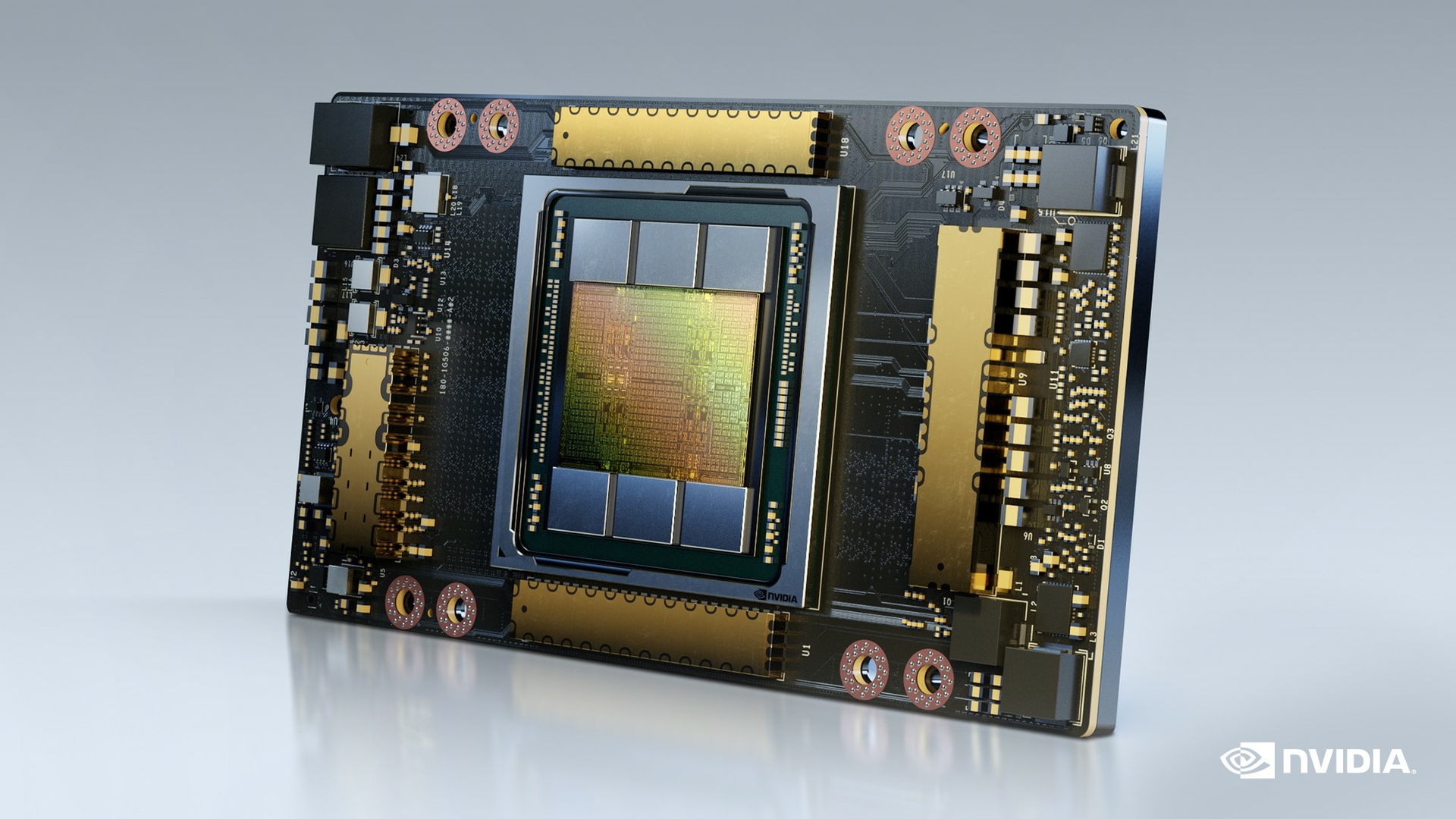
Strip the adjectives and that is an asset-life claim. For a pool of third-party capital lending against equipment rather than against a borrower's credit, the load-bearing words are "fungible and transferable": the box has to be re-lettable to a different operator, running a different workload, at a price that clears the remaining debt. Product design gives the argument something to stand on. A100-class hardware could be partitioned into as many as seven independent inference instances, or ganged through NVLink to behave as one large GPU for training [10], and a chip with two distinct duty cycles has more than one possible tenant.
What the announcement does not have is terms. Nvidia disclosed no financial terms, no investment commitments by individual firms, and no timetable for deploying the planned $500 billion; the Financial Times reported it first and Reuters confirmed [4][2]. These are memorandums of understanding [1]. And the headline number deserves a scale check: more than $500 billion mobilised over time sits below the more than $730 billion of combined big tech AI outlays Reuters says are set for this year alone [8][3]. The platforms are additive financing, not a second buildout.
The bear case on compute debt did take damage
The strongest evidence against the view that nobody will lend against depreciating accelerators came from CoreWeave's second quarter. The company reported a $3.1 billion term loan it describes as the first ever publicly syndicated delayed draw facility backed by HPC infrastructure [15], alongside more than $10 billion of unsecured debt and convertible bonds including an inaugural Eurobond, and a $1 billion strategic investment from Jane Street [16]. On the offtake side it reported revenue backlog of approximately $104 billion as of June 30, 2026 [17], with active power expanded by nearly 500MW to 1.5GW and total contracted power at approximately 3.7GW [18].
That combination is what the financing platforms need to exist at scale: contracted revenue of a size that public syndication desks will look at, and a security package that a broad lender group has now actually priced rather than merely discussed. Whatever else is arguable, the claim that this equipment cannot support publicly distributed debt is weaker than it was.
And the vendor-financed bull case took damage too
The other half of the week ran the other way. The original $250 billion backstop behind the OpenAI campus was reported in late July and would have been the largest financial guarantee ever discussed between two private companies; Nvidia shares fell 5% after that first Journal report, and the guarantee is now under half the size with nothing about the site itself changed in the intervening three weeks, according to thenextweb.com's relay of the reporting [21]. The Journal says the reduction was made to address investor concerns about Nvidia's own risk exposure [7].
The reason Nvidia's balance sheet was in the structure at all is the part worth holding on to. Because OpenAI has no investment-grade credit rating, lenders were being asked to price the debt against Nvidia's instead; Reuters noted that OpenAI carries an $852 billion valuation and is not profitable, that Nvidia did not respond to it, and that OpenAI declined to comment [23]. SB Energy, a SoftBank subsidiary, is developing what would be the largest data centre project announced anywhere, with a first phase of roughly 800MW due for completion in 2028 and a total cost that passes $500 billion once the silicon is counted [22]. A separate arrangement to finance chip purchases could total $350 billion across the full project, money Nvidia would help arrange rather than guarantee outright [24]. Goldman Sachs is advising SB Energy and Morgan Stanley is advising Nvidia [32]. The US government controls the power for the site, and Japan funds it separately under a recent trade deal [33]. Reuters reported the same evening that OpenAI is still negotiating a binding lease for the full 10GW [26]. An earlier agreement announced last September covering at least 10GW, with Nvidia investing up to $100 billion, stalled after some inside Nvidia expressed doubts [25].
Here is the tension, stated plainly. If the residual and re-let value of Nvidia compute were as self-supporting as the financing-platform release argues, a vendor guarantee on a single campus would be a convenience, useful for shaving basis points. In this deal it is the pricing mechanism: the debt was being underwritten off Nvidia's credit because the borrower has none [23]. The company was willing to write that wrapper for half the project and has deferred the question on the rest [7]. That is not a contradiction of the $125 billion option [3] so much as its boundary condition, and the boundary moved in the same week the option was announced [1].
Nine years is the horizon, and no source here prices it
The A100, the first GPU on the Ampere architecture, was announced as being in full production and shipping to customers worldwide at GTC 2020, with up to 20x the performance of its predecessors [9]. CoreWeave completed the first bring-up and validation of NVIDIA Vera Rubin NVL72 in the second quarter of 2026 [13], six years later [4].
Now look at what the equity side is pricing. Cryptopolitan.com reported on August 15, citing Reuters and two people said to be familiar with the company's finances, that Anthropic has told people involved in its planned offering it expects revenue of $190 billion to $200 billion in 2028 [27]. A roughly $965 billion valuation works out to about five times that range, against the $47 billion run rate the company cited in May [28], implying about 4.1x growth at the midpoint [6]. The filing was confidential, with a target Nasdaq debut in October 2026 [29]. Per the same report, banks are applying enterprise value-to-revenue multiples to projections, as investors in Cerebras Systems did with forecasts extending to 2028 and SpaceX did with forecasts through 2029 [14]. A GPU that entered full production in 2020 would be nine years old in 2029 [5], the far end of that horizon.
So both instruments are duration bets on the same demand curve, taken in opposite directions: equity buyers accepting two-year-forward revenue, lenders accepting multi-year asset life. The forecast itself depends on costs growing more slowly than revenue while the company keeps spending heavily on compute, training and hiring [30]. And the argument that whichever lab lists first sets a template for pricing on expected rather than current business is explicitly the article author's interpretation, not a reported finding [31].
What none of this material contains is a used price, a depreciation schedule, or any observed resale value for older accelerators. The A100 evidence here is a 2020 product announcement [9][10], not a secondary-market print. Nvidia asserts longest life [5]; the investors who forced the OpenAI guarantee down were acting on exposure to a specific unrated counterparty [7][23]. Neither is a residual value.
Three things would move this from assertion to number. Whether the first-phase deal is signed at under $120 billion or the figure moves again, and who ends up guaranteeing the remaining 5GW, are the two questions thenextweb.com leaves open [34]; under $120 billion would be less than a quarter of the project's stated total cost including silicon [7]. Second, whether the six memorandums convert into facilities with disclosed terms, individual commitments and a deployment timetable, none of which exists yet [4], and specifically whether Nvidia's $125 billion option is ever drawn [3][2]. Third, whether the next HPC-backed syndication after CoreWeave's $3.1 billion facility [15] prices tighter or wider. The first lender group to publish a residual assumption on this equipment will have said more than either side did last week.
Claim ledger
Ranked by verification strength, evidence, and original report placement.
- [1]
On Aug. 10, 2026, NVIDIA announced strategic partnerships to establish independent compute financing platforms with Apollo, BlackRock, Blackstone, Brookfield, Goldman Sachs and KKR to mobilize over $500 billion of third-party capital for the buildout of AI infrastructure over time, via memorandums of understanding.
ReportedView cited source - [2]
Reuters reported on Aug. 10 that Nvidia said on Monday it had partnered with six major financial institutions to launch compute financing platforms aimed at raising over $500 billion in third-party capital for AI infrastructure.
ReportedView cited source - [3]
Nvidia CEO Jensen Huang said on X that the company has the option to backstop up to $125 billion, or 25% of the potential deals.
ReportedView cited source - [4]
Nvidia did not disclose the financial terms, investment commitments by individual firms or a timetable for deploying the planned $500 billion; the Financial Times reported the development first on Monday, later confirmed by Reuters.
ReportedView cited source - [5]
NVIDIA's release states: "NVIDIA compute is an investable asset - one which provides the lowest token cost, highest revenue and longest life along with a rich ecosystem of offtakers built upon NVIDIA's CUDA platform."
ReportedView cited source - [6]
Huang, quoted in NVIDIA's release: "In AI, compute is revenue. NVIDIA compute is uniquely suited for this role. It is broadly adopted, flexible across models and workloads, fungible and transferable across customers and operators, and continuously improved through CUDA software - extending its useful life and improving its economics over time... That is why we are bringing the world's leading long-term capital providers together to independently underwrite AI infrastructure."
ReportedView cited source
Sources & coverage · 5 publishers
The reporting this story was synthesized from, earliest first. Every link goes to the original.
- pivotnews.ai2d agoAnthropic's IPO price rests on 2028 revenue, writes
- pivotnews.ai